


Key Takeaways
- Define pressure, flow, vacuum level, air quality, and duty cycle before comparing equipment.
- Do not size equipment using horsepower alone.
- Compressors, blowers, and vacuum pumps serve different pressure and flow ranges.
- Energy use, piping, storage, controls, and leaks affect total performance.
- Evaluate service access, replacement parts, and future production needs before purchase.
Selecting industrial air, blower, and vacuum equipment starts with the process, not a catalog or horsepower rating. Whether a facility needs a compressor for pneumatic tools, a blower for conveying, or a vacuum pump for packaging depends on actual operating conditions, air quality needs, and long-term operating costs. A system that is too small can create pressure drops, downtime, and product-quality issues. One that is too large may waste electricity and cycle inefficiently for years. A practical selection process helps match equipment capacity, controls, treatment, and maintenance requirements to the work the facility actually performs.
Start With the Process
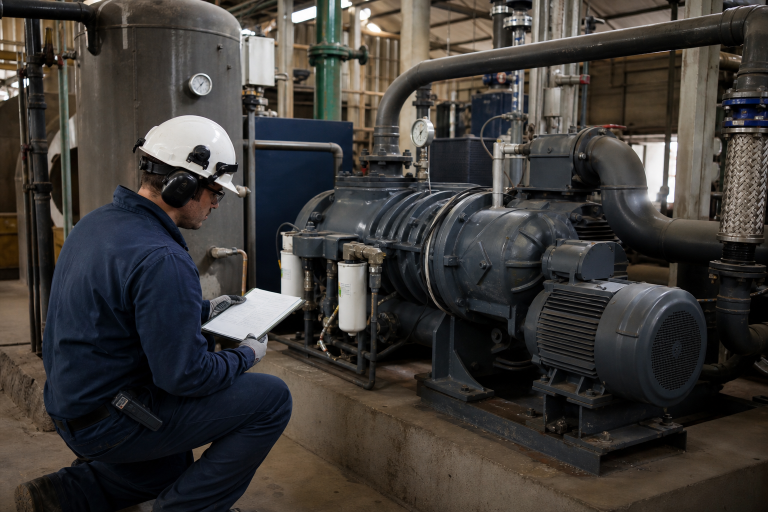
Begin by listing every task that relies on compressed air, low-pressure air, or a vacuum. Common uses include pneumatic tools, clamping, material conveying, aeration, drying, lifting, packaging, forming, filtration, degassing, and cleanup. Record when each task runs and whether multiple users run it at the same time. For each application, document the required pressure or vacuum level, expected flow, daily operating hours, ambient temperature, humidity, contamination risk, and anticipated production growth. Measuring actual demand is preferable to estimating it from old equipment ratings. Older machines may be oversized, poorly controlled, or compensating for leaks and restrictions elsewhere in the system.
Know the Main Equipment Types
Air Compressors
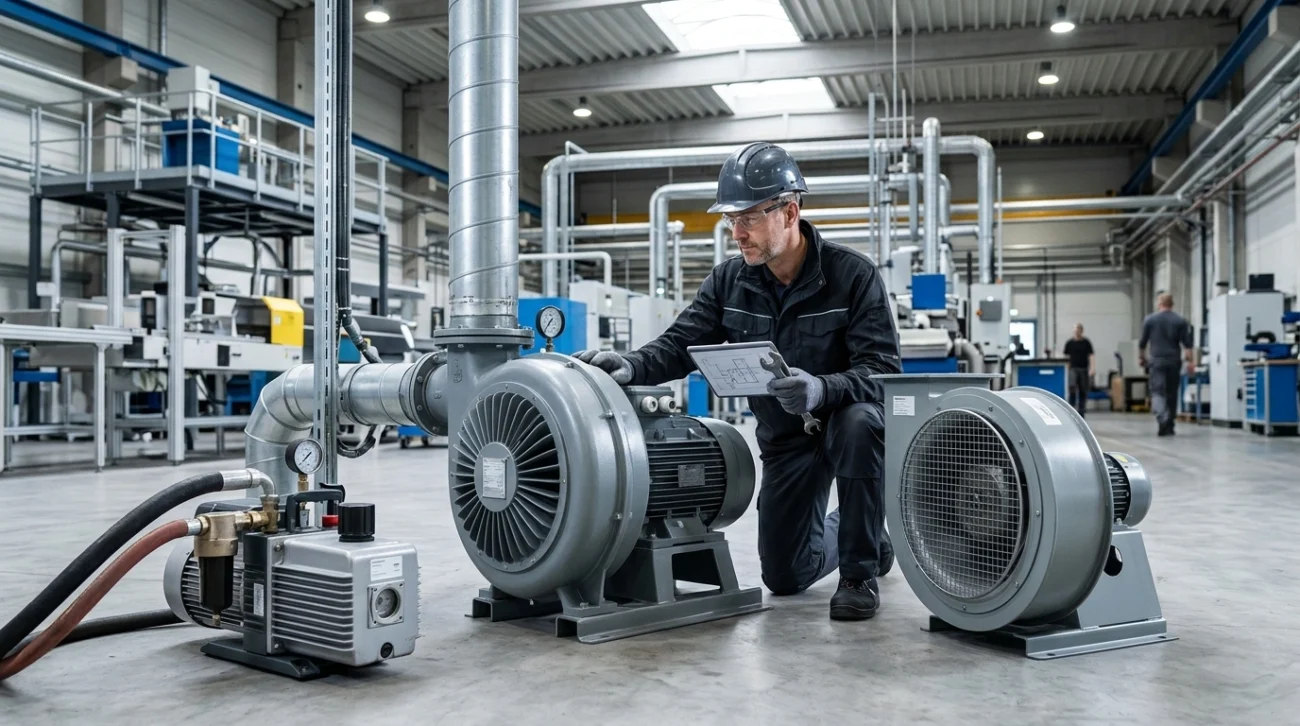
Air compressors increase air pressure for tools, controls, and production equipment. Rotary screw units are common for steady industrial demand, while reciprocating compressors are well-suited to intermittent or high-pressure work. Scroll and oil-free models may suit applications where lower noise or cleaner air is important. Understanding the differences among rotary screw compressor designs can help buyers compare equipment beyond a simple capacity rating.
Blowers
Blowers move high volumes of air at lower pressure than most compressors. They are often used for wastewater aeration, pneumatic conveying, cooling, drying, and agitation. A blower can be a more efficient fit when the process needs volume rather than high pressure.
Vacuum Pumps
Vacuum pumps remove air or gas from a closed space. They support vacuum lifting, packaging, thermoforming, filtration, evacuation, and material handling. Compressor, blower, and vacuum pump technologies are not interchangeable. The correct equipment depends on the pressure range, required flow pattern, process material, and control needs.
Set Pressure, Flow, and Vacuum Targets
Vague descriptions such as “heavy duty” or “high pressure” do not create a usable specification. Pressure is the force available at the point of use, while flow is the volume delivered over time. Vacuum level describes pressure below atmospheric pressure. Duty cycle identifies how often the equipment runs, and the turn-down range shows how effectively it responds when demand falls. Consider both normal and peak demand. A packaging line may need brief bursts of high flow but modest average consumption. In that situation, added storage and better controls may be more effective than installing a much larger machine that operates lightly loaded throughout the day.
Match Air Quality to the Application
Not every process needs the same level of clean, dry air. General manufacturing may tolerate limited moisture and particulate matter, while food processing, pharmaceutical production, electronics, painting, and laboratory work may require stricter control of oil, water, and other contaminants. Filters remove particles and oil aerosols, dryers reduce moisture, and separators and drains manage condensate. Specify treatment requirements before choosing the main machine. Adding filters, dryers, and drains after installation can introduce unexpected pressure drop, space constraints, and added expense.
Review Energy Use and Total Cost
The purchase price is only one part of the ownership cost. Electricity, installation, maintenance labor, replacement parts, downtime, ventilation, and eventual replacement often have a greater long-term impact. The U.S. Department of Energy notes that compressed air system performance can improve through proper equipment selection, leak reduction, storage, controls, and energy-management practices. Compare rated power, specific energy use, efficiency at partial load, expected maintenance intervals, heat recovery potential, parts costs, and service requirements. A lower-priced machine may not be the lowest-cost solution if it consumes more energy or requires frequent production interruptions.
Check the Full System Design
Even excellent equipment can underperform in a poorly designed system. Undersized piping, long runs, unnecessary bends, restrictive filters, leaking fittings, and incorrectly placed dryers all create pressure drop or instability. Operators may respond by raising system pressure, thereby increasing energy use and potentially masking the real problem.
- Review pipe diameter, routing, bends, valves, and point-of-use regulators.
- Locate storage near large or rapidly changing demand where appropriate.
- Check filter and dryer pressure drop at expected operating flow.
- Separate critical loads from noncritical loads when reliability demands it.
- Provide ventilation, heat removal, service clearance, and room for expansion.
Plan for Maintenance and Monitoring
Maintenance planning should happen before installation. Confirm that technicians can safely reach filters, belts, drains, separators, lubricants, and control panels. Establish daily operator checks, monthly condition reviews, scheduled service intervals, critical spare-parts lists, and emergency-response procedures. Modern controls can track pressure, temperature, runtime, load, energy use, and service alerts. Monitoring is valuable when staff review the data and act on it. Sudden run-time increases, unstable pressure, unusual temperatures, and rising energy consumption can reveal leaks, restrictions, or equipment problems before they become failures.
Follow a Simple Selection Process
- Map every air, blower, and vacuum application.
- Measure normal and peak demand at real operating conditions.
- Set pressure, flow, vacuum, duty-cycle, and air-quality requirements.
- Compare equipment types that match the process range.
- Include piping, storage, dryers, filters, drains, and controls in the review.
- Calculate operating and maintenance costs, not only the purchase price.
- Confirm service support, parts availability, and staff training needs.
- Write one clear specification for every proposal and allow for future growth.
Avoid Common Buying Mistakes
- Choosing equipment by horsepower alone.
- Sizing for a single peak event instead of the full demand profile.
- Ignoring leaks, pressure drop, and poor piping design.
- Forgetting air treatment and condensate management.
- Leaving installation, electrical, ventilation, and service-access costs out of the budget.
- Adding capacity without reviewing storage and control strategy.
- Failing to account for added shifts, new equipment, or production expansion.
Final Checklist
The right industrial air, blower, or vacuum solution should meet present demand without creating unnecessary energy use, operating costs, or maintenance burden. Facilities should define the process first, measure actual operating conditions, establish air or vacuum quality requirements, review the complete system, and compare equipment based on lifetime costs rather than purchase price alone. It is also important to consider controls, installation requirements, service access, spare parts availability, and future changes in production demand. Taking these factors into account can help prevent oversized equipment, unstable performance, unexpected repairs, and avoidable downtime. A careful selection process supports reliable production, better energy efficiency, easier maintenance, and a system that remains practical and dependable as facility needs change over time.
