


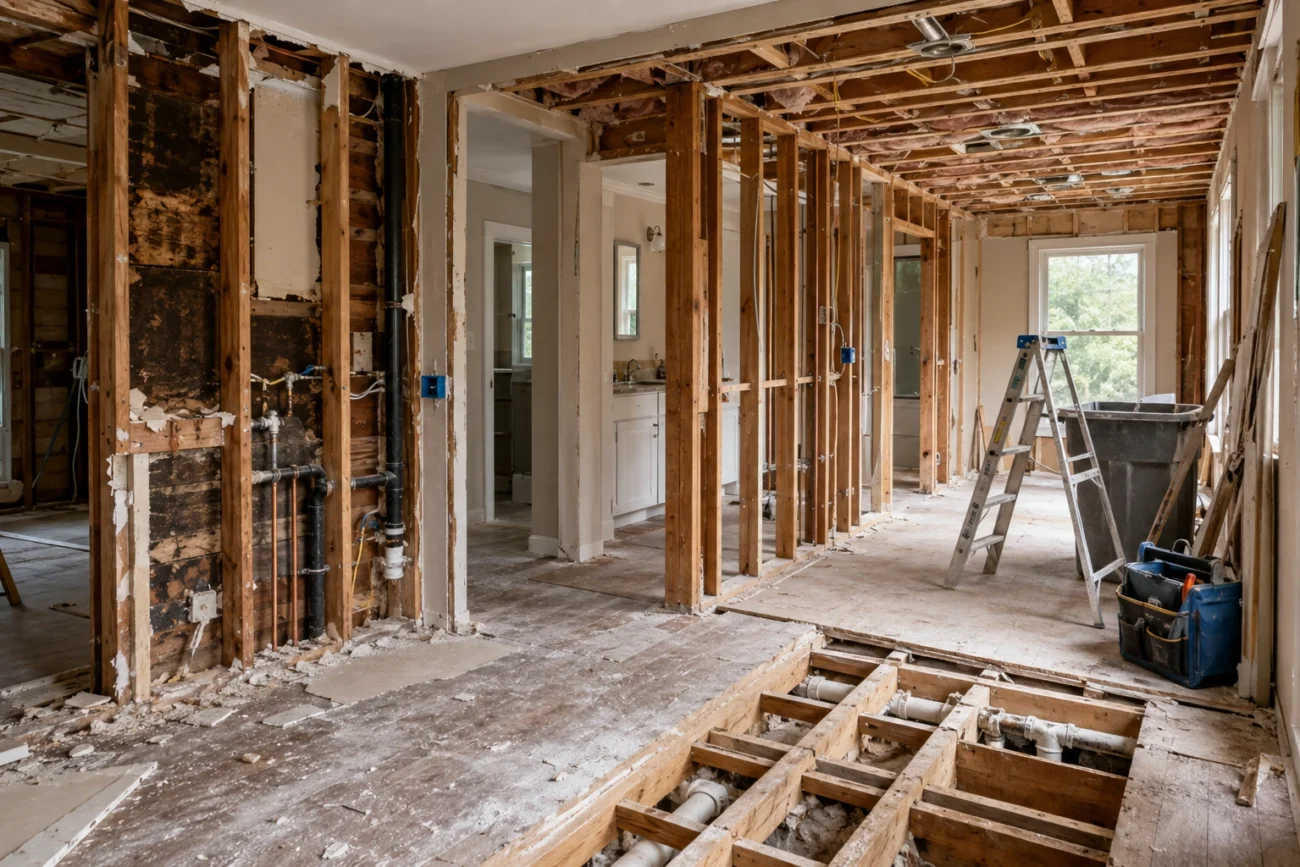
Demolition is often the moment when a remodeling project stops being theoretical.
Before walls are opened, contractors and designers work with:
- visible conditions,
- measurements,
- drawings,
- inspection findings,
- available records.
But some parts of an existing house cannot be fully evaluated until finishes are removed.
That is when hidden framing, plumbing, electrical systems, subfloors, insulation, and previous repairs become visible.
Most of the time, demolition simply confirms what the team expected.
Sometimes it does not.
A wall that looked perfectly normal may contain old water damage.
A bathroom floor may hide a deteriorated subfloor.
A ceiling may reveal structural framing that was altered during a previous renovation.
The important question is not whether a remodel will uncover surprises.
It is how those discoveries are handled.
Demolition changes a renovation because conditions that previously existed only as assumptions become visible. When contractors open the walls and discover hidden damage, the right response is usually to document the condition, understand its cause and determine whether it affects structure, safety or the planned work before simply continuing construction.
Demolition Turns Assumptions Into Evidence
Before demolition, a project team may have reasonable expectations about what is behind the finishes.
Those expectations can come from:
- building age,
- previous remodels,
- visible symptoms,
- permit history,
- exploratory openings.
But a remodel still involves an existing structure.
Unlike new construction, the team did not control how every component was originally built.
Once drywall, flooring, cabinetry, or ceilings are removed, assumptions become evidence.
That evidence sometimes changes the plan.
Not Every Surprise Means the Remodel Was Poorly Planned
Homeowners sometimes assume that any hidden condition should have been identified before construction.
That is not always realistic.
Some conditions are literally concealed behind finished surfaces.
Finding them would have required destructive investigation before the project began.
Good planning can reduce risk.
It cannot eliminate every unknown.
The more useful question is whether the condition was:
- reasonably foreseeable,
- reasonably discoverable,
- handled properly once exposed.
Common Hidden Conditions Demolition Can Reveal
1. Water Damage and Rot Behind Finished Walls
Water damage is one of the most common hidden conditions found during remodeling.
Possible sources include:
- old plumbing leaks,
- failed shower waterproofing,
- exterior water intrusion,
- window leaks,
- roof leaks.
Sometimes the leak has already stopped.
The damage remains.
Contractors may discover:
- stained framing,
- deteriorated sheathing,
- mold-like growth,
- softened wood.
The visible damage should not simply be covered with new drywall.
The source needs to be understood first.
2. The Cause Matters More Than the Stain
Replacing damaged material without correcting the source can recreate the same problem.
If moisture came through a window, ask why.
Possible causes may include:
- failed flashing,
- deteriorated sealant,
- drainage problems.
If the damage occurred around a shower, the problem may involve:
- waterproofing,
- plumbing,
- enclosure details.
Repair should address both the damage and the reason it happened.
3. Damaged or Altered Structural Framing
Opening walls may reveal framing that does not match expectations.
Examples include:
- notched joists,
- cut studs,
- removed supports,
- improvised repairs.
Some conditions may have existed for decades without obvious symptoms.
That does not automatically make them acceptable.
If the framing affects load paths or structural performance, the project may need additional evaluation.
4. Do Not Assume Every Unusual Framing Detail Is Dangerous
Older homes were built under different standards and construction methods.
Unusual does not automatically mean unsafe.
The correct response is not panic.
It is evaluation.
If there is uncertainty, a structural engineer or qualified professional can determine:
- what the framing is doing,
- whether reinforcement is needed,
- whether the remodel affects it.
5. Old or Questionable Electrical Wiring
Demolition may expose electrical work that homeowners never knew existed.
Possible discoveries include:
- abandoned wiring,
- damaged insulation,
- improper splices,
- overloaded junction boxes.
The issue may be unrelated to the remodel itself.
But once exposed, it can affect the new work.
Electrical systems should be evaluated by the appropriate licensed professional.
6. Hidden Electrical Work Can Affect the New Layout
A planned wall removal may uncover:
- wiring serving several rooms,
- switches,
Those systems may need to be rerouted.
That can affect:
- labor,
- drywall,
This is why a seemingly simple wall change can sometimes become more involved after demolition.
7. Plumbing Problems That Were Previously Hidden
Walls and floors often hide plumbing conditions.
Contractors may find:
- corroded pipes,
- old repairs,
- leaking fittings,
- unsupported piping.
Sometimes a remodel creates an opportunity to replace a small problematic section while the area is open.
But homeowners should distinguish between:
necessary repair
and
optional upgrade.
They are not the same decision.
8. Old Plumbing May Change the Scope Even If It Is Not Leaking
A pipe does not necessarily need replacement simply because it is old.
But if a major remodel exposes an aging system that will soon be buried behind new finishes, homeowners may want to evaluate whether replacement now makes sense.
The decision should consider:
- material,
- condition,
- accessibility,
- future risk.
9. Weak or Damaged Subfloor
Flooring can hide substantial problems.
After demolition, contractors may discover:
- water-damaged subfloor,
- uneven areas,
- previous patching,
- inadequate support.
This frequently occurs around:
- toilets,
- showers,
- exterior doors,
New flooring should not simply be installed over a compromised base.
10. Subfloor Problems Can Affect More Than Flooring
A damaged or uneven subfloor can influence:
- tile installation,
- cabinetry,
- door clearances.
Correcting it early is usually easier than compensating for it with finish work later.
The floor assembly needs to be stable before expensive finishes are installed.
11. Previous Remodels That Were Built Differently Than Expected
Homes often contain multiple generations of construction.
A wall may have been moved.
A doorway may have been closed.
A bathroom may have been added.
Demolition can reveal work that does not match:
- original plans,
- current assumptions,
- visible finishes.
That does not necessarily mean the work was improper.
But it may require the current project to adapt.
12. Old Repairs May Be Perfectly Functional but Still Affect New Work
A previous homeowner may have repaired a wall or floor in a way that is structurally acceptable but inconvenient for the new design.
The current remodel may need to:
- modify,
- relocate,
- work around
that older solution.
Construction history matters because new work must connect to what actually exists, not what the team hoped existed.
13. Unpermitted Work Can Become a Bigger Issue Than the Physical Defect
Sometimes the surprise is not damaged material at all but evidence that the house was altered previously without clear documentation. Discovering unpermitted work during a remodel can require permit research, engineering or selective investigation before new construction is safely built around the existing condition.
Possible examples include:
- converted rooms,
- removed walls,
- added bathrooms,
- electrical modifications,
- deck additions.
The physical work may look fine.
The documentation may not be.
14. Unpermitted Does Not Automatically Mean Unsafe
It is important to separate two questions.
Was the work permitted?
and
Was the work built correctly?
Those are related but not identical.
A project may need research or inspection to determine what actually exists.
The correct response depends on:
- location,
- project scope,
- existing condition,
- current permit requirements.
What to Do When an Unexpected Condition Is Exposed
15. Do Not Immediately Cover a Questionable Condition Back Up
Once a condition is exposed, there is often pressure to keep moving.
The schedule is active.
Trades are waiting.
Materials may already be ordered.
But covering a questionable condition before understanding it can create a much larger problem later.
If something appears:
- damaged,
- unsafe,
- inconsistent with plans,
stop long enough to evaluate it.
16. Document What Was Found Before It Is Changed
Photos are extremely useful.
They create a record of:
- condition,
- location,
Before repairing or removing something unexpected, document it.
This can help:
- contractor,
- engineer,
- inspector,
It also creates a useful history for future maintenance.
17. Include Scale and Context in Photos
A close-up of a damaged piece of wood may not show where the condition occurred.
Take:
- detailed photos,
- wider photos showing location.
If possible, include a reference for scale.
Good documentation makes later decisions easier.
18. When an Engineer Should Be Involved
Not every discovery needs an engineer.
But structural questions deserve professional evaluation.
Examples may include:
- altered beams,
- damaged joists,
- removed bearing walls,
- unusual foundation conditions.
Engineering is particularly important when the new remodel changes loads or removes structural components.
19. Specialty Contractors May Be Needed Too
Depending on the condition, additional expertise may come from:
- electrician,
- plumber,
- waterproofing contractor,
- HVAC technician.
A general remodeling team does not need to personally solve every specialty issue.
Good project management includes knowing when to bring in the right expert.
How Hidden Conditions Affect Cost, Schedule, and Scope
20. Hidden Conditions Affect the Budget in Different Ways
Some discoveries are inexpensive.
Others are not.
The cost depends on:
- extent,
- accessibility,
- required correction,
- whether other trades are affected.
For example, replacing a small damaged subfloor section may be relatively contained.
Repairing extensive structural water damage may involve:
- framing,
- exterior work,
- insulation,
21. Separate Required Repair From Optional Improvement
Suppose demolition exposes old plumbing.
The plumber may say:
“This section needs repair.”
They may also say:
“Since the wall is open, replacing another 15 feet would be a good idea.”
Those are different categories.
The first may be required.
The second may be strategic but optional.
Homeowners should know which is which.
22. Hidden Conditions Can Consume Contingency Quickly
This is one reason remodeling budgets should include contingency.
The reserve exists because existing homes contain unknowns.
But contingency should not become an excuse for vague pricing.
Even when the money is available, the homeowner should still understand:
- what changed,
- why,
- how much it costs.
23. How Hidden Conditions Affect the Construction Schedule
Unexpected work can affect time as well as cost.
A discovery may require:
- inspection,
- engineering,
- new materials,
- specialty trade.
That can interrupt the planned sequence.
A delay does not necessarily mean the contractor is disorganized.
It may be the correct response to a real condition.
24. The Sequence of Trades Can Change
Imagine framing is ready to continue.
Then hidden plumbing damage is discovered.
Framing may need to pause until plumbing is repaired.
That may affect:
- insulation,
- drywall,
Construction schedules are interconnected.
One hidden condition can move several later activities.
25. Material Availability Can Add Additional Delay
A repair may require materials that were not part of the original order.
Specialty components may have lead times.
If the condition affects:
- windows,
- structural hardware,
- plumbing equipment,
the team may need to source additional products.
This should be communicated clearly.
26. Required Repair vs. Optional Upgrade
This distinction is one of the most important during demolition.
Required repair: necessary to correct a legitimate problem.
Optional upgrade: something that may be convenient or valuable while the area is open.
For example:
A damaged pipe may require replacement.
Replacing all nearby piping may be optional.
Both can be sensible.
They should simply be presented honestly.
27. Do Not Let “While We’re Here” Automatically Expand the Project
Demolition creates opportunities.
A homeowner may suddenly consider:
- extra lighting,
- additional insulation,
- new wiring.
Some of those changes are smart.
But they still affect:
- cost,
Evaluate them separately from the actual hidden problem.
28. Why a Written Change Is Better Than an Informal Agreement
Unexpected conditions often lead to rapid conversations.
The contractor explains the issue.
The homeowner says:
“Okay, go ahead.”
Later, nobody remembers exactly:
- what was approved,
- how much it cost.
A written change should record:
- condition,
- proposed correction,
- price,
- schedule impact.
That protects both sides.
29. Verbal Approval Can Create Confusion
A homeowner may think they approved:
repair damaged framing.
The contractor may think they approved:
repair plus adjacent reinforcement.
Written scope removes that ambiguity.
The more expensive the change, the more important documentation becomes.
30. A Change Order Should Explain the Reason
A good change document should not simply say:
“Additional framing — $6,000.”
It should explain:
- what was discovered,
- what work is required,
- what the new work includes.
Context helps homeowners understand whether the change is reasonable.
How Planning Can Reduce Remodeling Surprises
31. What Good Preconstruction Can Prevent
Good planning can reduce many surprises.
For example:
- reviewing permit history,
- inspecting crawlspaces,
- evaluating visible water damage,
- exploratory openings.
These steps can identify risk before full demolition.
They also allow the team to build more realistic contingency into the budget.
32. Exploratory Openings Can Be Valuable
If a wall is particularly important to the design, a small exploratory opening may reveal:
- framing direction,
- plumbing,
This can answer important questions before final construction documents are completed.
Selective investigation can be especially valuable in complex older homes.
33. But You Cannot Open Every Wall Before Construction
There is a practical limit.
A homeowner usually does not want the house extensively demolished months before the project begins.
The planning team must balance:
- investigation,
Some unknowns therefore remain until construction.
That is part of remodeling.
34. Permit Research Can Reveal Previous Changes
Available building records may show:
- additions,
- structural work,
- plumbing changes.
But records are not always complete.
Older homes may have decades of history that are only partially documented.
Permit research is useful.
It is not a guarantee.
35. Existing Drawings May Not Match Reality
Even when old plans exist, the house may have changed.
A previous remodel may have modified:
- walls,
- doors,
Treat historical drawings as useful evidence, not absolute truth.
Field verification still matters.
How to Make Better Decisions During Construction
36. The Contractor Should Explain What Changed
When an unexpected condition appears, homeowners should receive a clear explanation.
Useful questions include:
- What did you find?
- Why is it a problem?
- Does it affect safety or structure?
- What happens if we do nothing?
- What is the recommended repair?
- Are there alternatives?
- Does it affect schedule?
The goal is informed approval.
37. Homeowners Should Avoid Making Decisions From Photos Alone
A contractor may send a photo from the job site.
Photos are helpful.
But a complex structural or water issue may require more context.
Ask for:
- explanation,
- recommendation,
Do not feel pressured to make a significant decision based on one image and a short text message.
38. Some Discoveries Can Improve the Project
Not every surprise is negative.
Opening a wall may reveal that:
- a structural condition is simpler than expected,
- plumbing can be routed more efficiently.
The real house sometimes creates opportunities that drawings did not show.
The project should remain flexible enough to take advantage of them when appropriate.
39. Avoid Treating Demolition Like a Race
Fast demolition can look productive.
But careful demolition sometimes provides valuable information.
The team may need to observe:
- framing,
- old repairs,
- water pathways.
Removing everything as quickly as possible can destroy useful evidence.
Speed matters.
Understanding the building matters more.
40. Hidden Damage Should Not Automatically Trigger a Full-House Upgrade
Discovering one old electrical issue does not necessarily mean rewiring the entire house.
Finding one damaged joist does not automatically mean every floor system is compromised.
Evaluate the actual extent.
Avoid turning a localized discovery into a much larger project without evidence.
41. Ask Whether the Problem Is Isolated or Systemic
This is a useful question.
A small leak may have caused local damage.
Or it may be one symptom of a broader drainage problem.
The repair strategy should reflect the real cause and extent.
Correct diagnosis matters more than aggressive scope.
42. Keep the Original Project Goals Visible
Unexpected conditions can distract everyone.
The project starts as:
“remodel the kitchen.”
Then demolition reveals:
- wiring,
- plumbing,
Suddenly every conversation is about hidden work.
Necessary corrections should be made.
But the team should still protect the original goals of the remodel.
43. Revisit the Budget After a Significant Discovery
If a major unexpected repair consumes contingency, homeowners may need to reconsider optional upgrades.
For example:
- premium tile,
- custom built-ins,
- decorative lighting.
It is usually better to reduce optional finishes than compromise required repairs.
The project should remain financially balanced.
44. Do Not Spend Contingency Twice
If contingency has already been used for a legitimate hidden condition, it is no longer available for another surprise.
Update the project budget after each significant change.
Homeowners should always know:
- original contract,
- approved changes,
- remaining contingency.
45. A Well-Managed Remodel Can Still Have Surprises
The absence of surprises is not the only measure of good project management.
A better measure is:
- how quickly conditions are identified,
- how clearly they are explained,
- how well changes are documented.
Existing houses are complicated.
The process should be designed to respond to that reality.
The Goal Is Controlled Correction, Not a Surprise-Free Remodel
Demolition is one of the most revealing stages of renovation.
It can expose:
- water damage,
- structural alterations,
- outdated systems,
- undocumented work,
- previous repairs.
Some discoveries are minor.
Others can affect cost and schedule significantly.
The right response is not to assume the entire project has gone wrong.
It is to slow down enough to understand what has actually been found.
Document the condition.
Determine whether it is required work or an optional improvement.
Bring in the appropriate specialist when needed.
Price the correction clearly.
Record the change.
Then continue construction with better information than you had before the wall was opened.
A successful remodel is not one where demolition reveals absolutely nothing unexpected.
It is one where unexpected conditions become controlled decisions instead of uncontrolled problems.
