


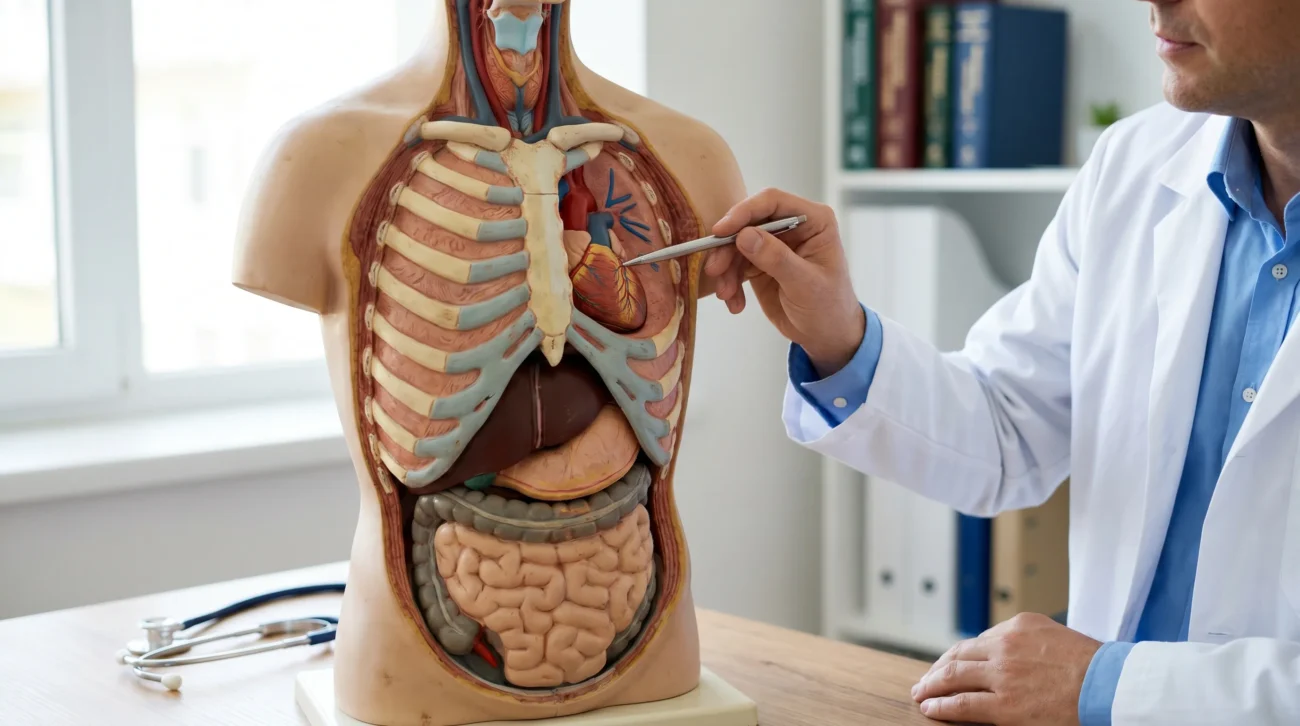
Your heart is located in the front of your chest, slightly left of center, behind your sternum, also called the breastbone. It sits between your right and left lungs, protected by your rib cage. So, while many people say the heart is “on the left side,” the more accurate answer is that your heart is mostly in the middle-left area of your chest, not fully on the far-left side. Cleveland Clinic describes the heart as sitting slightly behind and to the left of the sternum, between the lungs.
This simple question matters because many people search for heart location when they feel chest pain, notice a strong heartbeat, or wonder whether discomfort on the left or right side could be heart-related. Let’s break it down in a clear, medically careful way.
Where Is Your Heart Located in the Body?
Your heart location is in the thoracic cavity, which is the chest space that contains the heart, lungs, major blood vessels, and other important structures. More specifically, the heart sits in an area called the mediastinum, which is the central part of the chest between the lungs.
The heart is positioned behind the breastbone, slightly to the left of the center line of the body. Your sternum runs down the middle front of your chest, and your heart sits behind it, leaning a little toward the left side of the chest. Your rib cage surrounds and protects the heart and lungs from injury. Cleveland Clinic also notes that the left lung is slightly smaller than the right lung to make room for the heart.
| Body landmark | Relationship to the heart |
| Sternum / breastbone | The heart sits behind and slightly left of it |
| Lungs | The heart sits between the right and left lungs |
| Rib cage | Protects the heart and lungs |
| Left lung | Slightly smaller to make room for the heart |
| Thoracic cavity | The chest space where the heart is located |
So, when someone asks where is your heart located, the best short answer is: inside the chest, behind the breastbone, between the lungs, and slightly left of center.
Is Your Heart on the Left Side or in the Middle?
The question “is your heart on the left side or in the middle?” is one of the most common points of confusion. The answer is: both, in a way.
Your heart is not completely on the left side of your body. A large part of it sits behind the middle of the chest, while more of its mass extends toward the left. That is why people often describe the heart as being on the left side of the chest. But anatomically, it is better to think of the heart as sitting in the central-left chest.
This matters because pain or pressure in the center of the chest can still be heart-related. Some people mistakenly believe heart symptoms only happen directly over the far-left side of the chest, but that is not true. Heart-related discomfort can appear in the center, left side, or sometimes in nearby areas due to referred pain.
A simple way to picture it is this: place your hand over the center of your chest, then move it slightly left. That area roughly represents the usual position of the human heart.
Why Does Your Heart Feel Like It’s on the Left Side?
Many people feel their heartbeat more clearly on the left side, especially when lying down, exercising, feeling anxious, or drinking caffeine. One reason is the apex of the heart.
The apex of the heart is the lower tip of the heart. It points downward and toward the left side of the chest. Because of that leftward angle, your heartbeat may feel stronger near the left side, especially below the left nipple area or along the left chest wall.
That does not always mean something is wrong. You may notice your heartbeat more when your heart rate increases during exercise, stress, fever, dehydration, or anxiety. However, if a strong heartbeat comes with chest pain, shortness of breath, dizziness, fainting, or unusual weakness, it should be taken seriously.
The important point is that feeling your heartbeat on the left side is common because of cardiac positioning, but new or severe symptoms should not be ignored.
What Organs and Structures Are Around the Heart?
The heart does not sit alone. It is surrounded by several important organs and structures that help protect it and support blood circulation.
Your lungs sit on both sides of the heart. The right lung is usually a bit larger, while the left lung has a natural indentation to make room for the heart. The sternum and rib cage protect the heart from the front and sides. Below the heart is the diaphragm, a muscle that helps you breathe.
The heart is also wrapped in a thin protective sac called the pericardium. Nearby are major blood vessels, including the aorta, pulmonary artery, pulmonary veins, and vena cava. These vessels move oxygen-rich blood and deoxygenated blood between the heart, lungs, and the rest of the body.
This is why chest symptoms can sometimes be confusing. Pain in the chest may come from the heart, lungs, ribs, muscles, esophagus, or digestive system. Location helps, but it does not always reveal the exact cause.
Basic Heart Anatomy: Chambers, Valves, and Blood Flow
The heart is a muscular organ that works like a pump. Its main job is to send blood through the cardiovascular system and circulatory system, delivering oxygen and nutrients to your cells while carrying away carbon dioxide and waste.
The heart has four chambers: the right atrium, right ventricle, left atrium, and left ventricle. Cleveland Clinic explains that the atria are the upper chambers and the ventricles are the lower chambers.
| Heart chamber | Basic role |
| Right atrium | Receives oxygen-poor blood from the body |
| Right ventricle | Sends blood to the lungs |
| Left atrium | Receives oxygen-rich blood from the lungs |
| Left ventricle | Pumps oxygen-rich blood to the body |
The heart also has heart valves that help blood move in the right direction. These include the tricuspid valve, pulmonary valve, mitral valve, and aortic valve. Blood vessels such as arteries, veins, and capillaries carry blood throughout the body.
In simple terms, the right side of the heart sends blood to the lungs to pick up oxygen. The left side of the heart sends that oxygen-rich blood out to the body. This is why the left ventricle is especially strong; it has to pump blood throughout the entire body.
Can Your Heart Be on the Right Side?
Yes, in rare cases, a person’s heart can be on the right side of the chest. This condition is called dextrocardia. It is usually present from birth, which means it is a congenital condition.
In dextrocardia, the heart may be positioned as a mirror image of the usual heart location. Some people with dextrocardia have no major health problems, while others may have related heart or organ differences. A related condition is situs inversus totalis, where major internal organs are mirrored from their usual positions. Research literature describes situs inversus as a rare congenital condition in which major visceral organs are reversed in a mirror-image pattern.
Another related condition is heterotaxy syndrome, where organs may be arranged unusually rather than in a complete mirror image. These conditions are uncommon, but they are important because they can affect how doctors interpret symptoms, imaging, EKG results, and surgical planning.
For most people, though, the heart is not on the right. It is in the middle-left chest, behind the breastbone.
Where Is Heart Pain Usually Felt?
Heart-related discomfort is not always felt exactly where the heart sits. It may appear as chest pain, pressure, tightness, squeezing, heaviness, burning, or discomfort in the center or left side of the chest. The American Heart Association says many heart attacks involve discomfort in the center of the chest that lasts more than a few minutes or goes away and comes back. Symptoms can also include discomfort in one or both arms, the back, neck, jaw, or stomach, and shortness of breath.
This is called referred pain, meaning pain is felt in an area away from the original source. Heart-related pain may spread to the:
- Left arm
- Shoulder
- Jaw
- Neck
- Upper back
- Stomach area
However, not every chest pain is a heart attack. Chest pain can come from many causes, including the lungs, ribs, muscles, stomach acid, anxiety, or inflammation. The safest approach is to take new, severe, or unusual chest symptoms seriously.
Does Left-Side Chest Pain Always Mean Heart Trouble?
No, left-side chest pain does not always mean heart trouble. Because the heart sits slightly left of center, it is natural to worry when pain appears on the left side of the chest. But there are many possible causes.
Pain on the left side may come from muscle strain, especially after lifting, exercise, coughing, or awkward movement. It may come from costochondritis, which is inflammation where the ribs connect to cartilage. It may also come from acid reflux or GERD, which can cause a burning feeling in the chest. Mayo Clinic notes that GERD can cause heartburn, a burning chest sensation.
Anxiety and panic can also cause chest tightness, rapid heartbeat, shortness of breath, and a frightening sense of pressure. Lung-related problems, such as inflammation or irritation, can also cause chest discomfort.
Still, you should not try to self-diagnose serious chest pain. If the pain feels heavy, crushing, sudden, severe, or comes with symptoms like sweating, nausea, fainting, or shortness of breath, seek urgent medical care.
Can Right-Side Chest Pain Still Be Related to the Heart?
Right-side chest pain is less commonly associated with the usual heart location, but it should not be automatically dismissed. The heart is normally in the central-left chest, but symptoms can sometimes spread or feel unusual.
Right-side chest pain may come from the ribs, chest muscles, lungs, gallbladder, acid reflux, or digestive issues. It may also happen with inflammation around the lungs or chest wall. In rare cases, people with dextrocardia may have the heart on the right side, which can change where heart-related symptoms appear.
The key point is that pain location alone cannot confirm or rule out a heart problem. A healthcare professional may consider your symptoms, medical history, risk factors, physical exam, electrocardiogram, blood tests, chest X-ray, echocardiogram, CT scan, or heart MRI when needed.
If right-side chest pain is severe, sudden, or comes with breathing trouble, sweating, fainting, or pain spreading elsewhere, it needs prompt medical attention.
When Should Chest Pain Be Treated as an Emergency?
Chest pain should be treated as an emergency when it feels serious, sudden, or unusual, especially if it comes with other warning signs. The American Heart Association lists warning signs such as chest discomfort, pain or discomfort in the arms, back, neck, jaw, or stomach, shortness of breath, and other symptoms.
Seek emergency help if chest pain includes:
- Pressure, squeezing, fullness, or tightness
- Pain spreading to the arm, jaw, neck, back, or stomach
- Shortness of breath
- Cold sweat
- Nausea
- Lightheadedness
- Fainting
- Unusual fatigue or weakness
- Symptoms that last more than a few minutes or return repeatedly
Mayo Clinic notes that heart attack chest pain may last more than 15 minutes and can be mild or severe; some people may not have chest pain or pressure at all.
This article can help you understand anatomy, but it cannot diagnose chest pain. When in doubt, it is safer to seek medical help.
Is Heart Location Different in Men, Women, and Children?
The basic heart location is generally the same in men, women, and children. The heart sits in the chest, behind the sternum, between the lungs, and slightly left of center.
However, body differences can affect how people feel symptoms. Body size, age, chest shape, breast tissue, posture, and muscle mass can change where a person notices pressure, palpitations, or discomfort. In children, the heart is smaller but still located in the chest in the same general area.
Heart attack symptoms may also feel different from person to person. The American Heart Association notes that women may experience chest pressure or pain, but also symptoms such as shortness of breath, nausea, lightheadedness, or pain in the arms, back, neck, jaw, or stomach.
So, while the human heart location is similar across people, the way symptoms feel can vary.
Simple Heart Location Diagram Explanation
Imagine a simple heart location diagram without needing a picture.
Your sternum is the flat bone in the middle front of your chest. Cleveland Clinic describes the sternum as a flat, T-shaped bone at the center and front of the chest that helps protect organs and muscles inside the chest.
Now imagine the heart sitting behind that bone. It is not exactly in the center like a button, and it is not fully on the far-left side either. It sits behind the breastbone, between both lungs, with the lower tip — the apex of the heart — pointing down and left.
A simple way to remember it:
Breastbone in the middle. Lungs on both sides. Heart behind the breastbone, leaning slightly left. Rib cage around it for protection.
That is the clearest visual answer to what side of the chest is your heart on.
Why Knowing Your Heart’s Location Matters
Knowing where your heart is located helps you understand your body better. It also helps you describe symptoms more clearly if you ever need medical care.
For example, saying “I have sharp pain under my left ribs” is different from saying “I have pressure in the center of my chest that spreads to my jaw.” Doctors use details like pain location, timing, severity, triggers, and related symptoms to decide what tests or treatment may be needed.
Heart position can also matter for medical testing. An EKG or electrocardiogram records the heart’s electrical activity. If someone has an unusual heart position, such as dextrocardia, healthcare professionals may need to adjust how they interpret results.
Understanding heart anatomy does not mean you should diagnose yourself, but it can help you communicate better and recognize when symptoms deserve attention.
Quick Recap: What Side Is Your Heart On?
So, what side is your heart on? Your heart is mostly in the middle-left part of your chest. It sits behind the sternum, slightly left of center, between your right and left lungs, and protected by your rib cage.
The heart may feel like it is on the left because the apex of the heart points down and left. Rarely, a person can have a right-sided heart due to dextrocardia or related congenital conditions such as situs inversus totalis.
If you are searching because of chest pain, remember that pain location alone cannot tell you the cause. Severe, sudden, or unusual chest pain should be treated seriously.
Frequently Asked Questions
What side of the body is your heart on?
Your heart is slightly left of the center of your chest, behind the breastbone, between the lungs. It is not fully on the far-left side of the body.
Is your heart on the left or right side?
For most people, the heart is on the middle-left side of the chest. Rarely, a person may have dextrocardia, where the heart is positioned on the right side.
Is your heart in the middle of your chest?
Partly, yes. The heart sits behind the sternum, which is in the middle of the chest, but more of the heart extends toward the left.
Why can I feel my heartbeat on the left side?
You may feel your heartbeat on the left because the apex of the heart points down and left. Exercise, stress, anxiety, caffeine, or lying down can make your heartbeat more noticeable.
Where is heart pain usually felt?
Heart-related discomfort is often felt in the center of the chest or left side of the chest, but it can also spread to the arm, jaw, neck, back, or stomach.
Does left chest pain always mean a heart attack?
No. Left chest pain can come from the heart, but it can also come from muscle strain, acid reflux, anxiety, costochondritis, or lung-related causes. Serious or unusual symptoms need medical attention.
When should I worry about chest pain?
Worry about chest pain if it feels like pressure, squeezing, heaviness, or tightness, or if it comes with shortness of breath, sweating, nausea, fainting, or pain spreading to the arm, jaw, neck, or back. In those cases, seek emergency care.
Disclaimer:
This article is for general informational and educational purposes only. It is not a substitute for professional medical advice, diagnosis, or emergency care. Heart location, chest pain symptoms, and related health concerns may vary from person to person. If you have sudden, severe, unusual, or persistent chest pain — especially with shortness of breath, sweating, nausea, fainting, or pain spreading to the arm, jaw, neck, back, or stomach — seek emergency medical help immediately.
