


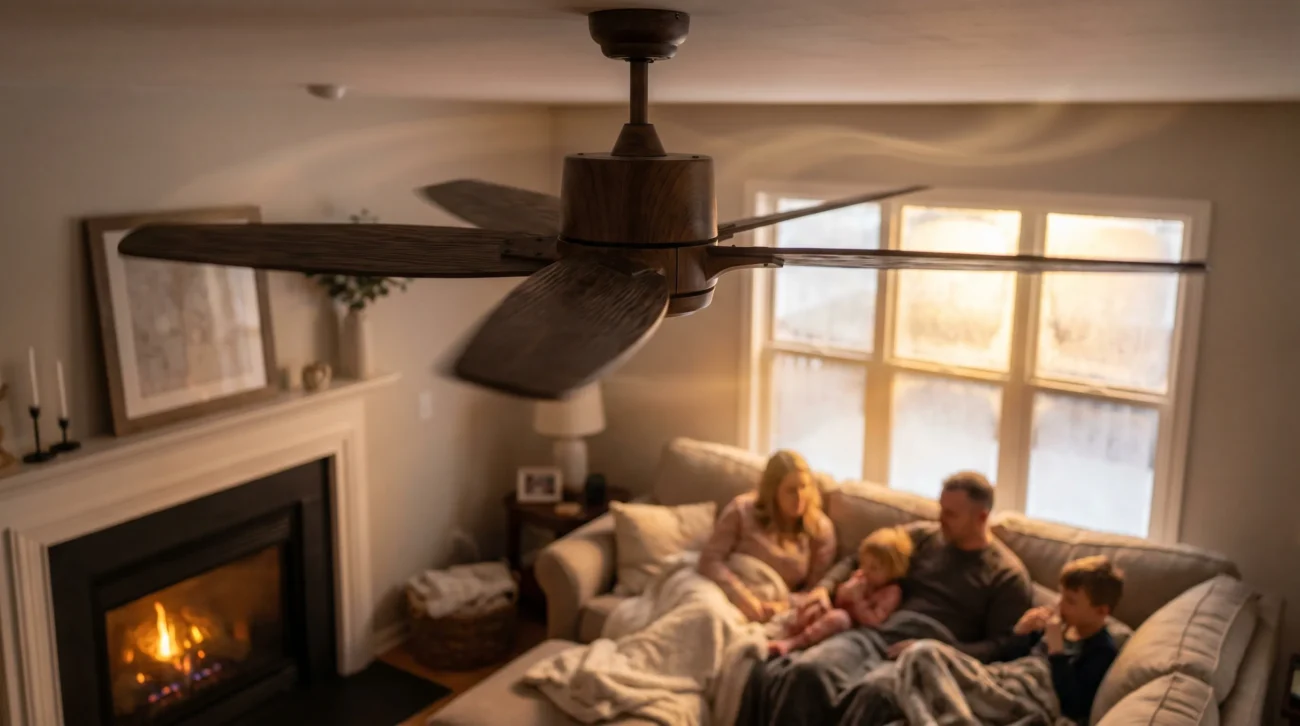
In winter, your ceiling fan should turn clockwise on low speed when you are standing underneath it and looking up. This clockwise ceiling fan direction creates a gentle updraft, which helps pull cooler air upward and push warm air trapped near the ceiling back down along the walls.
That simple switch can make a room feel more comfortable without constantly raising the thermostat setting. A ceiling fan does not create heat like a furnace, heat pump, radiator, or space heater, but it can improve warm air circulation and support better heating efficiency.
The most important rule is this: winter = clockwise on low speed. If you feel a strong breeze blowing directly down on you, the fan may be moving too fast, spinning the wrong way, or sitting too close to where you sleep or sit.
What Direction Should a Ceiling Fan Turn in Winter?
In winter, the correct ceiling fan direction is clockwise. To check this properly, stand under the ceiling fan and look up. If the fan blades move in the same direction as the hands of a clock, your fan is spinning clockwise.
This matters because many people get confused about direction. Clockwise from below is the standard way to judge ceiling fan blade rotation. If you look at the fan from above, the direction may seem opposite, which can lead to the wrong setting.
A clockwise ceiling fan winter setting is designed to move air gently. The goal is not to create a cooling breeze. Instead, the fan pulls cooler air upward toward the ceiling and helps push warmer air outward and down. This is why the fan should run on low speed or the lowest setting in colder months.
Here is the simple winter rule:
| Season | Correct Fan Direction | Best Speed | Main Purpose |
| Winter | Clockwise | Low speed | Redistribute warm air |
| Summer | Counterclockwise | Medium or high speed | Create a cooling breeze |
So, if you are wondering which way should a ceiling fan turn in winter, the answer is: clockwise on low speed when viewed from below.
Why Clockwise Ceiling Fan Direction Works in Winter
A clockwise ceiling fan creates an updraft, and that updraft is what makes the winter setting useful. In a heated room, warm air rises because it is lighter than cool air. As a result, warm air often collects near the ceiling while the lower part of the room still feels chilly.
This is especially common in rooms with high ceilings, vaulted ceilings, stairwells, open floor plans, and large living areas. You may be paying to heat the room, but much of that heat may sit above the area where people actually live, sit, sleep, or work.
When the ceiling fan rotates clockwise on low speed, it gently pulls cooler air upward. This movement pushes the warmer air near the ceiling outward toward the walls and then down into the occupied space. This process helps reduce air layers, also called stratification, and improves air circulation.
The fan does not make the air hotter. Instead, it helps distribute the heat you already have. That is why ceiling fan direction in winter is mostly about home comfort, room temperature balance, and heating system workload.
The low-speed setting is important because a fast fan can create a wind chill effect. In summer, that breeze feels good. In winter, it can make the room feel colder. For the best winter comfort, the airflow should be gentle enough that you barely feel it.
As a practical rule: if you feel a noticeable breeze on your skin, lower the speed or recheck the direction.
Ceiling Fan Direction in Winter vs. Summer
The easiest way to remember ceiling fan direction in summer and winter is this:
Clockwise in winter. Counterclockwise in summer.
In winter, ceiling fan blades should rotate clockwise to create an updraft and help move warm air down. In summer, the blades should rotate counterclockwise to push air downward and create a cooling breeze.
| Setting | Direction | Air Movement | Comfort Effect |
| Winter mode fan | Clockwise | Pulls cool air up, moves warm air down | Helps the room feel warmer |
| Summer mode fan | Counterclockwise | Pushes air down | Helps the room feel cooler |
This seasonal difference is important because the same fan can either support warming effect or cooling effect, depending on its direction and speed.
In summer, the counterclockwise ceiling fan direction helps air move down across your skin. That creates a breeze and supports natural cooling through evaporation. In winter, that same downward airflow can feel unpleasant. That is why the winter ceiling fan direction should be reversed.
Some fans label this as a reverse function, summer/winter function, or winter mode. Older ceiling fans may have a small toggle switch or blade direction switch on the fan housing. Newer smart ceiling fans may let you change direction with a remote control, wall control, or app.
What Speed Should Your Ceiling Fan Be in Winter?
Your ceiling fan should usually run on low speed in winter. The lower setting helps circulate air without creating a direct draft.
Many fans have 3 speed settings: low speed, medium speed, and high speed. Some newer fans, especially models with DC motors, may offer 6 speeds or more. In most winter situations, choose the lowest or second-lowest setting.
The reason is simple: winter ceiling fan use is about redistributing warm air, not cooling people. A high-speed fan can push too much air around and create a drafty feeling, even if the direction is technically correct.
Use this quick guide:
| Room Condition | Recommended Winter Fan Speed |
| Standard bedroom or living room | Low speed |
| High ceiling or vaulted ceiling | Low to medium-low |
| Room feels drafty | Lowest speed or turn fan off |
| Large open room with fireplace | Low speed first, then adjust |
| Low ceiling room | Lowest speed only |
If you are asking what speed should ceiling fan be in winter, start with low speed. If the room still has uneven heating, increase only slightly. If you feel cold air moving across your skin, reduce the speed.
How to Check If Your Fan Is Turning Clockwise
To check the ceiling fan direction in winter, stand directly underneath the fan and look up. If the blades are moving like the hands of a clock, the fan is spinning clockwise.
A helpful way to picture it is this: the blades should move from the top of the circle toward the right, then downward, like a clock hand moving from 12 to 3 to 6.
You can also use airflow as a clue. In winter mode, you should not feel a strong breeze blowing straight down. Instead, the airflow should feel gentle or barely noticeable. If your fan feels like it is pushing cold air onto you, it may be spinning counterclockwise, running too fast, or installed too low.
This is one of the most common homeowner mistakes. People often ask, “Which way is clockwise when looking up at a ceiling fan?” The answer is always based on your view from below the fan, not from above it.
A quick visual check:
- Clockwise from below: best for winter.
- Counterclockwise from below: best for summer.
- Strong breeze downward: likely summer mode or too high speed.
- Gentle upward pull: likely winter mode.
This simple check can prevent the wrong setting from making your room feel colder.
How to Change Ceiling Fan Direction for Winter
Changing your ceiling fan direction for winter is usually simple, but the method depends on the fan type. Some fans use a manual switch, while others use a remote control, wall-mounted control, or smart app.
Before changing direction, always turn the fan off and wait for the blades to stop completely.
For Fans with a Manual Switch
Many ceiling fans have a small blade direction switch on the fan motor or fan housing. It is usually located above the blades.
Follow this safe process:
- Turn off the ceiling fan.
- Wait for the blades to completely stop moving.
- Use a sturdy ladder if the switch is high.
- Find the small switch on the fan housing.
- Flip the switch to reverse the direction.
- Turn the fan back on.
- Set it to low speed.
- Stand below and confirm the blades move clockwise.
Some how-to guides describe this as a 9-step process, especially when including safety steps like clearing furniture, setting up the ladder, and confirming the final blade direction.
Never try to flip the switch while the blades are moving. It can damage the motor or create a safety risk.
For Fans with a Remote, Wall Control, or Smart App
Many modern fans do not require you to climb a ladder. If you have a remote-controlled fan, look for a button labeled reverse, direction, or an icon showing circular arrows.
For a smart ceiling fan winter mode, open the app and look for settings such as:
Fan direction, reverse function, winter mode, or summer/winter function.
Some fans only allow direction changes after the blades fully stop. Others may require you to hold a button for several seconds. If you cannot find the setting, check the user manual or the manufacturer’s support page.
For smart homes, some fans may connect with voice assistants or Wi-Fi controls, but not every model supports direction changes through Alexa, Google Home, or an app. If your remote has a ceiling fan direction button, use that first.
Does a Ceiling Fan Save Money in Winter?
A ceiling fan can help support energy savings in winter, but it is important to understand how. The fan itself does not heat the room. It uses electricity to move air. The savings come from better heat distribution and improved indoor comfort.
When warm air collects near the ceiling, your thermostat may continue calling for heat even though warm air already exists in the room. A ceiling fan on clockwise low speed can help move that warm air downward, making the occupied space feel more comfortable.
In some homes, this may allow you to lower the thermostat slightly while still feeling warm. Some energy-saving discussions mention savings of up to 10% on heating bills annually when thermostat settings are managed carefully. However, your actual savings depend on your home size, insulation, heating system, climate, and energy rates.
A simple case study:
Example: A homeowner with a vaulted living room notices that the upper part of the room feels warm while the seating area feels cold. After setting the ceiling fan to clockwise on low speed, the room feels more even. The thermostat does not need to be raised as often, and the living area becomes more comfortable.
This is not magic. It is better air distribution. For rooms with high ceilings, fireplaces, or uneven heating, the benefit can be especially noticeable.
When a Ceiling Fan Can Make a Room Feel Colder in Winter
Sometimes people reverse their fan and still feel colder. If your ceiling fan is making the room colder in winter, the issue is usually one of four things: wrong direction, high speed, poor placement, or room conditions.
First, check the direction. If the blades are spinning counterclockwise, the fan is likely pushing air down like it would in summer. That can create a direct breeze and make you feel chilly.
Second, check the speed. Even with the correct clockwise winter rotation, a fan running too fast can create uncomfortable air movement. Use the lowest speed first.
Third, look at the room layout. If your bed, sofa, desk, or dining table sits directly below the fan, you may feel more airflow than someone sitting off to the side. This is especially true in rooms with low ceilings or oversized fans.
Fourth, consider the home itself. Poor insulation, leaky windows, cold walls, and air gaps can make a room feel cold no matter what the fan does.
If the fan feels drafty in winter, try this:
| Problem | Likely Cause | Fix |
| Strong breeze downward | Fan spinning wrong way | Change to clockwise |
| Room feels chilly | Speed too high | Use lowest setting |
| Bed feels cold | Fan above sleeping area | Lower speed or turn off at night |
| Room stays uneven | High ceiling or poor airflow | Use low clockwise longer |
| Fan wobbles or makes noise | Balance or installation issue | Inspect or call a technician |
A ceiling fan should improve thermal comfort, not make the room uncomfortable.
Best Ceiling Fan Direction for High Ceilings, Vaulted Ceilings, and Large Rooms
The ceiling fan direction for high ceilings is especially important in winter. Rooms with vaulted ceilings, two-story ceilings, lofts, and large open layouts often collect warm air far above the living area.
In these rooms, the occupied space may feel cold while the upper part of the room is warm. This is classic heat stratification. A clockwise fan on low speed helps reduce that temperature difference by moving warm air down gradually.
Fan placement matters too. Many installation guides recommend that fan blades sit around 7 to 9 feet off the floor, or about 8 or 9 feet off the floor for effective airflow in many living spaces. Fans should also have enough clearance from walls, often around 18 inches away from walls, depending on the room and fan type. In some metric-based guidance, fans in pass-through areas should not hang below about 2.20 m.
For vaulted ceilings, a downrod may help place the fan at a better height. For low ceilings, a flush mount ceiling fan or hugger fan may be safer and more comfortable.
In large rooms, one small fan may not be enough. You may need a larger fan, better blade span, or multiple fans to move air evenly.
Ceiling Fan Direction for Bedrooms, Nurseries, and Draft-Sensitive Rooms
For bedrooms, the best ceiling fan direction in winter is still clockwise on low speed. However, bedrooms need extra attention because people are often more sensitive to drafts while sleeping.
If your bed is directly under the fan, use the lowest setting. If you feel chilled during the night, turn the fan off or use it only before bedtime to even out the room temperature.
For a nursery, baby room, elderly person’s room, or any draft-sensitive space, comfort should come first. A fan can help move warm air, but it should never create a cold breeze over someone sleeping or resting.
In these rooms, look for signs that the fan is too strong:
Cold hands or feet, disturbed sleep, complaints of drafts, dry eyes, or a noticeable breeze over the bed.
A silent fan or low-noise model may be better for light sleepers. If the fan has multiple speeds, choose the lowest one. If it has a smart schedule, you may run it briefly in the evening and turn it off overnight.
The key is balance. Use the fan to improve home comfort, not to force airflow where people are most sensitive.
Ceiling Fan Direction with a Fireplace, Wood Stove, Heat Pump, or Radiator
One major content gap in many ceiling fan guides is how fan direction works with different heating systems. The same clockwise low-speed rule usually applies, but the benefit may vary depending on the heat source.
With a Fireplace or Wood Stove
A fireplace or wood stove often creates strong heat near one part of the room. Much of that warm air rises quickly and collects near the ceiling. A ceiling fan set to clockwise on low speed can help circulate that heat more evenly.
If you are wondering how to circulate fireplace heat with a ceiling fan, start with the lowest speed. The goal is to move warm air without blowing smoke, ash, or cold drafts around the room.
With a Heat Pump or Furnace
With a heat pump, gas furnace, or central HVAC system, a ceiling fan can help reduce hot and cold spots. This is especially useful if supply vents are near the ceiling or if one side of the room stays warmer than the other.
Use clockwise winter direction to support even room heating. If your system already circulates air well, you may only need the fan in rooms with high ceilings or uneven temperatures.
With Radiator or Baseboard Heat
With radiator heat or baseboard heating, warm air may rise from the edges of the room. A fan can help blend air layers, but high speed may feel drafty. Use low speed and check comfort after a few minutes.
With a Space Heater
If you use a space heater, be careful. A ceiling fan can help distribute warmth, but it should not blow directly across the heater or create unsafe airflow around cords, curtains, or furniture. Always follow the heater manufacturer’s safety instructions.
Should You Leave a Ceiling Fan On All Day or When No One Is Home?
In most cases, you should not leave a ceiling fan on all day in an empty room. A ceiling fan does not heat the room by itself. It improves comfort by moving air around people.
That means running a fan when no one is present can waste electricity. If your goal is personal comfort, turn the fan off when you leave the room.
However, there are exceptions. In a large room with a fireplace, wood stove, or severe heat stratification, running the fan for a while may help distribute heat through the space. But even then, the fan should be on low speed, and it should not run endlessly without purpose.
A good rule is:
Run the fan when it helps people feel warmer. Turn it off when it does not serve a clear comfort or circulation purpose.
For overnight use, bedrooms are personal. Some people sleep better with gentle air movement. Others feel chilled. If you ask, should ceiling fan run all night in winter, the best answer is: only if it is clockwise, on low speed, and not making you cold.
Troubleshooting: What If Your Ceiling Fan Will Not Reverse Direction?
If your ceiling fan won’t change direction, do not assume it is broken right away. Start with the basics.
First, turn the fan off and wait until the blades stop completely. Some fans will not reverse while moving. Next, check the fan housing for a small manual switch. It may be above the blades, near the motor, or on the side of the housing.
If you use a remote, replace the batteries and look for a reverse button or circular arrow symbol. If you have a wall control, check whether it has a direction setting. For smart ceiling fans, open the app and look through advanced settings.
If there is no visible switch and no remote setting, check the user manual. Some older fans do not have a reverse function at all.
Also watch for warning signs. If the fan hums, wobbles, clicks, or smells hot after changing direction, turn it off. Loose screws, motor issues, improper installation, or electrical problems may require a qualified technician.
Common problems include:
| Problem | What to Check |
| No reverse switch | Fan may not support reverse function |
| Remote not working | Batteries, pairing, or hidden direction button |
| Fan hums | Motor or electrical issue |
| Fan wobbles | Loose screws, blade balance, mounting |
| Direction changes but airflow feels wrong | Speed may be too high |
Safety matters more than airflow. If something feels unsafe, stop using the fan until it is inspected.
Winter Ceiling Fan Safety and Maintenance Tips
Before using your ceiling fan in winter, take a few minutes to check safety and maintenance. A clean, stable fan works better and runs more quietly.
Dust on ceiling fan blades can reduce smooth airflow and spread particles around the room. Clean the blades with a soft cloth before the heating season begins. Some homeowners also clean blades once a month, especially in bedrooms, kitchens, and homes with pets.
Check for loose screws, wobbling, unusual noise, or movement at the ceiling mount. If the fan shakes after reversing direction, it may need balancing or tightening.
When changing direction manually, always use a sturdy ladder and never stretch from furniture. Turn off the fan first and wait for the blades to stop. If the fan is high above a stairwell or vaulted ceiling, consider calling an installer or technician instead of climbing unsafely.
It is also smart to check fan direction at the beginning of each season. Use clockwise in winter and counterclockwise in summer. Making this part of your fall and spring routine can prevent comfort problems later.
Quick Winter Ceiling Fan Checklist
Use this simple checklist when cold weather arrives:
- Stand under the ceiling fan and look up.
- Set the fan to clockwise.
- Run it on low speed.
- Make sure you do not feel a strong breeze.
- Use it most in rooms with high ceilings, vaulted ceilings, or uneven heating.
- Try it with fireplaces, wood stoves, heat pumps, or furnaces if warm air collects near the ceiling.
- Turn the fan off in empty rooms unless it is helping a specific heat-circulation problem.
- Clean the blades before winter use.
- Check direction again at the beginning of each season.
The simplest winter ceiling fan setting is still the best one: clockwise, low speed, viewed from below.
FAQs About Ceiling Fan Direction in Winter
Should a ceiling fan turn clockwise or counterclockwise in winter?
A ceiling fan should turn clockwise in winter when viewed from below. This creates an updraft and helps move warm air down from the ceiling area.
How do I know if my ceiling fan is spinning clockwise?
Stand directly under the fan and look up. If the blades move like the hands of a clock, the fan is spinning clockwise.
What happens if my ceiling fan spins the wrong way in winter?
If the fan spins counterclockwise in winter, it may push air down and create a cold breeze. This can make the room feel colder, especially if the fan is on high speed.
Should I run my ceiling fan on high in winter?
No. In winter, use low speed. High speed can create a wind chill effect and make people feel colder.
Does a ceiling fan actually heat a room?
No. A ceiling fan does not generate heat. It helps redistribute warm air that already exists in the room.
Should I use a ceiling fan with a fireplace in winter?
Yes, in many cases. A ceiling fan set to clockwise on low speed can help circulate warm air from a fireplace or wood stove, especially in rooms with high ceilings.
Can I reverse a ceiling fan with a remote?
Many modern fans can be reversed with a remote control, wall control, or smart app. Look for a reverse button, circular arrow icon, or winter mode setting.
Should I leave my ceiling fan on when I leave the room?
Usually, no. Ceiling fans improve comfort for people in the room. If no one is there, the fan is often just using electricity unless it is helping distribute heat from a specific source.
What if my ceiling fan does not have a reverse switch?
Check the remote, wall control, app, or user manual. If there is no reverse option, your fan may not have a reverse function.
Why does my room still feel cold with the fan on?
The fan may be spinning the wrong direction, running too fast, installed too low, or placed directly over where you sit or sleep. The room may also have insulation or draft problems.
Final Answer: Clockwise on Low Speed
So, what way should the ceiling fan turn in winter? Your ceiling fan should turn clockwise on low speed when viewed from below. This winter setting creates a gentle updraft, helps move warm air trapped near the ceiling back into the room, and can improve indoor comfort without creating a cold breeze.
Use the fan most in rooms with high ceilings, vaulted ceilings, uneven heating, fireplaces, wood stoves, or large open layouts. Keep the speed low, avoid drafts in bedrooms and nurseries, and turn the fan off when it is not helping comfort.
The winter rule is easy to remember: clockwise for warmth, counterclockwise for cooling.
Disclaimer:
This article is for general informational and home comfort guidance purposes only. Ceiling fan performance, airflow, heating efficiency, energy savings, and comfort levels may vary based on fan model, ceiling height, room size, insulation, heating system, and personal preference. Always follow the manufacturer’s instructions when changing fan direction, speed, or controls, and consult a qualified technician if your fan has electrical issues, wobbling, or unsafe operation.
