


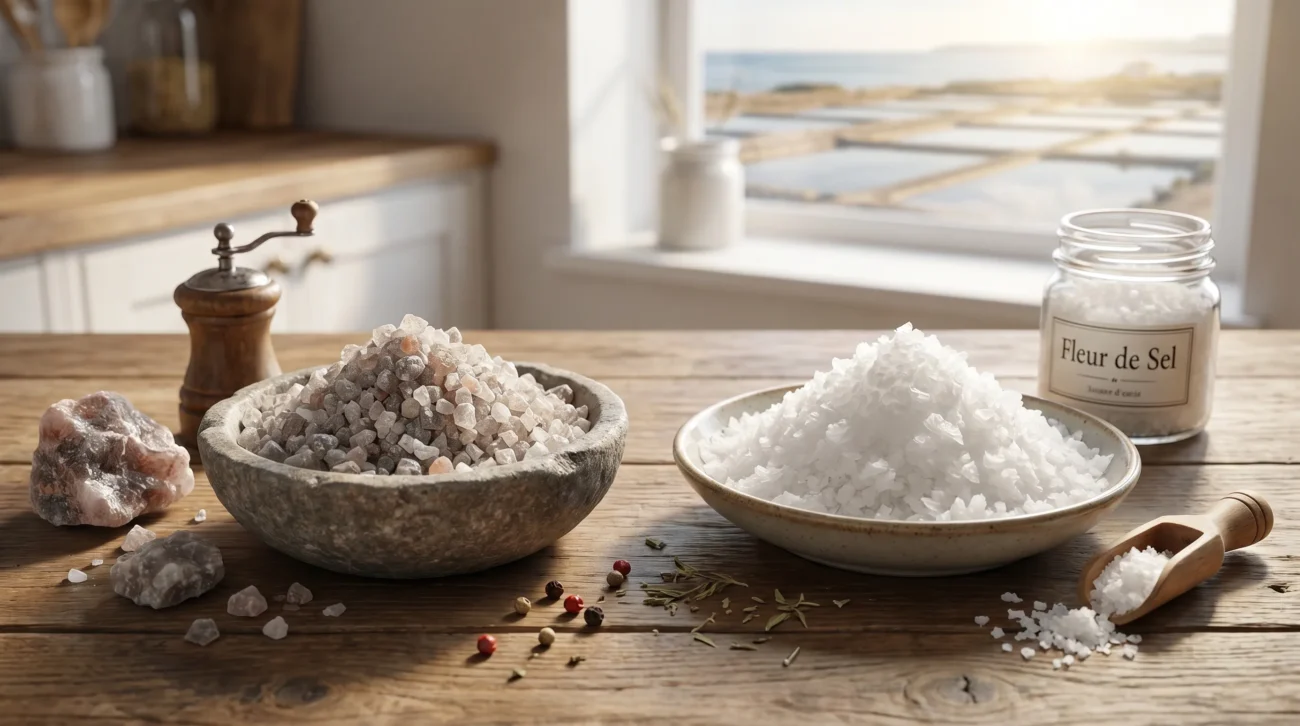
Is rock salt the same as sea salt? Not exactly. Both are made mostly of sodium chloride, but they are not the same in source, texture, processing, appearance, and best culinary use. Rock salt is usually mined from underground deposits formed by ancient evaporated seas, while sea salt is typically produced by evaporating seawater. In everyday cooking, they can sometimes overlap, but they are not automatically interchangeable in every recipe, and they are not automatically healthier just because one sounds more natural. The bigger health issue is still how much sodium you consume overall. Authoritative sources note that table salt, kosher salt, and most sea salts contain about 40% sodium, and the FDA’s Daily Value for sodium is 2,300 milligrams per day.
A lot of the confusion comes from the way people use the word “salt.” Some mean table salt, some mean Himalayan pink salt, some mean coarse sea salt flakes, and some even mean industrial rock salt used for icy roads. That is why the real answer is a little more nuanced than a simple yes or no. This guide will explain the difference between rock salt vs sea salt, how they compare for health, whether one has more iodine or trace minerals, and when you should choose one over another in the kitchen.
What Is Rock Salt?
Rock salt is salt that forms in large underground deposits, often from ancient sea beds that dried up long ago. In geology, the mineral is commonly called halite. Food-grade rock salt sold for cooking is still mostly sodium chloride, but it may look different from refined table salt because the crystals are often larger, coarser, and less uniformly processed. Some rock salts are white, while others are pink, gray, or slightly off-white because of small amounts of other minerals.
One of the most famous examples is Himalayan pink salt, which is a type of rock salt, not a sea salt. It is mined in the Punjab region of Pakistan and gets its pink color from trace minerals, including iron. That makes it visually distinctive, but it does not turn it into a low-sodium food. Like other culinary salts, it remains primarily sodium chloride.
There is one important practical point many articles skip: not all rock salt is edible. Some products labeled rock salt are intended for de-icing, water softeners, or industrial uses, not for cooking. If you are buying rock salt for food, it should clearly be labeled food-grade or sold specifically for culinary use. That distinction matters more than many readers realize. This is one of the biggest content gaps around the topic.
What Is Sea Salt?
Sea salt is produced by evaporating ocean water or water from other salty bodies of water. Depending on how it is harvested, sea salt can be fine, coarse, flaky, or slightly moist. Some specialty varieties, such as fleur de sel, are prized for their delicate crystal structure and finishing texture.
Because sea salt is often less heavily processed than standard table salt, many people assume it is much healthier. But that is where the marketing around “natural salt” can get ahead of the facts. Sea salt can contain small amounts of minerals like magnesium, calcium, and potassium, but the American Heart Association notes that these are only trace levels, and you can easily get those minerals from other foods.
Sea salt also varies widely by brand and style. A fine sea salt used in baking behaves very differently from a flaky finishing salt sprinkled on vegetables, fish, or dessert. So when people ask whether sea salt and rock salt are the same, part of the answer depends on which kind of sea salt they have in mind.
So, Are They the Same? The Short Answer
The clearest answer is this: rock salt and sea salt are similar, but they are not identical. They are similar because both are mostly made of sodium chloride. They are different because they come from different sources, may be processed differently, and can vary in crystal size, texture, moisture, trace minerals, and intended use.
That distinction matters because readers are usually asking two different questions at once. The first is a chemistry question: are they basically the same compound? In many cases, yes, they are mostly sodium chloride. The second is a practical cooking and health question: do they act the same in food, and is one better for you? Not necessarily. In real recipes, the shape and size of the crystals can affect how salty food tastes and how much sodium fits into a teaspoon. For health, the main issue is still total sodium intake, not whether the salt came from the sea or from a mine.
Rock Salt vs Sea Salt at a Glance
| Feature | Rock Salt | Sea Salt |
|---|---|---|
| Source | Mined from underground deposits | Evaporated from seawater |
| Main composition | Mostly sodium chloride | Mostly sodium chloride |
| Texture | Often coarse, chunky, crystalline | Can be fine, coarse, or flaky |
| Color | White, pink, gray, off-white | White, gray, or specialty colors |
| Trace minerals | May contain some | May contain some |
| Iodine | Not usually unless fortified | Not usually unless fortified |
| Best uses | Grinding, some cooking, salt blocks, specialty uses | Cooking, finishing, baking, seasoning |
| Health advantage | No automatic sodium advantage | No automatic sodium advantage |
The most useful takeaway from this table is that source and texture differ more consistently than nutrition. That is why a chef may prefer one salt for finishing and another for baking, even though both are still mostly sodium chloride.
Are They Chemically the Same?
From a chemistry standpoint, both rock salt and sea salt are primarily sodium chloride. The American Heart Association explains that common culinary salts are roughly 40% sodium and 60% chloride, which is why sea salt is not automatically a low-sodium alternative.
Where the difference appears is in the small extras. Sea salt may retain tiny amounts of minerals from seawater. Rock salt may also contain small traces depending on where it was formed and how it was processed. These differences can affect color, taste, and texture, but for most people they do not transform salt into a meaningful source of nutrients.
So if someone asks, “Nutritionally and chemically, are rock salt and sea salt basically the same?” the fair answer is mostly yes at the macro level, but not exactly in form or function.
Which Has More Sodium?
This is where many readers get tripped up. By composition, both salts are still mostly sodium chloride, so one is not a magic low-sodium replacement for the other. The AHA explicitly says that sea salt usually is not any less salty and typically contains about 40% sodium, just like table salt.
But there is a practical twist: sodium by weight and sodium by volume are not the same thing. A coarse salt with large crystals takes up more space in a spoon, so less actual salt may fit into one teaspoon compared with a fine salt. That means a teaspoon of coarse sea salt or coarse rock salt can sometimes look lower in sodium than a teaspoon of fine table salt, even when the salt itself is not fundamentally healthier. The difference is often about crystal size, not a better mineral profile.
That is why a recipe substitution chart matters. If you swap fine sea salt, coarse sea salt, rock salt, or table salt without adjusting the quantity, your food can come out too salty, too bland, or just inconsistent.
Is One Healthier Than the Other?
For most people, no major health authority says sea salt or rock salt is automatically healthier than ordinary table salt. The more important factor is your total intake of sodium over the day. The FDA uses a Daily Value of 2,300 mg of sodium, and the AHA emphasizes that a large share of the sodium people eat comes from packaged, prepared, and restaurant foods rather than from the salt shaker itself.
This is also why the “healthy gourmet salt” idea is often overstated. Trace minerals sound impressive on labels, but they usually appear in such small amounts that they do not outweigh the cardiovascular importance of managing sodium intake. The AHA links excess sodium intake to health concerns including high blood pressure, which in turn raises risk for heart disease and stroke.
A practical case study makes this easier to understand. Imagine two people both believe they have switched to a healthier salt. One uses pink rock salt, the other uses flaky sea salt. If both continue adding large amounts to food, neither has really solved the main issue. They have changed the style of salt, not the need to watch overall sodium.
Iodine, Trace Minerals, and the Natural Salt Myth
One of the biggest differences between salts is not rock salt vs sea salt, but iodized vs non-iodized salt. The NIH Office of Dietary Supplements explains that iodine is essential for making thyroid hormones, which help regulate metabolism and support growth and development. It also notes that iodine is added to some types of salt and that iodized salt remains a major strategy for controlling iodine deficiency.
This matters because many fashionable salts, including some sea salts and Himalayan salts, are not iodized. So while they may contain tiny amounts of minerals like iron, calcium, magnesium, or potassium, that does not mean they are better for thyroid health. In some households, standard iodized table salt may actually be the more practical nutritional choice.
That is the part many comparison articles miss. The smarter question is not just “Which salt is more natural?” but also “Which salt actually meets my cooking needs and supports my diet?”
Can You Use Rock Salt Instead of Sea Salt in Cooking?
Sometimes yes, sometimes no. For general seasoning, some food-grade rock salts and sea salts can be used in similar ways. But the details matter. Sea salt flakes are often better as a finishing salt because they dissolve pleasantly on the tongue and add a light crunch. Coarse rock salt may be better suited for grinders, salt crusts, or specialty presentation. Very large rock salt crystals are usually a poor direct substitute for fine sea salt in delicate baking.
If you are seasoning fish, meat, vegetables, or salting pasta water, the difference may be small once the salt dissolves. But for baked goods, salted caramel, and other recipes where precision matters, crystal size matters a lot. This is why chefs often choose salt based on function, not hype.
Here is a simple rule. Use fine salt when you need even distribution, flaky salt when you want texture on top, and coarse salt when the recipe is forgiving or the salt will dissolve slowly.
Food-Grade vs Non-Food Rock Salt
This is the most overlooked part of the topic. Some readers search “is rock salt the same as sea salt” and assume all rock salt is a culinary ingredient. It is not. De-icing rock salt for roads and salt for water softeners are not food products. Even if they resemble edible crystals, they are not intended for cooking.
So if you are shopping for edible rock salt, check the label. It should clearly indicate that it is for food use. This one clarification can protect readers from making a mistake that most comparison articles never address.
How Rock Salt, Sea Salt, Table Salt, and Kosher Salt Differ
Many readers do not just want rock salt vs sea salt. They also want to know how these compare with table salt and kosher salt. Table salt is usually more refined, often contains anti-caking agents, and is frequently iodized. Kosher salt is valued in cooking because its crystal shape makes it easy to pinch and sprinkle evenly. The AHA notes that kosher salt and sea salt are not automatically healthier than table salt.
That means the best choice depends on the job. Table salt works well in baking and when iodine matters. Kosher salt is popular for everyday cooking. Sea salt works well for finishing and some specialty applications. Rock salt, including Himalayan pink salt, often appeals for texture, visual presentation, or grinder use. None of these deserves a health halo on sodium alone.
Is Himalayan Pink Salt Rock Salt or Sea Salt?
Himalayan pink salt is a rock salt. It comes from mined deposits, not from modern evaporated seawater. Its pink color comes from trace minerals, especially iron. That makes it visually attractive and popular in grinders and finishing applications, but it does not change the core fact that it is still mostly sodium chloride.
This is one of the most important follow-up questions because many people treat pink salt as a completely separate category. In reality, it belongs under the broader rock salt umbrella.
Why Crystal Size Changes Taste and Recipe Results
One of the best gap topics for this article is crystal size. A fine salt dissolves quickly and spreads evenly, which is why it is useful in baking and precise seasoning. A coarse salt may taste less intense in a single pinch because the crystals hit the tongue differently. A flaky finishing salt creates a light crunch and a quick burst of saltiness.
This is also why equal teaspoons of different salts are not equal in practice. Bigger crystals leave more air gaps in the spoon. So when readers search “can coarse salt replace fine salt” or “coarse salt to fine salt conversion,” they are really asking a smart kitchen question that many comparison articles fail to answer directly.
Quick Guide: Which Salt Should You Use?
Here is a practical way to choose:
| Use | Best choice |
|---|---|
| Everyday cooking | Kosher salt or a fine sea salt |
| Baking | Table salt or fine salt for precision |
| Finishing dishes | Flaky sea salt |
| Grinders | Rock salt or coarse crystals |
| Brining / pickling | Recipe-specific salt; avoid guessing with crystal size |
| When iodine matters | Iodized table salt |
The takeaway is simple. Choose salt for function, not just for branding. A beautiful salt is not always the best salt for the recipe.
Final Answer
So, is rock salt the same as sea salt? No, but they are closely related. Both are mostly sodium chloride, yet they differ in where they come from, how they are processed, what their crystals look like, whether they are iodized, and how they perform in cooking. Sea salt is usually harvested by evaporating seawater. Rock salt is usually mined from underground deposits, and Himalayan pink salt is a well-known type of rock salt.
For health, the biggest issue is still total sodium intake, not whether the salt sounds more natural. For nutrition, iodized salt can still play an important role because iodine supports the thyroid. For cooking, the best salt is the one that fits the recipe, the crystal size you need, and whether the product is clearly food-grade.
If you want the simplest possible conclusion, here it is: rock salt and sea salt are not the same, but they are similar enough that the real difference is usually in texture, use, and labeling, not in some dramatic health advantage.
Disclaimer:
This article is for general informational and educational purposes only. Salt types, sodium content, iodine levels, mineral traces, culinary uses, and health effects may vary by brand, processing method, crystal size, serving amount, and individual dietary needs. Always check product labels carefully, use only food-grade salt for cooking, and consult a qualified healthcare professional or registered dietitian for personal sodium or iodine guidance.
