


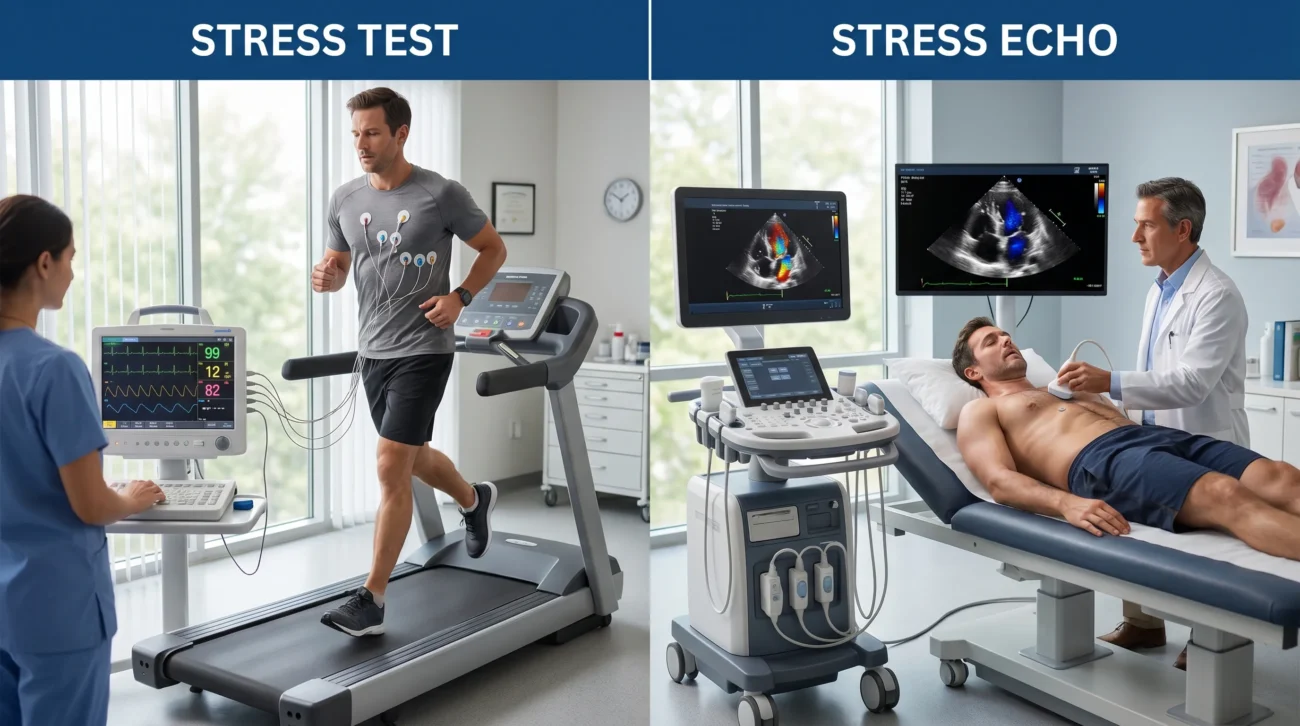
What is the difference between stress test and stress echo? The simplest answer is that a stress test usually checks how your heart rate, blood pressure, electrical activity, and symptoms respond to exercise, while a stress echo does all of that plus ultrasound imaging to show how your heart chambers, heart walls, heart muscles, and heart valves move under stress.
That difference matters more than it may seem at first. Many people hear terms like stress test, exercise ECG, stress echocardiogram, stress echo, or even echocardiogram stress test and assume they all mean the same thing. They do not. They are related, but they answer slightly different questions. A regular stress test can show whether exercise triggers abnormal electrical activity of the heart, abnormal heart rhythm, or signs that the heart is struggling during exertion. A stress echocardiogram goes a step further by adding ultrasound images, which can help a doctor see whether part of the heart is not moving normally, whether blood flow may be reduced, or whether there is a problem with valve function during exertion.
For patients, the real question is usually not just stress test vs stress echo. It is: Which one do I need? Which one gives more detail? What happens during each test? And can a stress echo show something a standard stress test might miss? This guide answers all of that in clear, simple language.
What Is a Stress Test?
A stress test, often called an exercise stress test, heart stress test, or exercise ECG, looks at how your heart performs when it is working harder. In most cases, you walk on a treadmill or pedal a stationary bike while a medical team watches your heart rate, blood pressure, symptoms, and electrical activity through electrodes placed on your chest. This is commonly done with a 12-lead ECG and sometimes compared with your baseline ECG before exercise begins.
The goal is not to take pictures of the heart. Instead, the goal is to see whether exercise causes changes that suggest the heart is under strain. A doctor may order this kind of non-invasive heart test if you have chest pain, shortness of breath, reduced exercise tolerance, abnormal heart rhythms, or a history that raises concern for coronary artery disease. It can also be used as an initial screening step when someone has symptoms but does not yet need a more advanced imaging test.
A standard stress test is useful because it is widely available, straightforward, and gives information about how the heart reacts to physical activity. It may show whether exercise triggers an abnormal heart rhythm, a drop or rise in blood pressure that seems unusual, or ischemic ECG changes that suggest the heart muscle may not be getting enough oxygen during exertion.
Still, a standard stress test has limits. It does not directly show the heart’s structures. It does not let the doctor watch the heart chambers contract in real time. It cannot directly image the heart valves, assess wall motion abnormalities, or visualize how the heart muscle itself is moving during stress. That is where a stress echocardiogram becomes important.
What Is a Stress Echo?
A stress echo, also called a stress echocardiogram, is a heart test that combines stress with ultrasound imaging of the heart. In other words, it includes the exercise part of a stress test, but it also uses a transducer and ultrasonic sound waves to create images of the heart before and after stress.
This makes a big difference. With a stress echo, the doctor is not only checking electrical activity, heart rhythm, and blood pressure. They are also looking at how the heart walls, heart muscles, heart chambers, and heart valves behave under pressure. If a portion of the heart does not squeeze normally after exercise, that can suggest myocardial ischemia, reduced blood flow, or a problem linked to coronary artery disease.
There are different forms of this test. An exercise stress echocardiogram uses walking or biking to raise the heart’s workload. A dobutamine stress echocardiogram, sometimes called DSE, is used when a patient is unable to exercise enough. In that version, dobutamine or another medication to mimic exercise makes the heart work harder, and the sonographer captures images at the right moments.
Because a stress echo uses imaging, it can reveal things a standard stress test may not. It may help assess valvular dysfunction with exercise, possible damage after a heart attack, unexplained dyspnea, murmurs, and situations in which previous tests were unclear. It also helps evaluate heart function more closely, which is why doctors often choose it when they need more than a simple exercise ECG.
Stress Test vs Stress Echo: The Key Differences
The easiest way to understand the difference between stress test and stress echo is to compare what each test is designed to show.
| Feature | Stress Test | Stress Echo |
| Main purpose | Checks how the heart responds to exercise | Checks response to exercise plus heart movement on ultrasound |
| What it measures | Heart rate, blood pressure, symptoms, electrical activity | All of the stress test data plus ultrasound imaging |
| Imaging included? | No | Yes |
| Can it assess heart valves and wall motion? | Not directly | Yes |
| Common use | Initial screening, exercise tolerance, rhythm changes | More detailed evaluation, unclear prior test, suspected structural or blood flow problem |
| Exercise required? | Usually yes, though modified versions exist | Exercise or dobutamine if needed |
| Typical detail level | Good for basic functional response | More detailed and often more specific |
| Radiation | No radiation | No radiation |
So, when people ask, what is the difference between stress test and stress echo, the most practical answer is this: a stress test tells your doctor how your heart responds to exertion from an electrical and physical standpoint, while a stress echo shows how the heart actually looks and moves during that same process.
This is why the phrase treadmill ECG vs stress echo matters. The first focuses more on rhythm and ECG changes. The second adds a visual layer that may reveal wall motion abnormalities, valve issues, or other signs of reduced blood flow that an ECG alone may not fully explain.
Which Test Gives More Detail, and Which One Do You Need?
If your doctor is choosing between a regular stress test and a stress echocardiogram, the decision usually depends on what question needs to be answered.
A standard stress test may be enough if the goal is initial screening, especially when someone has mild symptoms, needs a broad check of exercise tolerance, or has a history that does not immediately suggest a more complex problem. It can also be helpful when looking for arrhythmias, monitoring heart health, or assessing how the body handles exertion in a simple, cost-conscious way.
A stress echo is often chosen when doctors want to evaluate heart function more closely. For example, it may be preferred when a patient has chest pain assessment needs, unexplained shortness of breath, suspected CAD, valve issues, murmurs, syncope, or symptoms that keep happening even though a previous treadmill test was not clearly abnormal. It can also be useful in pre-operative assessment, in some cases of investigation of dyspnea, or when a doctor wants to know whether exercise causes valvular dysfunction or signs of ischaemia.
Think of it this way. A standard stress test answers: Does exercise create a concerning response? A stress echo answers: Why might that response be happening, and what does the heart look like while it happens?
A simple case example
A patient with occasional chest pain and a normal resting ECG may first have an exercise stress test. But if the result is borderline, or if symptoms continue, the next step may be a stress echocardiogram to look for wall motion abnormalities or signs of reduced blood flow to the heart. That is one reason many patients are told to start with one test and then move to another.
What Happens During Each Test?
Many patients worry more about the process than the medical terminology. The good news is that both tests are usually non-invasive and fairly routine.
For a standard stress test, you usually arrive wearing comfortable clothes or are asked to change into a gown. A clinician places ECG electrodes on your chest, checks your blood pressure, and records your baseline ECG. Then you start walking on a treadmill or using a stationary bicycle. The speed and incline may increase every 2–3 minutes so your heart works gradually harder. The team watches your heart rhythm, symptoms, and blood pressure until the target level is reached, symptoms appear, or the doctor has enough information.
A stress echo begins in a similar way, but it also includes ultrasound images. Before the exercise part, the sonographer uses a transducer with gel to take images of the heart at rest. Then you exercise on a treadmill or bike, or receive intravenous dobutamine if you cannot safely exercise enough. After that, the team quickly takes more heart images, often within a very short time window, because the goal is to compare the heart at rest and under stress.
A typical appointment may last around 30–45 minutes, sometimes close to 40 minutes and occasionally up to one hour, depending on the protocol and whether extra imaging is needed. Patients often ask, what happens during a stress echo test or how long does the echocardiogram stress test take because they want to know whether it is difficult. In reality, the hardest part is usually the exercise itself, not the imaging.
How Accurate Is a Stress Test Compared With a Stress Echo?
This is one of the most important topics, and it is also where many articles stay too vague.
A standard stress test can be very useful, but it is more likely than a stress echo to leave unanswered questions in some patients. That is because it relies heavily on ECG patterns, symptoms, and physical response to exercise. If those signals are unclear, the result may be less certain. This is especially relevant in people with baseline ECG abnormalities, people whose symptoms do not follow a classic pattern, or patients whose pretest probability sits in an in-between range.
A stress echo often gives more detail because it adds imaging. If the heart muscle is not getting enough blood during stress, the doctor may see wall motion abnormalities even when the ECG changes are subtle. This is why people often ask, which test is more accurate stress test or stress echo or search for stress test vs stress echo accuracy. In many real-world situations, the stress echocardiogram offers stronger diagnostic clarity.
That does not mean the stress echo is perfect. Like any imaging study, image quality can be affected by body habitus or a poor acoustic window. It is also somewhat operator dependent, which means the quality of capture and interpretation matters. Still, when the question is whether the heart muscle is moving normally under stress, the stress echo often has an advantage.
A useful patient-friendly way to say this is: a normal stress test can sometimes feel reassuring, but if symptoms continue, it may not be the final answer. That is why doctors sometimes order imaging after a treadmill test or explain that the first test was inconclusive. When that happens, it does not always mean something is seriously wrong. It means more detail is needed.
Stress Echo vs Treadmill Test vs Nuclear Stress Test
Another important gap topic is the difference between these heart tests.
A treadmill test usually means a standard exercise ECG without imaging. A stress echo adds ultrasound imaging. A nuclear stress test uses a tracer and special imaging to look at blood flow to the heart muscle. That last test is useful in some situations, but it is not the same as a stress echo.
One reason many people prefer learning about stress echo vs nuclear stress test is that they want to know about radiation exposure comparison. A major point here is that both a standard stress test and a stress echocardiogram involve no radiation. That can matter for patient comfort and decision-making, even though the best test still depends on the person’s symptoms, ECG pattern, history, and exercise ability.
If someone searches treadmill ECG vs stress echo, the main difference is detail. If they search stress echo vs nuclear stress test, the comparison becomes one of imaging method, radiation, and the specific clinical question being asked.
How to Prepare and What to Ask Your Doctor
Preparation can affect the quality of your test, so it is smart to ask about instructions ahead of time. Patients often search how to prepare for your stress echo test, can I eat before the test, or can I drive home after the test because they want the visit to go smoothly.
In many cases, your doctor may tell you to avoid caffeine, nicotine, alcohol, or certain medications before the appointment. The exact instructions depend on the type of test and your medical history, so it is always best to ask directly. Wear comfortable clothes and shoes if exercise is part of the plan. If you are unable to exercise, tell the clinic in advance so they can explain whether a dobutamine stress echocardiogram may be more appropriate.
Good questions to ask include:
Will I be walking on a treadmill or getting medication?
Should I take my usual heart medications?
How long will the appointment last?
Will I need someone to drive me home?
What happens if the result is unclear or abnormal?
Those questions are not excessive. They are exactly what informed patients should ask before any heart-related appointment or consultation.
Quick FAQ
Is a stress echo the same as a stress test?
No. A stress echo includes the stress portion of testing, but it also uses ultrasound imaging. A standard stress test usually does not.
Does a stress echo include an ECG?
Yes, in most cases the team still monitors electrical activity with ECG leads while also capturing ultrasound images.
Which test is more accurate?
That depends on the clinical situation, but a stress echocardiogram often provides more diagnostic detail because it can show wall motion abnormalities and structural findings that a standard treadmill ECG may not.
Can a stress test be normal even if symptoms continue?
Yes. That is one reason a doctor may order further imaging if symptoms persist.
Can I have a stress echo if I cannot exercise?
Often, yes. A dobutamine stress echocardiogram can be used when exercise is not possible.
Do either of these tests use radiation?
No. A stress test and a stress echo are both no-radiation tests.
What happens after an abnormal stress echo?
The next steps depend on the result. Your doctor may recommend more imaging, treatment changes, or consultation with a cardiologist.
Conclusion
The real difference between stress test and stress echo comes down to information. A stress test tells your doctor how your heart responds to exertion through heart rate, blood pressure, symptoms, and electrical activity. A stress echocardiogram gives that information plus a view of how the heart muscle, heart valves, and heart chambers actually move under stress.
That is why a stress test vs stress echo comparison matters so much. One is a strong starting point. The other often provides deeper answers when doctors need to evaluate heart function more closely, especially in cases involving chest pain, shortness of breath, coronary artery disease, or unclear earlier findings.
