


Table Of Contents
- Why Hidden Leaks Matter
- Early Warning Signs Around the Home
- How To Check the Water Meter
- What Water Pressure Can Reveal
- Yard and Landscape Clues
- Why Older Pipe Materials Need Attention
- Safe First Steps During a Suspected Leak
- Repair or Replacement?
- Questions To Ask Before Work Begins
- Conclusion
A water main problem can begin quietly, with no obvious drip under a sink or water pooling inside the house. Paying attention to changes in water use, pressure, and outdoor conditions can help homeowners act before a small underground leak becomes a costly disruption. If the evidence points to a buried supply-line issue, professional main water line repair and replacement in Salt Lake City can provide the testing and diagnosis needed to choose the right next step.
One symptom alone does not prove that the main water line is failing. A running toilet, irrigation leak, faulty appliance connection, or aging faucet can also increase water use. The key is to look for a pattern, then rule out simpler causes before authorizing excavation or replacement work.
Why Hidden Leaks Matter
A buried water service line can lose water for days or weeks before the problem becomes visible indoors. The escaping water may raise utility costs, saturate soil, damage landscaping, and contribute to shifting near driveways, sidewalks, or foundations. According to the EPA, the average family can waste 9,400 gallons of water annually from household leaks, which shows why even a suspected leak deserves attention. Still, a high bill is a clue, not a diagnosis. Indoor plumbing and irrigation equipment should be checked as well.
Early Warning Signs Around the Home
Water line trouble often starts as a series of small changes rather than a dramatic failure. Watch for several warning signs occurring together, especially when they cannot be explained by weather, recent water use, or a known plumbing issue.
- Lower water pressure at multiple fixtures throughout the home.
- A water meter that moves while all water-using devices are off.
- A water bill that rises without a meaningful change in household habits.
- Wet areas near the foundation, driveway, sidewalk, meter box, or front yard.
- Cloudy, rusty, or brown water after faucets have been unused for a period.
- Hissing, rushing, or vibrating sounds near pipes, walls, or outdoor valves.
- A narrow patch of grass that grows faster or stays greener than the nearby lawn.
How To Check the Water Meter
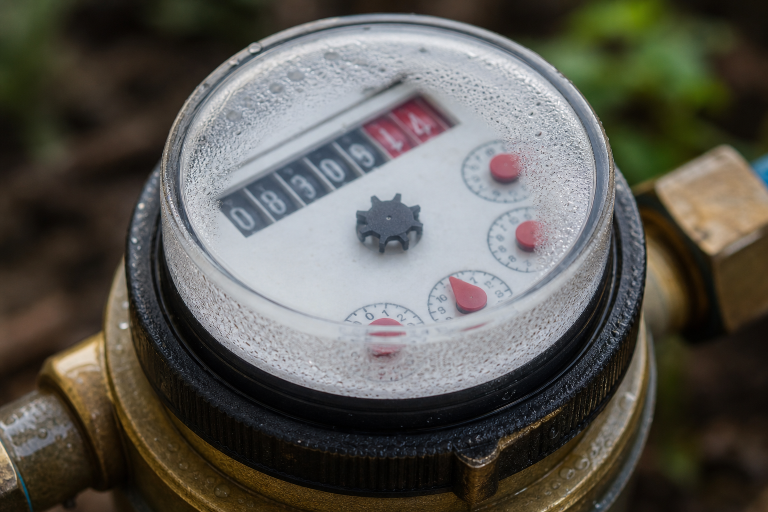
A basic meter test is one of the simplest ways to identify unexplained water use. It does not require special tools, although it cannot tell you exactly where a leak is located.
- Turn off faucets, showers, and water-using appliances.
- Pause irrigation, ice makers, water softeners, and other automatic systems.
- Record the meter reading or take a clear photo of the display.
- Wait one to two hours without using any water.
- Check the meter again for movement.
If the reading changes, water is likely moving somewhere on the property. Check toilets, visible fixtures, appliance hoses, and irrigation components first. Do not start digging based only on the meter result, since further testing is needed to pinpoint an underground leak.
What Water Pressure Can Reveal
Pressure changes can help narrow down the cause. Weak flow at a single faucet may be caused by a clogged aerator, mineral buildup, or a failing fixture. A sudden pressure drop at several fixtures at once is more concerning because it can indicate a supply restriction, valve problem, or leak affecting the whole home.
For a basic reading, attach a pressure gauge to an outdoor hose bib after water use has stopped. The EPA notes that incoming household water pressure generally performs best between 45 and 60 psi. Low pressure does not automatically mean the service line has failed, and homeowners should avoid adjusting a pressure-regulating valve until the underlying cause is understood.
Yard and Landscape Clues
Underground leaks often leave signs in the landscape. Look for soft soil or muddy areas during dry weather, puddles that return after drainage, water bubbling near a meter box, or new cracks and settling around paved surfaces. Soil movement or a developing depression should be treated seriously because it may create a trip hazard or affect nearby structures.
A practical example is a thin strip of unusually green grass running from the street toward the house. If rain has not fallen recently and irrigation is turned off, that healthy-looking strip may be receiving water from below ground rather than from normal lawn care.
Why Older Pipe Materials Need Attention
Pipe age alone does not confirm that replacement is necessary. However, corrosion, freezing temperatures, high water pressure, shifting soil, roots, and prior construction work can shorten a line’s useful life. Homeowners with older plumbing should identify the service-line material before deciding between a repair and a larger project.
Review inspection reports, renovation records, visible pipe sections near the shutoff valve, and any available municipal documentation. Knowing whether the line has a history of leaks or uses an older material helps make the diagnosis more useful and the estimate easier to compare.
Safe First Steps During a Suspected Leak
- Shut off the main water valve if water is actively entering the home.
- Keep people away from standing water near outlets, appliances, or electrical equipment.
- Move furniture, boxes, and valuables away from wet floors or walls.
- Take photos of visible water, damaged surfaces, and meter readings.
- Contact the water utility if the issue appears to involve the meter or the public side of the line.
- Schedule professional leak detection when the problem is underground, severe, or unclear.
Repair or Replacement?
The right solution depends on the leak location, pipe condition, repair history, accessibility, and expected performance of the remaining line. A written diagnosis should explain the damaged area, proposed materials, access method, testing process, restoration work, and timeline.
When A Local Repair May Make Sense
- The damage is limited to one confirmed area.
- The remaining pipe appears sound and suitable for continued use.
- There is no pattern of recurring leaks.
- The repair will not create multiple weak connections or require extensive access work.
When Replacement May Be Worth Considering
- Multiple leaks have occurred within a short period.
- The line has widespread corrosion, cracking, deformation, or material concerns.
- Past repairs have become frequent or increasingly disruptive.
- Most of the line must be exposed to reach the damaged section anyway.
Questions To Ask Before Work Begins
- Where is the leak, and how was its location confirmed?
- Is it on the homeowner’s side or the utility’s side of the meter?
- Would a targeted repair solve the issue, or is wider failure likely?
- Are permits, inspections, or utility coordination required?
- How will the yard, driveway, walkway, or landscaping be restored?
- What pressure and leak tests will be completed after the work?
- What costs, materials, labor, and restoration are included in writing?
- What warranty applies to labor and materials?
Conclusion
Low pressure, unexplained meter movement, wet soil, and higher water use are all signs worth checking promptly. A quick meter test can provide an early clue, but underground water line problems require careful diagnosis. Taking action early can reduce water waste, limit property damage, and help you make a repair decision based on evidence instead of guesswork.
