


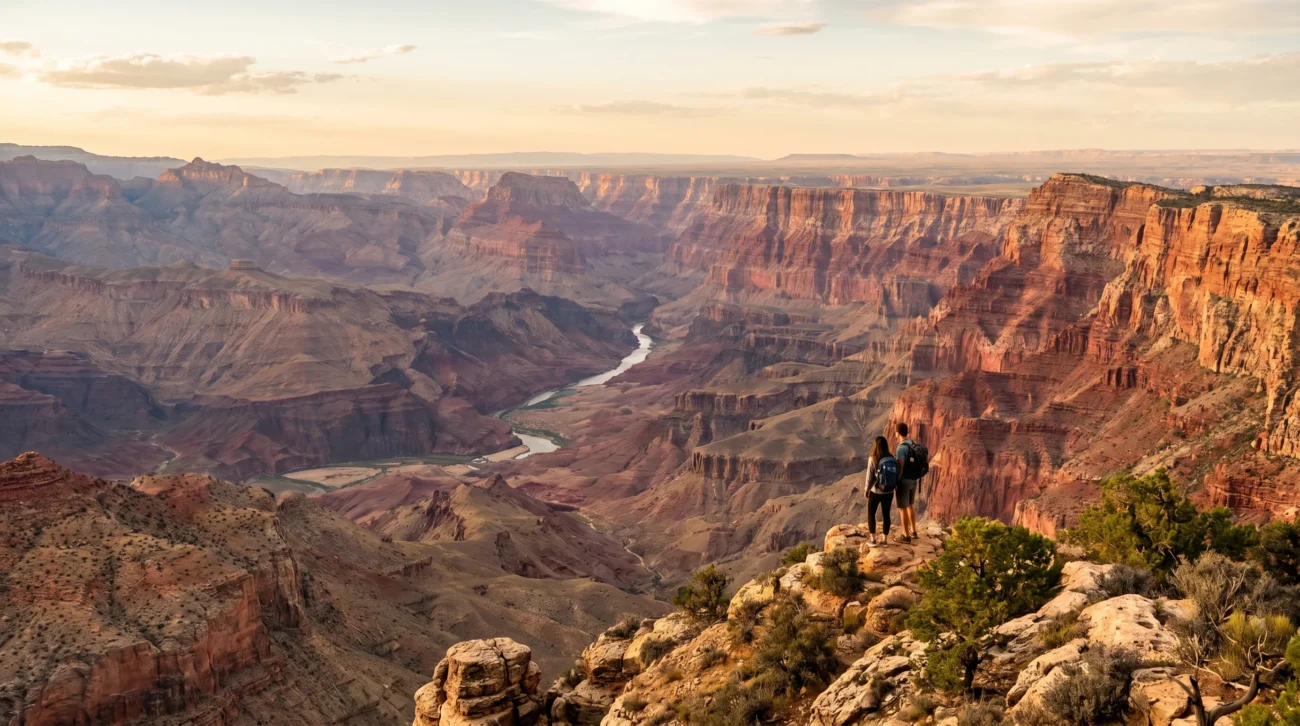
How big is the Grand Canyon? The short answer is that the Grand Canyon is about 278 river miles long, averages 10 miles rim to rim, reaches 18 miles at its widest, and is about 1 mile deep on average. If you include the full protected area of Grand Canyon National Park, the park covers roughly 1,904 square miles or 1,218,375 acres. Those numbers are impressive on their own, but they still do not fully capture what the canyon’s true scale feels like when you stand at the rim and try to take it all in.
For most readers, the real challenge is not finding one size number. It is understanding which size number matters. Some pages talk about the length of the canyon, others focus on rim-to-rim width, and others mention the overall park size. That is why this guide breaks the canyon down in plain English, so you can understand its dimensions, its geology, and why the Colorado River created one of the most famous landscapes in the United States.
The Grand Canyon by the Numbers
When people ask how long is the Grand Canyon, the most widely used official answer is 278 river miles. You may also see 277 miles on some pages, especially broader reference pages. That difference is small, but it is one reason readers get confused. In practice, both numbers describe the same huge landform, and the official National Park Service figure is 278 river miles.
When people ask how wide is the Grand Canyon, the answer depends on where you measure it. At its narrowest in Marble Canyon, it is about 600 feet wide. Across much of the better-known park area, the average rim-to-rim distance is about 10 miles, and at its widest it reaches 18 miles. That range is why some articles say 4 to 18 miles wide, while official park statistics emphasize the average and maximum rim-to-rim measurements.
When people search how deep is the Grand Canyon, the common answer is that it is over a mile deep. The official park statistics page gives the average depth as 1 mile, while broader reference sources often cite the deepest commonly quoted figure of 6,093 feet. Both help explain why the canyon feels less like a crack in the ground and more like an enormous open world of cliffs, rock layers, shadow, and distance.
There is also a major difference between the size of the canyon and the size of the national park. The canyon itself is the famous landform carved by the Colorado River. The park is the much larger protected area around it. That is why a good article should clearly separate the canyon’s length, width, and depth from the park’s 1,904 square miles of land. This distinction is one of the biggest content gaps in competing articles.
Here is a simple snapshot:
| Measurement | Grand Canyon Figure |
| Length | 278 river miles |
| Average width | 10 miles rim to rim |
| Maximum width | 18 miles rim to rim |
| Average depth | 1 mile |
| Park size | 1,904 square miles |
| Park size in acres | 1,218,375 acres |
| South Rim elevation | 7,000 feet |
| North Rim elevation | 8,000 feet |
These quick facts answer the main keyword directly, but most readers still want one more thing: a way to picture what these numbers mean in real life.
How Big the Grand Canyon Feels in Real Life
Raw measurements can sound abstract. 278 miles long is huge, but it does not always feel meaningful until you compare it to something familiar. That is why many travel and fact pages compare the Grand Canyon to places like Rhode Island or Delaware. Since Grand Canyon National Park covers about 1,904 square miles, it is much larger than Rhode Island’s 1,034 square miles and almost the same size as Delaware’s 1,982 square miles. That makes the canyon and park easier to picture for readers who are more comfortable with state-size comparisons.
But even those comparisons only go so far. What makes the canyon unforgettable is not just the map size. It is the combination of width, depth, and exposed rock layers. You are not simply looking across a valley. You are looking into a vast, layered landscape shaped over millions of years, with cliffs, side canyons, shadows, and terraces stretching across the Colorado Plateau. That is why how big does the Grand Canyon feel in person is one of the best gap angles for an article like this. The measurements are impressive, but the human experience of scale is even more powerful.
A useful way to explain it is this: the canyon is so large that what looks like a short distance from one rim may actually involve a multi-hour drive or an overnight hike. That is a better real-world explanation than simply repeating numbers.
Why Grand Canyon Size Numbers Vary
One reason people keep searching how large is the Grand Canyon is that different websites use different figures. That does not always mean the information is wrong. Usually, the source is measuring a different thing.
Some pages use 277 miles, while the official park statistics use 278 river miles. Some cite a width range of 4 to 18 miles, while others focus on the 10-mile average. Some say the canyon is over a mile deep, while others use 6,093 feet. And some articles blur the difference between the canyon and the surrounding Grand Canyon National Park.
That is why the most reader-friendly way to answer the keyword is to explain all four of these measurements separately:
The canyon is 278 river miles long. It averages 10 miles rim to rim. It reaches 18 miles at its widest. It is about 1 mile deep on average. The national park around it covers 1,904 square miles.
Once you understand those categories, the numbers stop feeling contradictory and start making sense.
How the Colorado River Made the Grand Canyon So Big
Any article about Grand Canyon size gets stronger when it explains how the Colorado River carved the Grand Canyon. The official park geology page says the Colorado River established its course through the canyon about 6 million years ago, and since then erosion by the river, its tributaries, slopes, springs, and tectonic activity has continued shaping the canyon.
That geology matters because it explains why the canyon is not just long. It is also deeply cut, heavily layered, and visually dramatic. The National Park Service notes that the park preserves rocks ranging from about 1.8 billion-year-old igneous and metamorphic rocks to 230 million-year-old sedimentary rocks, plus younger volcanic deposits. In plain terms, the Grand Canyon is like a giant history book of the Earth, opened page by page by erosion.
This is also why what makes the Grand Canyon so big is not a simple one-line answer. The size comes from a long combination of uplift, erosion, time, water, and the way the Colorado Plateau rose and exposed rock to gradual cutting. In SEO terms, this section supports topical authority because it naturally brings in Grand Canyon geology, geologic history, erosion, sedimentary rocks, igneous rocks, and tectonics without sounding forced.
How Old Is the Grand Canyon?
A lot of competing pages touch on age because readers naturally connect size with time. The common summary is that the modern canyon was carved by the river over roughly 5 to 6 million years, but the rocks exposed inside it are much older. Some of the rock record in the canyon goes back roughly 1.8 billion years, which is why the place feels ancient in a way few landscapes do.
That distinction is important. The canyon itself in its present form is much younger than the rocks inside it. That is another place where readers often get mixed signals. A good article should clarify that the debate is usually about when the canyon reached its modern form, not whether the rocks are old. The rocks are unquestionably ancient.
South Rim, North Rim, and West Rim
When readers move from pure curiosity to travel planning, they usually ask which part of the Grand Canyon best shows its scale. The answer depends on the rim.
The South Rim sits at about 7,000 feet elevation and is the most visited side of the park. The North Rim is higher, at about 8,000 feet, and feels more remote. Because of that elevation and access difference, the same canyon can feel different depending on where you see it from. The North Rim is not “bigger,” but the viewing experience can feel different because of the angle, forest cover, and elevation.
The South Rim is also open 24 hours a day, 365 days a year, with services available year-round. Reservations are strongly recommended during spring, summer, and fall. That makes it the easiest choice for first-time visitors and the most practical answer for many travel-related searches.
The West Rim is often mentioned on tourism sites because of attractions like the Skywalk and access from Las Vegas, but it is not the same as the main National Park Service South Rim experience. That is worth clarifying because many users searching which rim should I visit do not realize different operators and different jurisdictions are involved. Competitor content often mentions this, but not always clearly enough.
Width vs. Driving Distance: The Most Important Size Lesson
This may be the single most useful section in the whole article. The Grand Canyon is a perfect example of how a place can look close and still take a very long time to cross.
The National Park Service says that even though the average distance across the canyon is only 10 miles, it takes about 5 hours to drive the 215 miles between South Rim Village and North Rim Village. It also notes that if you hike rim to rim, it is about 21 miles, with a vertical descent and climb of about 1 mile. For 95% of individuals, that is an overnight hiking trip, not a casual walk.
This is exactly why the keyword Grand Canyon width vs driving distance deserves its own section. It solves a real user problem. Someone sees 10 miles across and imagines a quick trip. In reality, cliffs, terrain, roads, and the route to the crossing make the trip much longer. That practical explanation makes your article more helpful than a simple fact page.
There is even only one automobile crossing of the Colorado River in the area described on the NPS basic information page, which helps explain why the road journey is so indirect. Hikers crossing the canyon use a narrow footbridge that sits about 70 feet above the water. These details are excellent NLP entities with digits because they make the size and terrain feel real instead of abstract.
Best Places to Understand the Grand Canyon’s Size
If your goal is to understand how far can you see across the Grand Canyon or what the canyon’s scale really feels like, the best answer is often not another number. It is a viewpoint.
The South Rim is the easiest place for most visitors to grasp the canyon’s width and layered depth because it combines easy access, broad overlooks, visitor services, and year-round availability. Places like Desert View and other developed overlooks help translate the canyon from a statistic into a visual experience. The park’s visitor information also highlights major visitor centers, observation areas, and museums, which are useful for first-time travelers and families.
For readers creating a school project or wanting quick Grand Canyon size facts, a good strategy is to pair one clear table of measurements with one paragraph explaining that the canyon is long, wide, deep, and difficult to cross. That simple explanation is often more helpful than adding ten more disconnected factoids.
Quick Facts About the Grand Canyon
Here are the most useful facts to remember:
| Quick fact | Figure |
| Official park length | 278 river miles |
| Average rim-to-rim width | 10 miles |
| Maximum width | 18 miles |
| Average depth | 1 mile |
| National park area | 1,904 square miles |
| South Rim elevation | 7,000 feet |
| North Rim elevation | 8,000 feet |
| Drive between rims | 215 miles / about 5 hours |
| Rim-to-rim hike | 21 miles |
These are the facts most readers are actually looking for when they type how big is the grand canyon into a search bar.
Frequently Asked Questions
Is the Grand Canyon bigger than Rhode Island?
Yes. Grand Canyon National Park covers about 1,904 square miles, while Rhode Island is about 1,034 square miles, so the protected park area is much larger.
Is the Grand Canyon bigger than Delaware?
It is almost the same size. The park covers about 1,904 square miles, while Delaware is about 1,982 square miles.
How wide is the Grand Canyon at the South Rim?
There is no single width that applies to the whole South Rim. Across the park, the average rim-to-rim width is about 10 miles, and the maximum width is about 18 miles.
Is the Grand Canyon the biggest canyon in the world?
No. It is one of the world’s most famous canyons, but not generally considered the biggest by every possible measure. Some broader reference pages compare it with other enormous canyons, but the Grand Canyon’s fame comes from its combination of depth, width, exposed geologic history, and public accessibility.
Why do different websites show different Grand Canyon measurements?
Because they may be measuring different things: river length, rim-to-rim width, average depth, maximum depth, or the full park size. The most reliable approach is to keep those categories separate.
Final Answer
So, how big is the Grand Canyon? It is about 278 river miles long, averages 10 miles rim to rim, reaches 18 miles wide, and is about 1 mile deep on average. The surrounding Grand Canyon National Park covers about 1,904 square miles. Those numbers make it one of the most extraordinary landscapes in Arizona and the United States, but the best way to understand its true scale is to remember one simple idea: the Grand Canyon is not just large on a map. It is large in every direction at once—length, width, depth, and real-world travel distance.
