


Introduction
How big is fabric by the yard is one of the most common questions beginners ask when they start sewing, quilting, or shopping for material online. The short answer is simple: 1 yard of fabric is 36 inches long, or 3 feet, but the width depends on the type of fabric and the bolt it comes from. That is why one yard of quilting cotton does not look the same as one yard of upholstery fabric or one yard of 60 inch fabric. Ice Fabrics explains this clearly: a yard is measured by length, while the width can be 44, 54, 60, 72, or even 118 inches depending on the material.
That width difference matters more than most people think. Stitch Clinic notes that one yard of 60-inch fabric is bigger than one yard of 45-inch fabric, even though both are still exactly one yard long. Reddit users in r/sewhelp make the same point in more practical terms, showing that a one-yard cut of quilting cotton is usually about 36″ by 44″.
So if you have ever wondered whether a yard of fabric is enough, how much usable material you really get, or what you can actually make with it, this guide will walk you through it in plain English.
What Does “One Yard of Fabric” Actually Mean?
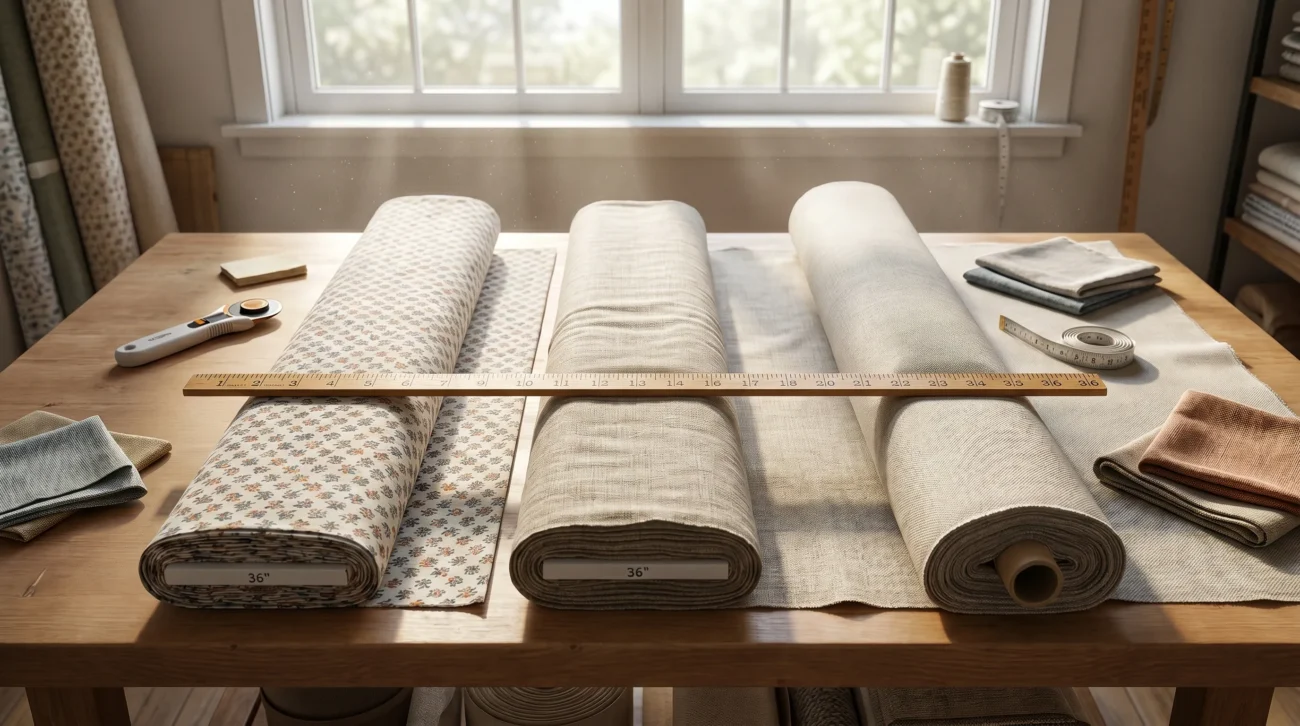
A yard of fabric refers to the length cut from the bolt or roll. It does not mean you are getting a square piece. That is the biggest misunderstanding behind searches like how much fabric is a yard, what dimensions is one yard of fabric, and how big is one linear yard of fabric.
In fabric terms, 1 yard = 36 inches = 3 feet. That part never changes. What changes is the width, because different fabrics are manufactured in different standard widths. Ice Fabrics states that when someone buys a yard, they receive a piece that is 36 inches long and as wide as the bolt, which could be 44″, 54″, 60″, 72″, or wider.
That means a linear yard of fabric is really a rectangle. If the fabric is 60 inches wide, then one yard gives you 36 x 60 inches. If the fabric is 44 inches wide, then one yard gives you 36 x 44 inches. Ice Fabrics uses those exact examples, and that is why linear yard vs square yard is such an important distinction for beginners.
This is also why fabric size chart results can be confusing at first. People often expect all “one-yard” pieces to look the same, but in reality, width controls how much usable fabric you get.
Common Fabric Widths You Should Know Before You Buy
Understanding common fabric widths will help you avoid mistakes when buying fabric by the yard. According to Ice Fabrics, some standard widths are:
| Fabric type | Typical width |
| Quilting cotton | 44–45 inches |
| Apparel fabrics | 54–60 inches |
| Upholstery fabric | 54–72 inches |
| Lace or mesh | 48–60 inches |
| Drapery/sheer fabrics | 118 inches |
Stitch Clinic gives similar guidance, listing quilting cotton, broadcloth, and flannel at 41–45 inches, home décor at 54 or 60 inches, and apparel at 60 inches. Reddit users also point out that 45″ and 60″ are the most common widths most people see today when using sewing patterns.
This matters because fabric width changes what you can cut from a single yard. A 44-inch width may be perfect for quilting blocks, pillowcases, or a tote bag, while a 60-inch width may let you cut a skirt panel, larger garment pieces, or wider home décor sections with fewer seams.
If you shop online, always check both the yardage and the width in the product description. A wide fabric often gives you more usable material per yard than a narrow one. Ice Fabrics says this directly, noting that wider fabric can be more cost-efficient because it gives you more usable material per yard.
How Big Is 1 Yard of Fabric in Real Life?
The best way to answer how big is fabric by the yard is to picture actual cut sizes.
One yard by common widths
| Fabric width | What 1 yard looks like |
| 44-inch fabric | 36″ x 44″ |
| 45-inch fabric | 36″ x 45″ |
| 54-inch fabric | 36″ x 54″ |
| 60-inch fabric | 36″ x 60″ |
| 72-inch fabric | 36″ x 72″ |
Ice Fabrics explicitly gives 36 x 60 inches for a yard of 60-inch wide fabric and 36 x 44 inches for a yard of 44-inch wide fabric. Reddit’s r/sewhelp thread echoes that a one-yard cut is commonly 36″ by 44″ in quilting cotton.
If you want to think about area, Ice Fabrics also notes that a yard can work out to about 2,160 square inches or 15 square feet in one example, which helps people visualize how much material that really is.
So when someone asks how wide is a yard of fabric, the best answer is: a yard is always 36 inches long, but the width depends on the fabric.
Half Yard, Quarter Yard, and Fat Quarter Explained
A lot of beginners do not actually need a full yard. They need a half yard of fabric, a quarter yard, or a fat quarter, and those are not the same thing.
A helpful Reddit answer in r/sewhelp breaks it down like this for most quilting cottons, which are about 44″–45″ wide:
- 1 yard = 36″ by 44″
- 1/2 yard = 18″ by 44″
- 1/4 yard = 9″ by 44″
- fat quarter = 18″ by 22″
The same comment explains that fabric width is measured from selvedge to selvedge, and yardage is measured along the fabric edge.
That last part is important because a fat quarter is not just a regular quarter yard. It is cut differently so you get a chunkier rectangle that is often more useful for quilting and craft projects.
Stitch Clinic also explains that stores can cut smaller sizes than a full yard, though some websites only allow half-yard and full-yard increments. It adds a practical note that fraction charts are useful because they are hard to visualize without a ruler or tape measure in front of you.
Fabric Width vs. Usable Width
Here is a detail that many articles skip: listed width is not always the same as usable width.
Stitch Clinic has a section on the usable size of cut fabric and warns that after you deal with uneven cut edges and prewashing, you may be left with slightly less than the amount you thought you bought. It recommends rounding up because crooked cuts, fraying, and thread loss can reduce usable length.
That means fabric width vs usable width can affect your project in real life. A fabric may be labeled as 45 inches wide, but the selvedges, fraying, shrinkage, print direction, and straightening can reduce the space you can comfortably use.
This becomes even more important with:
- directional prints
- nap fabrics
- striped or chequered fabric
- garment layouts
- projects that need exact matching
Tissura also points out that garment design details such as patch pockets, shoulder straps, folds, ruches, and patterned fabrics can increase how much material you need.
So when planning a project, think beyond yard of fabric dimensions and ask: how much usable fabric will I really have after cutting, straightening, and prewashing?
What Can You Make With One Yard of Fabric?
This is where the topic gets practical. People rarely search how much fabric is a yard just for math. They want to know whether one yard is enough for something they want to make.
Ice Fabrics gives a few useful real-world examples. With 44-inch wide fabric, it suggests a child’s dress, one standard pillowcase, a short apron, or a tote bag. With 60-inch wide fabric, it lists a basic T-shirt, a knee-length skirt, two pillow covers, and a small tablecloth. For upholstery fabric, it mentions one dining chair seat, half of a curtain panel, or a decorative pillow.
That means is one yard of fabric enough depends on two things: fabric width and project type.
Projects that often work with 1 yard
- Pillowcase
- Apron
- Tote bag
- Child’s clothing
- Small skirt
- Decorative pillow
- Small table topper or runner
- Simple craft projects
Projects that often need more than 1 yard
- Full-size dresses
- Most pairs of pants
- Curtains
- Large tablecloths
- Upholstery panels
- Garments with sleeves, gathers, or matching prints
Tissura goes even deeper into fabric consumption for clothing, explaining that required yardage changes based on body size, garment style, and fabric width. It notes, for example, that narrow fabric can require extra lengths for dresses and blouses, while pants can need added inches for extra parts depending on measurements.
How to Measure Fabric for a Project
If you want to stop guessing, use this simple method before buying fabric by the yard.
First, check the finished dimensions of your project. Second, check the fabric width. Third, think about how the pieces will sit on the fabric. If you are using a sewing pattern, the pattern envelope usually tells you how much yardage you need for different widths. Reddit users specifically note that pattern envelopes often list requirements for 45″ or 60″ widths.
Then add extra room for real-world issues:
- shrinkage
- cutting errors
- matching stripes or checks
- directional print layout
- selvedge loss
- prewashing fray
Stitch Clinic strongly recommends rounding up rather than down because you can lose fabric to crooked cuts, tangled threads, and edge cleanup after washing.
Tissura adds another useful reminder: narrow fabrics can force you to buy more length, and style details like folds or pockets can increase the amount needed.
In other words, how to measure fabric for a project is not just about the number of yards. It is about width, usable width, and layout.
Yard vs. Meter: Quick Conversion Guide
Fabric is often sold in yards in the U.S., but many international stores use meters. Ice Fabrics gives a simple conversion:
- 1 yard = 0.91 meters
- 1 meter = 39.37 inches
It also notes that if you buy from a European or Canadian store, a meter gives you slightly more fabric than a yard.
Here is the easiest way to remember it:
| Measurement | Equivalent |
| 1 yard | 36 inches |
| 1 yard | 3 feet |
| 1 yard | 0.91 meters |
| 1 meter | 39.37 inches |
This matters if you are comparing yard vs meter, using a running metre, or following tutorials from different countries.
Common Mistakes When Buying Fabric by the Yard
A lot of sewing frustration comes from buying the right length but the wrong type or width.
The biggest mistake is thinking a yard is a square. It is not. A yard is 36 inches long, but the width can vary a lot. That means one yard of quilting cotton and one yard of upholstery fabric are very different in practical size.
The second mistake is ignoring usable width. Stitch Clinic warns that after prewashing and straightening, what is left is the fabric you truly have to work with.
The third mistake is not checking whether the store sells in full-yard only, half-yard increments, or something else. Stitch Clinic notes that some websites only allow ½ yard and full yard cuts.
The fourth mistake is forgetting the project itself. Ice Fabrics points out that wider fabric can save seams and give more usable material per yard, especially for things like skirts, curtains, or upholstery.
A good rule is simple: when in doubt, buy a little extra.
Quick Reference Table: Fabric Yardage at a Glance
Here is a fabric yard chart you can save for quick reference.
| Cut | On 44″ fabric | On 60″ fabric |
| 1 yard | 36″ x 44″ | 36″ x 60″ |
| 1/2 yard | 18″ x 44″ | 18″ x 60″ |
| 1/4 yard | 9″ x 44″ | 9″ x 60″ |
| Fat quarter | 18″ x 22″ | not typically sold this way |
The 44-inch dimensions are grounded in the Reddit explanation for quilting cotton, while the 60-inch one-yard example is directly stated by Ice Fabrics.
This kind of chart is often more useful than a long explanation because it answers the query fast and visually.
FAQ
Is a yard of fabric always the same width?
No. A yard is always 36 inches long, but widths vary by fabric type. Common widths include 44–45 inches, 54 inches, and 60 inches.
What is the difference between a yard and a fat quarter?
A yard is a full 36-inch length of fabric. A fat quarter is usually 18″ x 22″ on quilting cotton and is cut differently from a standard quarter yard.
Is one yard of fabric enough for a dress?
Sometimes, but not always. A child’s dress may work with one yard, while an adult dress often needs more, especially if the fabric is narrow or the design includes sleeves, fullness, or matching prints.
How wide is quilting cotton?
Usually about 44″–45″, though Stitch Clinic gives a broader range of 41″–45″ for quilting cotton, broadcloth, and flannel.
What does “sold by the yard” mean online?
It means the store cuts the length you order in yards, while the width stays whatever the fabric was manufactured to be. Ice Fabrics says that if you order 3 yards, you receive 108 inches of length at the full width of the fabric.
Conclusion
The easiest way to remember how big is fabric by the yard is this: a yard is always 36 inches long, or 3 feet, but the width changes depending on the fabric. That is why one yard of 44-inch fabric is different from one yard of 60-inch fabric, even though both are still one yard. Ice Fabrics, Stitch Clinic, and the Reddit sewing discussion all point to the same lesson: once you understand length vs width, fabric shopping becomes much less confusing.
Disclaimer:
This article is for general informational and sewing guidance purposes only. Fabric yardage, width, usable size, shrinkage, and project requirements may vary by fabric type, manufacturer, store cutting method, washing process, pattern layout, and personal sewing needs. Always check the exact fabric width, product details, care instructions, and pattern requirements before buying or cutting fabric by the yard.
