


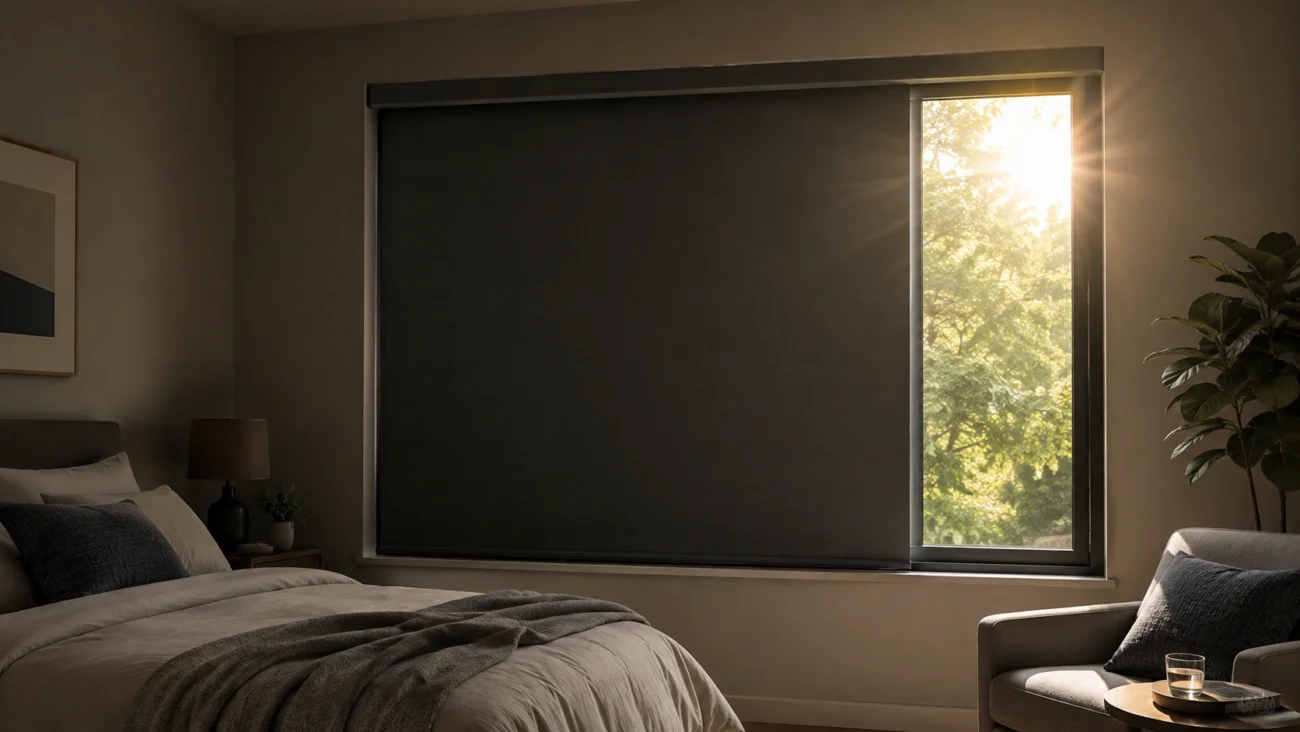
Blackout blinds and curtains are usually bought for one reason: blocking light. But a lot of buyers assume they get a second benefit for free, a cooler room in summer and a warmer one in winter. That assumption is only partly true, and the details matter more than most product listings let on.
Blackout material does affect a room’s temperature, but the effect comes from a different mechanism than most people expect, and it depends heavily on installation, not just the fabric itself.
Why Blackout Fabric Has Any Insulating Effect at All
Blackout fabric is typically a tightly woven face fabric bonded to one or more foam or acrylic backing layers. That layered construction is what blocks light, and it happens to also slow down heat transfer, since dense, layered material is a poor conductor compared to a single pane of glass.
This is a byproduct of the light-blocking construction, not a separate thermal technology. A thin blackout fabric with minimal backing will insulate far less than a heavier, multi-layer version, even if both block the same amount of light.
Where the Real Difference Comes From: Air Gaps, Not Just Fabric
Glass windows lose and gain heat constantly. The single biggest factor in whether a window covering actually helps with temperature is whether it creates a sealed pocket of still air between the fabric and the glass.
- A treatment mounted flush against the window traps a thin layer of air, which acts as extra insulation
- A treatment that hangs loosely, several inches from the glass, allows air to circulate freely, undoing most of the thermal benefit
- Gaps at the top, bottom, or sides let conditioned or heated room air escape toward the glass, working against the insulation effect entirely
This is the same principle that makes light leakage happen. A treatment with visible edge gaps is both letting light in and letting the insulating air pocket escape.
Curtains vs. Blinds for Thermal Performance
Heavy curtains, especially ones with a thermal or interlining layer, can perform well if they extend well past the window frame on all sides and pool slightly at the floor, minimizing the chimney effect where cold air sinks down and out from underneath.
Blinds mounted close to or within the window recess tend to create a tighter seal by design, since there is less distance between the material and the glass for air to move through. For this to actually work, the blind has to be sized to the window precisely. A blind that is a few centimeters narrower than its recess loses much of this advantage, which is one more reason how to measure for blackout blinds correctly is not just about aesthetics or light blocking.
Where This Matters Most
Thermal performance differences are most noticeable in rooms with single-pane or older double-pane windows, north or west-facing rooms with strong seasonal sun exposure, and homes where heating or cooling costs are already a concern. In a newer, well-insulated home, the difference is smaller and mostly limited to comfort rather than a measurable bill impact.
Common Misconceptions
- Assuming any blackout label means significant thermal insulation, when construction quality varies widely between products
- Believing a wider gap “lets the room breathe,” when in practice it just cancels out the insulating air pocket
- Expecting curtains and blinds to perform identically for temperature control when their gap patterns are fundamentally different
- Overlooking installation and mounting distance as the main variable, rather than fabric thickness alone
What Actually Helps
For anyone specifically trying to improve temperature regulation, not just light control, the priorities are a tight, edge-to-edge fit against the window rather than a loose hang, a mounting method that minimizes the gap between fabric and glass, and full coverage across the width and height of the window, corner to corner. Renters weighing their mounting options, especially where wall drilling is not permitted, can review what a no-drill window blind installation involves before assuming a sealed fit is out of reach.
None of this requires a specific brand or product type. It simply means treating fit and mounting as seriously as fabric choice, which is also the exact same advice that applies to light blocking. The two goals, temperature and darkness, are solved by the same underlying fix.
Frequently Asked Questions
Do blackout curtains lower your energy bill?
They can contribute to modest savings in rooms with poor window insulation, but the effect is small compared to proper window sealing or double glazing.
Is a tighter fit always better for insulation?
Generally yes. A snug fit against the window frame or recess traps a still air pocket, which is the main source of any thermal benefit.
Do blinds or curtains insulate better?
It depends more on fit and mounting distance from the glass than on the material type itself. A well-fitted option of either type outperforms a poorly fitted one.
