


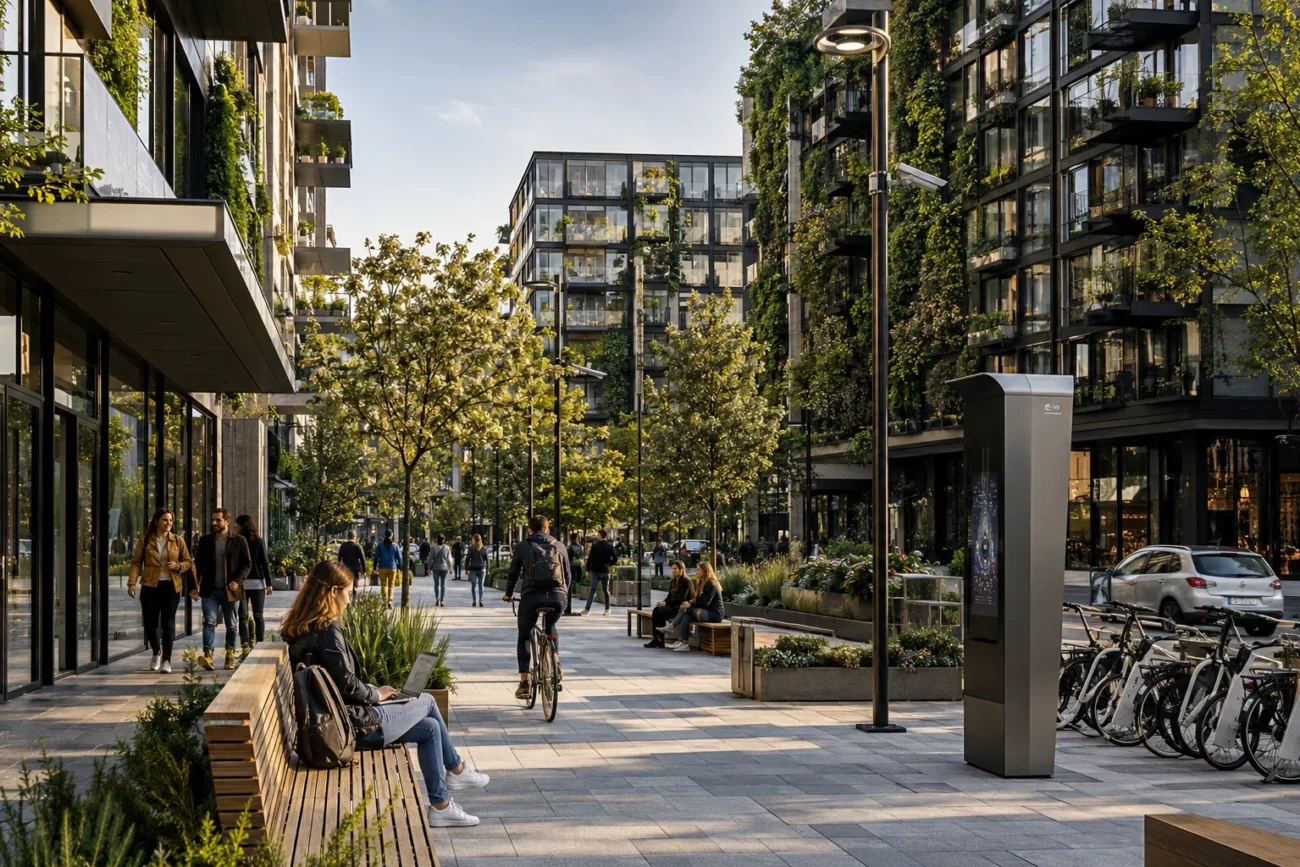
Axurbain is a term people increasingly encounter while searching for information about urban living, modern architecture, sustainable cities, and smart-city technology. However, its meaning is not as simple as many online explanations suggest. Depending on the context, Axurbain may refer to an urban-living media platform, an emerging idea about human-centered future cities, or a French urban-furniture company.
Understanding these distinctions matters because cities face serious pressure from population growth, housing shortages, traffic congestion, climate change, and aging infrastructure. More than half of the global population now lives in cities, and that share is expected to approach 70% by 2050. The United Nations says cities need stronger action on affordable housing, public transportation, environmental quality, resilience, and inclusive planning.
This guide explains the Axurbain meaning, the ideas commonly associated with it, the technologies behind smart urban living, its potential benefits and risks, and how it differs from established urban-planning frameworks.
What Is Axurbain?
In simple terms, Axurbain is an emerging online term connected with smart urban living, sustainable urban development, modern architecture, and human-centered city planning.
Several recently published articles describe Axurbain as a model in which technology, people, infrastructure, and nature work together. Under this interpretation, an Axurbain-style city may use artificial intelligence, Internet of Things sensors, renewable energy, connected transportation, data analytics, and green infrastructure to improve daily life.
The basic goal is not simply to install more technology. It is to create urban environments that are:
- Efficient
- Sustainable
- Inclusive
- Connected
- Safe
- Adaptable
- Comfortable for residents
However, Axurbain does not appear to be a universally recognized academic framework, government program, or certified type of city. It is better understood as an emerging and inconsistently defined concept that combines ideas already found in smart-city development, sustainable planning, and people-first design.
Is Axurbain a Real City?
Axurbain is not the official name of a known city. It is used online as a media brand, business name, and conceptual description of future urban living.
Cities such as Singapore, Copenhagen, Dubai, and Toronto are sometimes presented as examples of Axurbain principles. A more accurate explanation is that these cities have adopted certain practices associated with smart infrastructure, sustainable mobility, digital services, or green urban planning. They are not officially classified or certified as “Axurbain cities.”
What Does “Axurbain” Actually Refer To?
One of the biggest weaknesses in competing articles is that they describe Axurbain as though it has only one established meaning. In reality, the keyword has at least three distinct interpretations.
Axurbain as an Emerging Urban Concept
Many independent websites use Axurbain to describe a future-focused approach to city development. Their descriptions usually combine:
- Smart-city technologies
- Sustainable architecture
- Renewable energy
- Human-centered urban design
- Community participation
- Responsive public services
- Climate resilience
Under this interpretation, Axurbain represents a broad vision rather than a fixed technical standard. Its meaning changes slightly from one publisher to another.
Axurbain.media
Axurbain.media identifies itself as a media platform focused on urban living, architecture, design, real estate, renovation, sustainability, and urban innovation. Its website describes Axurbain as a modern media hub intended for architects, designers, planners, students, families, professionals, and general readers interested in city life.
The platform publishes accessible content about topics such as:
- Modern buildings and interiors
- Compact urban homes
- Sustainable materials
- Green rooftops
- Smart homes
- Renovation and adaptive reuse
- Artificial intelligence in urban design
- Changing city lifestyles
Therefore, some people searching for “Axurbain” have navigational intent and are simply trying to find the Axurbain media platform or one of its articles.
AXURBAIN, the French Urban-Furniture Company
AXURBAIN is also the name of a French business specializing in urban furniture and playground equipment. Its business profile describes products such as public benches, planters, waste bins, barriers, bollards, container screens, and customized street furniture made from materials including steel, wood, concrete, and polyethylene. The business was founded in 1996 and is based in Fabrègues, France.
This commercial meaning is separate from Axurbain.media and the emerging smart-city concept. Searchers looking for AXURBAIN France, mobilier urbain, public benches, playground equipment, or Agora Mobilier Urbain are likely showing commercial or navigational intent.
Why Axurbain Matters in Modern Urban Development
The ideas associated with Axurbain matter because modern cities must solve several problems at the same time. They need to provide housing, transportation, public services, jobs, clean air, green spaces, digital access, and climate protection without making urban life unaffordable or overly complicated.
The United Nations’ Sustainable Development Goal 11, commonly called SDG 11, aims to make cities and human settlements “inclusive, safe, resilient and sustainable.” Its targets cover affordable housing, accessible public transportation, participatory planning, air quality, waste management, disaster resilience, and universal access to public spaces.
These priorities closely match the strongest parts of the Axurbain smart-city vision. Yet the real value of an urban project should be measured by how well it improves residents’ lives—not by the number of sensors, apps, cameras, or automated systems it installs.
The Core Principles of Axurbain-Style Development
Because Axurbain does not have one official framework, its principles must be treated as a practical synthesis rather than formal rules. Five core pillars provide a useful way to understand the concept.
1. People-First Planning
A human-centered city begins with residents’ needs. Planners must consider whether homes are affordable, streets are safe, services are accessible, and neighborhoods support physical and mental well-being.
Technology should answer questions such as:
What problem are residents facing, and what is the simplest responsible way to solve it?
This is more useful than purchasing a new technology first and searching for a problem afterward.
2. Environmental Sustainability
Sustainable urban planning reduces energy use, pollution, waste, and pressure on natural resources. It can include renewable energy, energy-efficient buildings, urban forests, water conservation, circular-economy programs, and low-carbon transportation.
Sustainability should be integrated into construction, transport, housing, public services, and long-term city management rather than treated as an optional feature.
3. Connected and Responsive Infrastructure
Smart infrastructure uses reliable data to help public services respond more effectively. Smart streetlights may adjust to actual conditions, water-monitoring systems may identify leaks, and public-transport tools may provide real-time arrival information.
The objective is not constant surveillance. It is better resource management and faster responses to genuine public needs.
4. Inclusion and Community Participation
Successful urban development requires community engagement. Residents should be able to influence projects that affect their homes, transport, privacy, public spaces, and local businesses.
Inclusive planning must also consider older adults, children, low-income families, people with disabilities, digitally excluded residents, and communities at risk of displacement.
5. Resilience and Adaptability
Cities face heat waves, flooding, droughts, severe storms, cyberattacks, energy disruptions, and economic shocks. Urban resilience means preparing systems to continue operating, recover quickly, and protect vulnerable residents during emergencies.
How Would Axurbain Work in Practice?
An Axurbain-style project would ideally follow a continuous urban-improvement cycle.
First, a city identifies a clear problem, such as unreliable buses, high energy use, unsafe crossings, water leakage, or poor air quality. Relevant information is then collected through existing records, resident feedback, environmental monitoring, or carefully selected IoT sensors.
Next, planners, technical experts, and community representatives study the data. Artificial intelligence and predictive analytics may help detect patterns, but human decision-makers remain accountable for the final policy.
The city then tests a limited solution, measures the results, and adjusts the project. This process may include GIS mapping, urban simulation, digital twins, public consultation, and performance indicators.
The most important rule is that technology should support informed human decisions. It should not replace democratic planning, professional judgment, or public oversight.
Technologies Behind Axurbain-Style Cities
A future city may use several connected technologies, but each tool must serve a defined public purpose.
Artificial Intelligence and Predictive Analytics
AI in urban planning can analyze large datasets and help identify patterns that would be difficult to see manually. Potential uses include:
- Forecasting traffic congestion
- Predicting energy demand
- Planning emergency responses
- Identifying maintenance needs
- Comparing development scenarios
- Improving public-resource scheduling
Predictive maintenance can help cities repair equipment before it fails. However, AI-generated recommendations still need accurate data, professional review, transparency, and safeguards against algorithmic bias.
Internet of Things and Smart Sensors
The Internet of Things, or IoT, connects physical devices that collect or exchange information. In cities, IoT sensors may monitor:
- Air quality
- Noise levels
- Traffic flow
- Parking availability
- Water use
- Energy consumption
- Waste-container capacity
- Streetlight performance
These systems can make city services more responsive, but unnecessary data collection creates privacy and cybersecurity risks.
Digital Twins, GIS, and Urban Modeling
A digital twin is a digital representation of a physical place or system. An urban digital twin can help planners model land use, traffic, energy, buildings, weather risks, and infrastructure changes before making expensive real-world decisions.
Geographic information systems, or GIS, add location-based analysis. Together, digital twins, GIS mapping, real-time data, and urban simulation can help decision-makers compare possible outcomes.
Smart Grids and Connected Utilities
Smart grids help balance electricity supply and demand. They can support solar power, wind energy, microgrids, battery storage, smart meters, and demand-management systems.
Connected utilities may also detect water leaks, improve smart irrigation, manage streetlighting, and reduce resource waste. These systems require strong maintenance plans and protection for critical infrastructure.
Sustainable Architecture and the Built Environment
Buildings are central to sustainable urban development because they influence energy use, material consumption, indoor health, neighborhood character, and long-term affordability.
Energy-Efficient and Adaptable Buildings
Axurbain-style architecture may include energy-efficient buildings, passive design, smart heating and cooling, solar panels, modular housing, net-zero housing, and intelligent building-management systems.
Adaptability is equally important. A flexible building can change as family needs, work patterns, or community services evolve. This can reduce the need for demolition and new construction.
Green and Blue Infrastructure
Green infrastructure includes parks, urban forests, green roofs, vertical gardens, and planted public spaces. Blue-green infrastructure combines vegetation with water-management systems such as rain gardens, wetlands, permeable pavements, and natural drainage.
These measures can improve biodiversity, create shade, manage stormwater, reduce the urban heat-island effect, and provide healthier public spaces.
Circular Construction and Adaptive Reuse
A circular approach considers the complete life of a building. It encourages recycled materials, reusable components, responsible sourcing, lower waste, and lifecycle assessment.
Adaptive reuse converts an existing structure for a new purpose. For example, an old warehouse might become housing, offices, a cultural center, or a community facility. Reusing a sound building may reduce demolition waste and preserve neighborhood history.
Smart Mobility and Accessible Transportation
Smart mobility should not be limited to autonomous cars or futuristic transport. A practical urban-mobility strategy begins with safe, affordable, and accessible public transportation.
Reliable buses, rail systems, walking routes, cycling infrastructure, and integrated schedules can reduce congestion while improving access to education, employment, healthcare, and public spaces.
Technology can support these systems through:
- Real-time arrival information
- Integrated payment and ticketing
- Smart traffic signals
- Connected intersections
- Demand-responsive transit
- Bike-sharing and car-sharing services
- Mobility-as-a-Service, or MaaS
- Electric buses and other electric vehicles
Good transportation planning also follows the principles of transit-oriented development, which places housing, services, and employment near high-quality public transport.
Benefits for Residents, Communities, and Local Economies
When properly planned, Axurbain-style development could deliver benefits beyond technological efficiency.
For residents, the most meaningful improvements may include shorter journeys, cleaner air, safer streets, reliable utilities, accessible public spaces, lower energy use, and easier access to services.
For communities, better parks, libraries, markets, cultural spaces, and pedestrian-friendly streets may strengthen social interaction and a sense of belonging. Participatory planning can also improve trust when residents see how decisions are made and how their feedback is used.
For local economies, sustainable infrastructure may support green jobs, construction work, digital services, renewable-energy businesses, public-transport improvements, and urban innovation. Coworking hubs, flexible workspaces, and high-quality public spaces may also help small businesses and remote workers.
However, these benefits are not automatic. A smart district that increases rents, excludes low-income residents, or redirects investment away from basic services cannot be considered truly human-centered.
Axurbain vs Smart Cities and Recognized Urban Frameworks
Axurbain overlaps with several established planning ideas, but it should not be treated as identical to them.
| Urban model | Main emphasis |
| Axurbain | An emerging and inconsistently defined term connecting technology, sustainability, design, and human well-being |
| Smart city | Using data and technology to improve urban systems and services |
| 15-minute city | Enabling residents to reach daily needs within a short walk or bicycle ride |
| Transit-oriented development | Building compact, mixed-use communities around public transport |
| SDG 11 | Making settlements inclusive, safe, resilient, and sustainable |
| New Urban Agenda | An international framework for sustainable urban development |
| Complete streets | Designing streets for pedestrians, cyclists, public transport, and vehicles |
| Placemaking | Creating public spaces that reflect community needs and identity |
The New Urban Agenda was adopted at the Habitat III conference in Quito on October 20, 2016, and endorsed by the UN General Assembly on December 23, 2016. It provides a recognized international reference point, unlike Axurbain, which currently has no comparable official adoption process.
Therefore, Axurbain is best used as a broad descriptive label. Established frameworks should guide technical planning, governance, measurement, and public accountability.
Real-World Examples of Similar Principles
Several cities demonstrate individual elements associated with Axurbain, although they should not be called officially certified Axurbain cities.
Singapore is frequently discussed in connection with integrated digital services, data-driven infrastructure, and coordinated city management. Its example illustrates how technology can support transportation, utilities, and public administration when systems are planned together.
Copenhagen is commonly associated with cycling infrastructure, renewable energy, public-space quality, and low-carbon urban planning. Its approach shows that sustainable mobility depends as much on street design and public policy as it does on technology.
Dubai has invested in digital government services, connected infrastructure, and technology-led urban districts. It demonstrates the possibilities of rapid smart-city development, while also raising important questions about cost, inclusion, climate conditions, and long-term adaptability.
Toronto became an important smart-city case through proposals connected with Sidewalk Labs. The project also intensified debate about urban data governance, privacy, corporate influence, and community control. This makes Toronto useful not only as an innovation example but also as a warning that public trust must be established early.
Challenges, Risks, and Ethical Concerns
Axurbain-style systems can create value, but poorly governed technology may produce new problems.
High Implementation and Maintenance Costs
Smart infrastructure may require sensors, software, networks, trained staff, cybersecurity, repairs, subscriptions, and regular upgrades. Retrofitting an existing city can be more difficult than installing systems in a new district.
Cities must consider the lifecycle cost, not only the initial purchase price.
Privacy and Surveillance
Location data, cameras, facial recognition, digital identities, and mobile services may reveal sensitive information about residents. Excessive surveillance can reduce trust and restrict personal freedom.
Strong data governance should define what is collected, why it is needed, how long it is stored, who can access it, and how residents can challenge misuse.
Cybersecurity Risks
Connected transport, energy, water, healthcare, and emergency systems may become targets for cyberattacks. Critical-infrastructure cybersecurity must therefore be included from the beginning rather than added after deployment.
Algorithmic Bias
Automated systems may reproduce unfair patterns in the information used to train or design them. Biased tools could influence policing, housing, transportation investment, public benefits, or neighborhood risk assessments.
Cities need responsible AI, independent algorithm audits, explainable decisions, and meaningful human oversight.
Digital Inequality and Exclusion
Not every resident owns a smartphone, has affordable internet, understands digital systems, or can use inaccessible applications. Essential services should not become available only through an app.
Offline access, multilingual support, disability-inclusive design, digital-literacy programs, and affordable connectivity are necessary.
Gentrification and Displacement
New infrastructure can make an area more attractive, but rising property values may displace the residents the project was supposed to help. Housing affordability, mixed-income housing, tenant protection, community benefit agreements, and resident-led development should be considered before major investment begins.
Vendor Lock-In
A city may become dependent on one private technology provider if systems cannot communicate with other platforms. This vendor lock-in can raise costs, reduce flexibility, and make future upgrades difficult.
Open standards, clear procurement rules, data portability, and system interoperability can reduce this risk.
How Cities Could Implement and Measure an Axurbain-Style Project
A responsible project should begin with a community problem, not a sales presentation.
Step 1: Define the Need
The city should identify a measurable issue through resident consultation, existing records, professional analysis, and local knowledge.
Step 2: Establish Governance
Before collecting new data, decision-makers should set rules for privacy, security, ownership, access, accountability, procurement, and public oversight.
Step 3: Run a Limited Pilot
A pilot project allows the city to test one solution in a controlled area. Baseline data should be recorded before implementation so results can be compared honestly.
Step 4: Measure Meaningful Outcomes
Useful smart-city KPIs may include:
| Area | Possible measurement |
| Transportation | Travel time, reliability, public-transit access |
| Environment | Air quality, emissions, green-space access |
| Energy | Energy use, renewable-energy share, outage duration |
| Water | Leakage, consumption, service reliability |
| Housing | Affordability, availability, displacement risk |
| Inclusion | Accessibility, offline service access, digital participation |
| Safety | Emergency-response time, traffic injuries |
| Community | Resident satisfaction, public participation |
| Finance | Lifecycle cost, operating savings, return on investment |
International standards offer more structured measurement. ISO 37120 covers indicators for city services and quality of life, ISO 37122 covers smart-city indicators, and ISO 37123 covers indicators for resilient cities.
Step 5: Scale Only When Results Justify It
A pilot should expand only when there is evidence that it improves outcomes, protects rights, remains financially sustainable, and benefits different sections of the community.
The Future of Axurbain
The future of Axurbain will depend on whether the term develops into a clearer framework or remains a broad label for smart, sustainable, and human-centered urban living.
Technologies such as digital twins, predictive AI, edge computing, connected utilities, demand-responsive transport, and intelligent building systems are likely to play larger roles in city management. At the same time, cities will face growing pressure to use responsible AI, privacy-by-design, open standards, community data ownership, and transparent public oversight.
The strongest future cities will not necessarily be those with the most automation. They will be those that combine useful innovation with affordable housing, accessible services, environmental responsibility, resilient infrastructure, and meaningful community participation.
Frequently Asked Questions
What Does Axurbain Mean?
Axurbain is an emerging term associated with urban living, architecture, smart-city technology, sustainability, and human-centered planning. It may also refer specifically to Axurbain.media or the French AXURBAIN urban-furniture company.
Is Axurbain a Real City?
No. Axurbain is not the official name of a known city. It is mainly used as a brand name and as an informal urban-development concept.
Is Axurbain an Official Urban-Planning Framework?
There is currently no clear evidence that Axurbain is a formally recognized academic, governmental, or international planning framework. It is more accurately described as an emerging online concept.
Is Axurbain the Same as a Smart City?
Not exactly. A smart city generally emphasizes technology and data-driven services. Axurbain is commonly described as combining those tools with sustainability, architecture, community participation, and human well-being.
What Is Axurbain.media?
Axurbain.media is a media platform covering urban living, architecture, design, real estate, renovation, sustainable practices, and technologies shaping future cities.
Is AXURBAIN Also a French Company?
Yes. AXURBAIN is associated with a French business that designs and supplies urban furniture, customized public-space products, and playground equipment.
What Technologies Are Associated With Axurbain?
Commonly mentioned technologies include artificial intelligence, IoT sensors, big data, digital twins, GIS, smart grids, renewable-energy systems, connected transportation, cloud computing, and predictive analytics.
Can Existing Cities Apply Axurbain-Style Principles?
Yes. Existing cities can introduce individual measures such as building retrofits, smart public transportation, green infrastructure, digital public services, renewable energy, or participatory planning. Improvements should be introduced gradually and measured carefully.
Conclusion
Axurbain is best understood as a keyword with several meanings rather than one officially established urban model. It refers to an urban-living media platform, a French urban-furniture business, and an emerging vision of smart, sustainable, and human-centered cities.
The concept becomes most useful when it encourages better outcomes: affordable housing, reliable transportation, cleaner air, accessible services, safe public spaces, responsible technology, and resilient infrastructure. Technology alone does not make a city intelligent. A genuinely future-ready city uses innovation carefully, measures its impact, protects residents’ rights, and keeps people at the center of every decision.
Disclaimer:
This article is provided for general informational purposes only. Individual results, preferences, needs, and circumstances may vary, so readers should consider their own situation when applying the information.
