


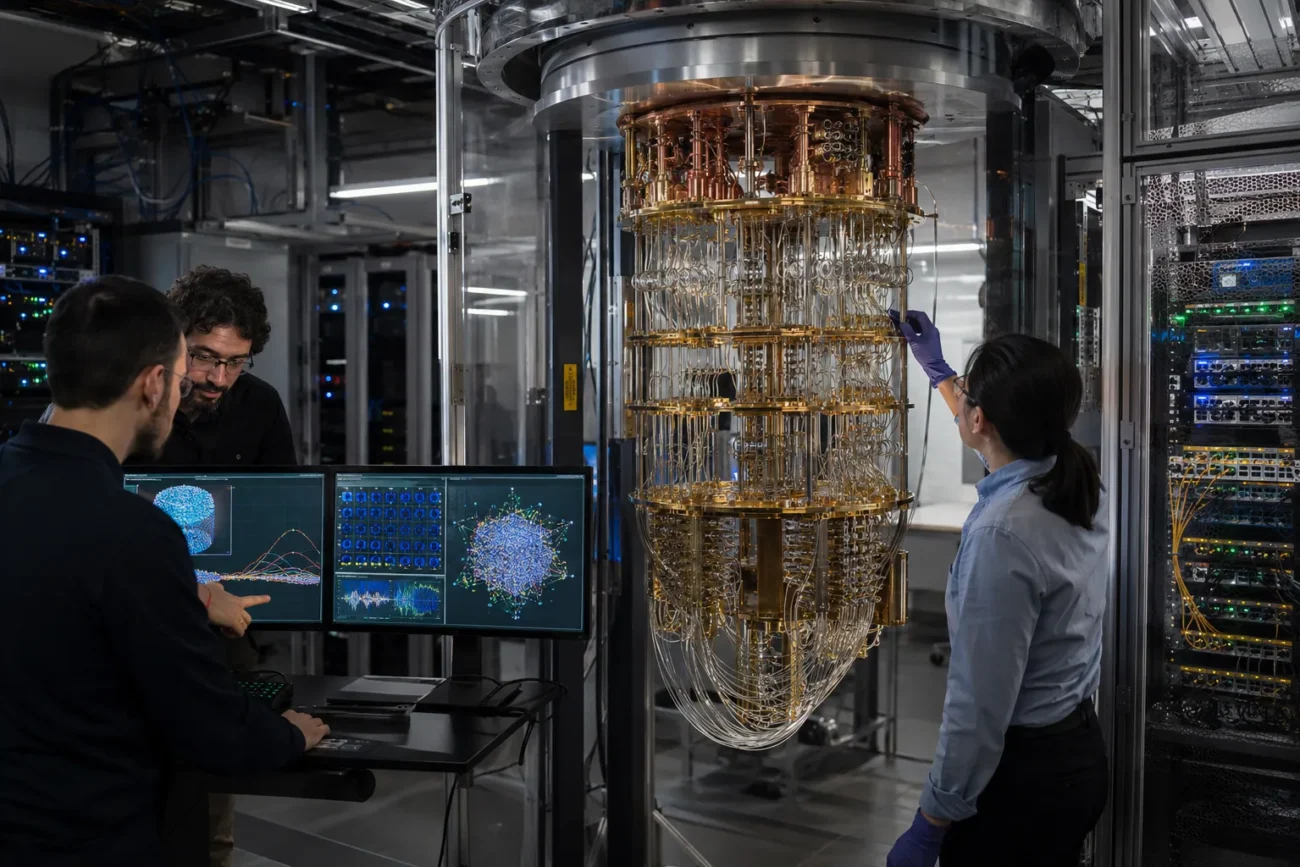
Latest breakthroughs in quantum computing 2024 marked a shift from impressive demonstrations toward measurable progress in quantum error correction, logical qubits, deeper circuits, AI-assisted decoding, and quantum-safe security. The year did not deliver a general-purpose machine that could replace classical computers. It did provide stronger evidence that logical qubits can become more reliable, errors can fall as codes grow, and software can help control noisy hardware. Governments and businesses also began preparing for future quantum cybersecurity risks.
Key Takeaways
The most important quantum computing breakthroughs of 2024 can be summarized in five developments:
- Google Willow demonstrated below-threshold surface-code error correction and performed a demanding random-circuit benchmark.
- Microsoft and Quantinuum created four logical qubits from 30 physical qubits, later expanding their work to 12 logical qubits.
- IBM Heron accurately executed selected circuits containing as many as 5,000 two-qubit gates.
- Google DeepMind’s AlphaQubit used a neural network to improve quantum-error decoding.
- NIST finalized three major post-quantum cryptography standards for protecting information from future quantum attacks.
Each milestone addressed a different problem. None, by itself, created a fully fault-tolerant or commercially universal quantum computer.
How to Recognize a Real Quantum Breakthrough
Quantum announcements often feature dramatic numbers, but a high qubit count or huge speed comparison does not automatically make a machine useful. Judge each claim by five questions: Was it peer-reviewed? Did reliability improve? Can it scale? Was it compared with the best classical method? Did it solve a meaningful problem or only a synthetic benchmark?
A laboratory milestone can be important without being a commercial product. A benchmark can also reveal unusual computational power without proving broad quantum advantage.
Quantum Computing in Simple Terms
A conventional computer stores information in bits, which represent either 0 or 1. A quantum computer uses qubits, which can be prepared in combinations of 0 and 1 through superposition. Qubits can also become entangled, creating correlations that classical bits cannot reproduce in the same way.
These effects let quantum algorithms treat certain problems differently, but qubits are fragile. Heat, vibration, defects, interference, and control mistakes can disturb them.
A physical qubit is a hardware element. A logical qubit encodes protected information across several physical qubits. Error correction measures error syndromes, and a decoder estimates what went wrong. The goal is fault-tolerant quantum computing, where long algorithms run while errors are continuously managed.
2024 Quantum Computing Breakthrough Timeline
| Date | Development | Why It Mattered |
| April 3, 2024 | Microsoft and Quantinuum reported four logical qubits from 30 physical qubits | Logical circuits showed a reported 800-fold error-rate improvement over comparable physical circuits |
| June 5, 2024 | Quantinuum expanded H2-1 to 56 trapped-ion qubits | Combined all-to-all connectivity with high-fidelity operations and a stronger random-circuit benchmark |
| August 13, 2024 | NIST finalized FIPS 203, FIPS 204, and FIPS 205 | Organizations gained approved standards for post-quantum encryption and digital signatures |
| September 10, 2024 | Microsoft and Quantinuum announced 12 logical qubits | The teams also demonstrated repeated error-correction rounds and a hybrid chemistry workflow |
| November 13, 2024 | IBM presented its 156-qubit Heron R2 processor | Heron and Qiskit accurately ran selected circuits containing up to 5,000 two-qubit gates |
| November 20, 2024 | Google DeepMind introduced AlphaQubit | The AI decoder improved the interpretation of quantum-error data |
| December 9, 2024 | Google announced Willow | The processor demonstrated below-threshold error correction and a major sampling benchmark |
Some results were announced in 2024 but peer-reviewed later. Google unveiled Willow in December 2024, while the full Nature paper appeared in 2025. Both dates should be stated clearly.
1. Google Willow and Below-Threshold Quantum Error Correction
Google’s Willow quantum chip became the most widely discussed quantum computing development of the year. Announced on December 9, 2024, Willow is a superconducting processor with 105 physical qubits. Its most important result was not merely its qubit count. Google demonstrated two surface-code memories operating below the error-correction threshold.
A threshold is central to scalability. Adding qubits creates more failure points; error correction works only when a larger code suppresses more errors than it introduces.
In the peer-reviewed Willow study, increasing the code distance from 5 to 7 suppressed the logical error rate by a factor of about 2.14. The distance-7 memory used 101 qubits and reached a reported logical error of approximately 0.143% per correction cycle. This provided experimental evidence that a larger encoded memory could become more reliable rather than less reliable.
Willow also completed a random circuit sampling benchmark in under five minutes. Google estimated that a leading classical supercomputer would need around 10 septillion years under its assumptions. However, this benchmark stresses hardware; it is not a drug-discovery calculation, financial model, or consumer application.
What Willow proved: error suppression can improve as a surface code grows on a superconducting processor.
What Willow did not prove: Google had not yet produced a general-purpose fault-tolerant machine, a long commercially useful algorithm, or a quantum computer that replaces classical systems.
2. Microsoft and Quantinuum Expanded Logical Computing
Another major logical qubit breakthrough came from Microsoft and Quantinuum. In April 2024, Microsoft applied its qubit-virtualization system to Quantinuum’s trapped-ion H2 hardware. The team encoded four logical qubits using 30 of the system’s 32 physical qubits.
Microsoft reported a logical circuit error rate of 10⁻⁵, or 0.00001, compared with 8 × 10⁻³, or 0.008, for corresponding entangled physical qubits. That produced the widely reported 800-fold improvement. This did not mean that every possible logical operation became 800 times better. It was a comparison within the team’s defined experiment, but it still showed that encoding could outperform the underlying physical circuit.
The collaboration progressed again in September. Microsoft and Quantinuum announced 12 logical qubits on the upgraded 56-qubit H2 system. The teams entangled all 12 logical qubits and carried out five rounds of repeated error correction on eight logical qubits. They also combined quantum hardware, artificial intelligence, and high-performance computing in an end-to-end chemistry workflow.
Fault tolerance requires computation to continue while errors are corrected. Yet 12 logical qubits remain far below industrial scale, and researchers must account for rejected runs, post-selection, and total resource costs.
3. IBM Heron Ran Deeper and More Accurate Circuits
IBM’s 2024 progress showed why qubit count alone is a weak performance measure. At the IBM Quantum Developer Conference on November 13, the company presented the second revision of its Heron processor. Heron R2 contained 156 superconducting qubits in IBM’s heavy-hex layout and used tunable couplers designed to reduce crosstalk.
The combined improvements in Heron hardware and Qiskit software allowed IBM to accurately execute selected mirrored kicked-Ising circuits containing up to 5,000 two-qubit gates. IBM said this was nearly twice the gate count of its 2023 quantum-utility demonstration. Supporting technical material reported best two-qubit gate error rates around 8 × 10⁻⁴.
Circuit depth matters because useful algorithms require many sequential operations. The 5,000-gate figure applied to selected circuits, not every arbitrary program. IBM’s achievement therefore reflected the integrated system: hardware quality, compilation, error mitigation, and execution speed.
4. AlphaQubit Brought AI Into Quantum Error Decoding
On November 20, 2024, Google DeepMind and Google Quantum AI introduced AlphaQubit, a neural-network decoder for surface-code error correction. A decoder receives a history of stabilizer or consistency-check measurements and estimates whether errors have changed the protected logical state.
AlphaQubit trained on simulated data and was refined with experimental data. In Nature, it outperformed the previous tensor-network decoder on Google’s experimental results and stayed accurate as simulated code distances increased.
AI did not physically repair qubits; it improved the software that interprets error-syndrome data. The limitation was real-time deployment. A fault-tolerant machine needs both accurate and extremely fast decoding, so AlphaQubit was not yet a complete large-scale control system.
5. Progress Beyond Google, Microsoft, and IBM
The latest quantum computing advances of 2024 came from several hardware approaches. No architecture had clearly won.
| Architecture | Representative Developers | Main Strength | Main Challenge |
| Superconducting qubits | Google, IBM | Fast gates and mature chip fabrication | Cryogenic cooling, crosstalk, and coherence |
| Trapped-ion qubits | Quantinuum, IonQ | High fidelity and flexible connectivity | Slower gates and complex optical control |
| Neutral atoms | QuEra, Pasqal | Large, reconfigurable arrays | Consistent high-fidelity control at scale |
| Photonic qubits | PsiQuantum, Xanadu | Natural networking and some room-temperature components | Photon loss and difficult interactions |
| Silicon-spin qubits | Diraq, Quantum Motion | Compatibility with semiconductor manufacturing | Uniform control and large-scale readout |
| Topological qubits | Microsoft | Potentially stronger built-in protection | Experimental evidence and engineering maturity |
Quantinuum’s June 2024 H2-1 upgrade was especially notable. The system offered 56 trapped-ion qubits with all-to-all connectivity. Quantinuum and JPMorgan Chase also reported a stronger cross-entropy benchmark in random circuit sampling than earlier industry results. Because this was still a sampling benchmark, its immediate commercial value remained limited, but it demonstrated the combined effect of scale, connectivity, and fidelity.
Quantum hardware cannot be ranked by one number. Connectivity, fidelity, coherence, error-correction overhead, control speed, and manufacturability all matter.
6. NIST Finalized Post-Quantum Security Standards
One of the most immediately useful quantum developments of 2024 did not involve a quantum processor. On August 13, the US National Institute of Standards and Technology finalized its first three principal post-quantum cryptography standards.
| Standard | Algorithm | Main Purpose |
| FIPS 203 | ML-KEM, derived from CRYSTALS-Kyber | Establishing shared encryption keys |
| FIPS 204 | ML-DSA, derived from CRYSTALS-Dilithium | General-purpose digital signatures |
| FIPS 205 | SLH-DSA, derived from SPHINCS+ | Hash-based digital signatures |
These classical algorithms are designed to resist attacks from both conventional and future quantum systems. NIST encouraged organizations to begin transitioning early.
Current systems cannot break widely deployed RSA or elliptic-curve cryptography at scale. The concern is that migration may take years. There is also a “harvest now, decrypt later” risk: attackers can store encrypted data today and target it when stronger quantum machines exist.
Which Real-World Applications Moved Closer in 2024?
Promising quantum computing applications include chemistry, materials, optimization, finance, energy, and selected AI workflows. Readers must distinguish a hardware demonstration, hybrid pilot, theoretical proposal, and commercial deployment.
In chemistry and materials science, quantum computers may eventually model electronic structures that become extremely expensive for classical machines. The Microsoft–Quantinuum chemistry case study combined logical qubits, AI, and HPC rather than relying on a quantum processor alone. That hybrid approach is likely to remain important because classical systems are efficient at data preparation, optimization, and interpretation.
In finance and logistics, researchers are testing portfolio, scheduling, routing, and risk problems, but many demonstrations remain small. Commercial value requires beating strong classical methods in total time, cost, and solution quality.
In AI, the clearest 2024 example was AlphaQubit improving the quantum stack. Machine learning can assist calibration, noise modelling, decoding, and experiment design.
For now, the strongest description is hybrid quantum-classical computing. Quantum processors act as specialized experimental accelerators inside workflows that still depend heavily on classical supercomputers, GPUs, and conventional software.
Quantum Advantage, Supremacy, and Utility Are Not the Same
The language surrounding quantum performance can confuse even experienced readers.
Quantum supremacy usually means that a quantum processor completed a specific task that would be impractical for available classical systems. The task does not have to be commercially useful.
Quantum advantage implies a meaningful benefit over the best practical classical approach. That benefit could involve speed, accuracy, cost, energy use, or solution quality.
Quantum utility is a broader term often used for scientifically useful calculations that may rely on quantum hardware, classical computing, and error mitigation together.
A practical advantage claim should identify the best classical baseline, include preprocessing and data loading, explain verification, disclose discarded runs, and count the complete workflow. Willow, Quantinuum, and IBM tested different hardware and tasks, so their results do not form a simple league table.
2024 Breakthroughs Compared
| Breakthrough | Core Metric | Evidence Status | Immediate Value | Main Limitation |
| Microsoft–Quantinuum logical qubits | 4 logical qubits, later 12; reported 800× circuit-error improvement | Official technical reports and research work | Demonstrated reliable encoded computation | Small logical scale |
| NIST post-quantum standards | 3 finalized FIPS standards | Government standards | Immediate migration framework | Not a quantum-hardware advance |
| IBM Heron R2 | 156 qubits and selected circuits up to 5,000 two-qubit gates | Official technical results | Deeper quantum experiments | Circuit-specific performance |
| AlphaQubit | State-of-the-art neural decoding on tested data | Peer-reviewed Nature research | Better interpretation of error syndromes | Real-time scaling remained unresolved |
| Google Willow | 105-qubit chip and below-threshold distance-7 memory | Announced in 2024; peer-reviewed paper published later | Strong evidence for scalable error suppression | Small logical memory and benchmark-focused speed claim |
The Challenges That 2024 Did Not Solve
The advances were meaningful, but the hardest engineering problems remained.
The first challenge is scale. Useful fault-tolerant algorithms may need many logical qubits and vast numbers of operations. The second is real-time control: syndrome measurement, decoding, feedback, and reset must outrun accumulating errors.
Hardware must also manage cryogenic cooling, laser or microwave control, defects, crosstalk, calibration drift, wiring, connectivity, and packaging. A small experiment can become much harder to operate as it grows.
The fourth challenge is resource estimation. Useful comparisons must include physical-to-logical overhead, circuit depth, logical gate fidelity, compilation, routing, and—in fault-tolerant algorithms—the cost of operations such as magic-state distillation.
Finally, quantum results can be difficult to verify. When a system performs a calculation beyond brute-force classical simulation, researchers need clever verification methods rather than simply repeating the entire computation classically.
What Happened After 2024?
Later processor announcements and research papers help explain why the 2024 milestones mattered, but they should be kept separate from a year-specific review. The developments after 2024 built on the same themes: better logical qubits, deeper circuits, faster decoding, modular hardware, and searches for verifiable real-world quantum advantage.
For SEO accuracy, an article about the latest breakthroughs in quantum computing 2024 should not silently add a 2025 product or result to its main list. It should state whether a development was announced, demonstrated, or formally published during the target year.
Frequently Asked Questions
What was the biggest quantum computing breakthrough of 2024?
Google Willow’s below-threshold quantum error correction was arguably the most important hardware result because it showed logical errors falling as the surface code increased in size. Microsoft–Quantinuum, IBM, AlphaQubit, and NIST achieved different but complementary milestones.
Did Google Willow solve a real-world problem?
No. Willow completed a demanding random circuit sampling benchmark, not a commercial calculation. Its most important result was the evidence that error correction could improve with scale.
Has quantum error correction been solved?
No. Researchers demonstrated important pieces of the solution, including more reliable logical qubits and below-threshold memories. Large-scale fault-tolerant computation still requires far more logical qubits, faster decoding, and reliable logical gates.
What is the difference between physical and logical qubits?
A physical qubit is a hardware element. A logical qubit stores protected quantum information across several physical qubits using an error-correcting code.
Can current quantum computers break RSA encryption?
No. Existing systems do not have enough reliable logical qubits or fault-tolerant operations to run cryptographically relevant versions of Shor’s algorithm. Organizations are migrating early because replacing cryptography can take many years.
Which quantum hardware approach is winning?
There was no clear winner in 2024. Superconducting, trapped-ion, neutral-atom, photonic, silicon-spin, and topological approaches each offered different trade-offs in fidelity, speed, connectivity, cooling, and scalability.
Conclusion
The latest breakthroughs in quantum computing 2024 made progress more measurable, but not yet universal. Google showed that surface-code error correction could improve as an encoded memory grew. Microsoft and Quantinuum demonstrated increasingly capable logical qubits. IBM ran deeper accurate circuits, AlphaQubit improved AI-based decoding, and NIST turned the future quantum-security threat into an immediate migration task.
The central lesson is simple: 2024 was not the year quantum computers replaced classical machines. It was the year researchers produced stronger evidence that reliable quantum computing may be built step by step.
Disclaimer:
This article is for general informational purposes only. Individual results, preferences, and circumstances may vary, so readers should consider their specific needs before making decisions.
