


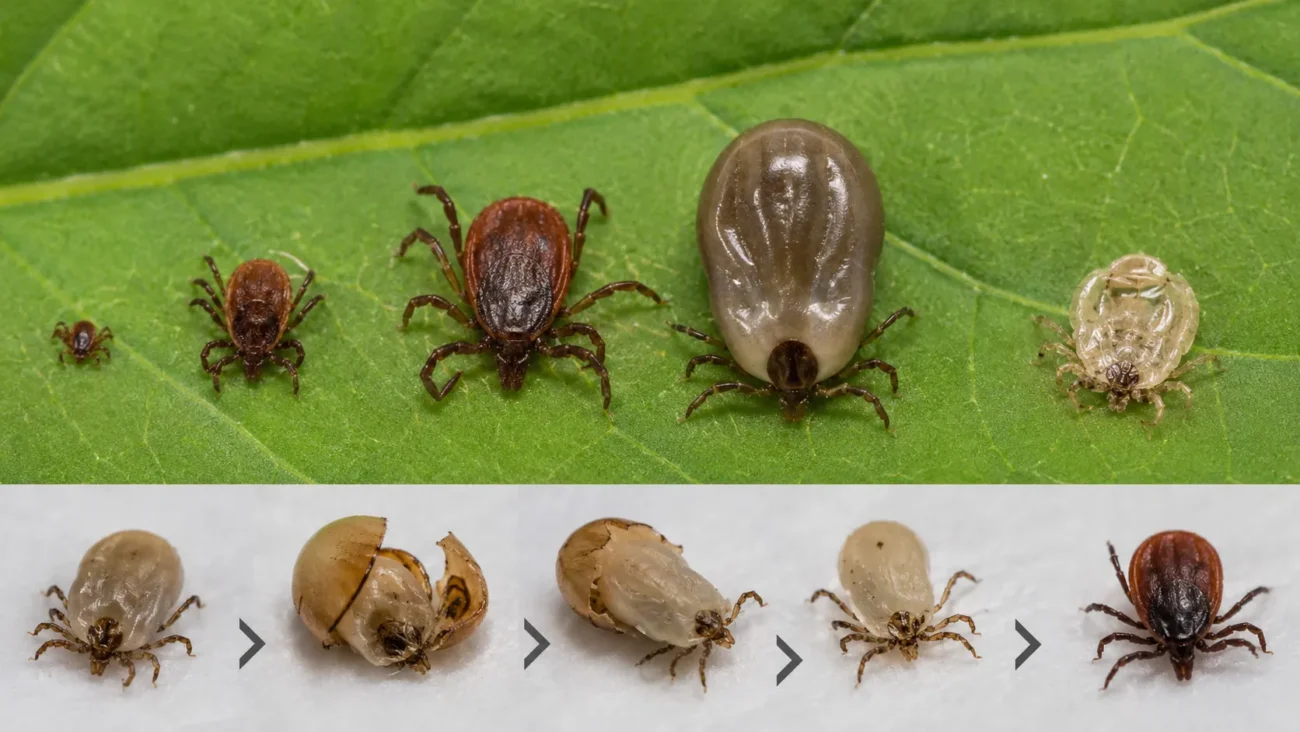
Can ticks regrow their outside shell after they are injured, crushed, removed, or swollen from feeding? The simple answer is no, ticks cannot regrow a damaged outside shell like healing skin, and they cannot grow a new body from a broken head or mouthpart. However, ticks do naturally shed and replace their exoskeleton during a process called molting as they move through their life cycle.
That difference matters. Many people see an engorged tick, a dried tick body, or a small dark piece left in the skin and wonder if the tick can “come back” or rebuild itself. In reality, ticks are arachnids with an exoskeleton, a hard outer covering made partly of chitin. They grow by moving through life stages, not by repairing a damaged shell on demand.
This guide explains what a tick’s “outside shell” really is, how tick molting works, why ticks swell after a blood meal, what happens when tick mouthparts break off, and when a tick bite may need medical attention.
Quick Answer: Can Ticks Regrow Their Outside Shell?
Ticks do not regrow their outside shell after injury. If a tick’s outer body covering is cracked, torn, dried out, or badly damaged, it cannot simply repair that shell like an animal healing a cut. Severe damage to the tick body, especially the abdomen or internal organs, usually kills the tick.
But ticks do replace their outer covering during normal growth. This happens through molting, also called ecdysis, where the tick sheds its old exoskeleton and forms a new outer layer. This is part of the tick life cycle, not a special repair ability.
Here is the easiest way to understand it:
| Question | Short Answer |
| Can ticks regrow a damaged shell? | No |
| Can ticks shed their shell? | Yes, during molting |
| Can ticks regrow their exoskeleton? | Only as part of normal life-stage development |
| Can a tick head grow a new body? | No |
| Can an engorged tick look like it grew a new shell? | Yes, but that is swelling from feeding |
Ticks have 4 tick life stages: egg, larva, nymph, and adult. After hatching, a tick usually needs a blood meal to move from one active stage to the next. During that process, it sheds the old outer layer and continues developing.
So, if you are asking, “do ticks regrow their shell?”, the best answer is: they do not repair a damaged shell, but they do naturally shed and replace their exoskeleton while growing.
What Is a Tick’s Outside Shell Actually Called?
What many people call a tick outside shell is scientifically known as an exoskeleton. Unlike humans and mammals, ticks do not have bones inside their bodies. Instead, their support and protection come from a tough outer covering.
Ticks belong to the group arachnids, which means they are more closely related to spiders and mites than insects. Their outer covering includes the cuticle, a protective layer that helps prevent drying out and supports the tick’s body shape. This cuticle contains chitin, a tough natural material also found in the outer coverings of many arthropods.
Hard ticks have another important body part called the scutum. The scutum is a hard, shield-like plate on the tick’s back. This is often what people notice when they say a tick has a “hard shell.” In male hard ticks, the scutum may cover much of the back. In female hard ticks, the scutum covers only part of the back, leaving a softer expandable area behind it.
That expandable area is important because it allows the tick to swell during feeding. A tick does not grow a new shell while feeding; instead, parts of its outer body stretch as it becomes full of blood.
Common tick shell terms include:
| Term | Meaning |
| Exoskeleton | The tick’s outer body covering |
| Cuticle | The outer layer involved in protection and flexibility |
| Scutum | The hard shield-like plate on hard ticks |
| Alloscutum | The softer expandable area behind the scutum |
| Sclerites | Hardened plates or areas of the exoskeleton |
Understanding these terms helps clear up the confusion. A tick’s “outside shell” is not a separate shell like a turtle shell. It is part of the tick’s body wall.
Molting vs Regrowing: The Key Difference
The biggest confusion around can ticks regrow their outside shell comes from mixing up molting and regrowing.
Molting means the tick sheds an old outer layer as part of natural development. Regrowing means replacing something that was lost, broken, or damaged. Ticks can molt at certain life stages, but they cannot decide to regrow a cracked shell whenever they are injured.
During tick molting, the old cuticle separates from the body, a new cuticle forms underneath, and the tick eventually sheds the old outer layer. The leftover shell-like casing may be called exuviae or exuvia. This can look like a dry, empty tick shell.
Molting is common in arthropods because an exoskeleton does not grow the same way soft skin does. A tick’s outer layer limits how much it can expand permanently. To move from a larva to a nymph or from a nymph to an adult, the tick must shed the old layer and continue development with a new one.
This does not mean ticks can rebuild themselves after being crushed. A crushed tick, torn tick, or dried out tick cannot repair its digestive system, nervous system, or damaged internal organs by molting. Molting is a controlled biological process, not emergency repair.
A simple way to say it is:
Ticks replace their exoskeleton during growth, but they do not regrow a damaged shell after injury.
That sentence should guide the whole article because it answers both the biology question and the common fear behind the search.
When Do Ticks Shed Their Exoskeleton?
Ticks shed their exoskeleton when they move through their life stages. Their life cycle is usually described as egg, larva, nymph, and adult. The egg stage does not feed, but after hatching, the active stages need blood meals to survive and develop.
A simplified tick life cycle looks like this:
| Tick Stage | What Happens |
| Egg | The tick begins life but does not feed yet |
| Larva | The tiny young tick feeds, then molts |
| Nymph | The nymph feeds, then molts into an adult |
| Adult | The adult feeds and reproduces |
The phrase “3 life stages after egg” refers to the larva, nymph, and adult stages. Hard ticks usually have 1 larval stage and 1 nymphal stage before becoming adults.
A blood meal before molting is important because feeding gives the tick the resources it needs to grow. After feeding, the tick drops off its host, digests the blood meal, and then molts when conditions are right. This is why a tick may seem to “change” after feeding, but it is not instantly regrowing a new shell.
Adult ticks generally do not keep molting again and again like younger stages. Once a tick reaches the adult stage, its main biological purpose is feeding and reproduction. So if an adult tick is badly damaged, it does not simply molt into a repaired version of itself.
Why Engorged Ticks Look Like They Regrew a Shell
One reason people ask “can ticks regrow their outside shell?” is because an engorged tick can look completely different from an unfed tick. A flat, small, dark tick may become round, gray, swollen, and much larger after feeding.
This dramatic change is called engorgement. It happens when a tick takes in a blood meal from a host. The tick’s body expands because the softer parts of the cuticle stretch. In female hard ticks, the hard scutum does not expand much, but the softer area behind it, sometimes called the alloscutum, can stretch greatly.
That expansion can make it seem like the tick has grown a new body or new shell. But what you are really seeing is blood meal expansion, not shell regrowth.
This is also why people search questions like:
- How do ticks get bigger after feeding?
- Why do ticks swell after drinking blood?
- Does a tick’s exoskeleton stretch?
- How can a tick expand if it has a hard shell?
The answer is that a tick’s body is not one solid, unchanging shell. It has hardened areas and flexible areas. The flexible cuticle allows swelling during feeding, while the hard scutum remains more rigid.
An unfed tick may look flat and tough. A fed tick may look smooth, round, and grayish. That change is normal tick engorgement, not evidence that the tick regrew an outside shell.
Can a Damaged Tick Shell Heal or Repair Itself?
A tick’s outside shell does not heal the way human skin heals. If a tick’s exoskeleton is scratched or slightly worn, the tick may continue living if the damage is minor. But if the body wall is cracked, crushed, punctured, or torn badly enough to damage internal organs, the tick usually dies.
A tick cannot survive without its outer covering because the exoskeleton protects the body and helps prevent moisture loss. It also provides structure for movement and feeding. A damaged tick may dry out, lose body fluids, or become unable to attach and feed.
This means a damaged tick shell cannot simply repair itself. A tick cannot rebuild a broken abdomen, grow a new digestive system, or recover from being smashed. The idea that a tick can “come back to life” after being crushed is a regrowth myth.
However, you should still dispose of ticks carefully. Do not crush an attached tick while it is on your skin because squeezing the body can increase contact with tick fluids. If you remove a tick, place it in a sealed bag or container, or follow local health guidance for disposal or identification.
The key point is simple: minor damage may not always kill a tick immediately, but ticks do not regrow a damaged outside shell as a repair response.
What Is Tick Exuviae? Can Ticks Leave an Empty Shell Behind?
Tick exuviae is the shed outer casing left behind after a tick molts. It may look like a tiny dry shell, husk, or empty tick body. This can confuse people who find something that looks like a dead tick but seems hollow.
An empty tick shell does not mean a tick was crushed and then regenerated. It usually means the tick went through normal old cuticle shedding and left behind the outer layer. The new tick body moved on after molting.
A molted shell may look:
- dry
- lightweight
- hollow
- pale or brownish
- less solid than a living tick
A dead tick, on the other hand, may still have a full body, legs, and internal material. It may look shriveled, dried, or flattened, depending on how it died.
If you find what looks like a tick shell in your house, it may be difficult to identify without magnification. It could be a molted arthropod casing, a dead tick, or even another small pest. Still, the presence of ticks or tick-like remains indoors is a good reason to check pets, bedding, carpets, clothing, and outdoor gear.
This is an important content gap because many articles talk about tick heads and tick bodies but do not explain exuviae. For the reader, the practical takeaway is: a shed tick shell is part of molting, not proof that ticks can regrow after damage.
Can Ticks Regrow Body Parts, Legs, or a Whole Body?
Ticks cannot regrow a whole body. A tick head cannot grow a new abdomen. A mouthpart fragment cannot become a living tick. A smashed tick cannot rebuild its organs and crawl away later.
That said, the topic of tick regeneration has some nuance. Some immature ticks may be able to regrow limited appendage structures, such as parts of legs, after molting. This kind of leg regeneration is not the same as whole-body regeneration, and it does not mean ticks can regrow their outside shell after injury.
For SEO and reader clarity, it helps to separate what ticks can and cannot do:
| Tick Regrowth Question | Reality |
| Can ticks regrow a whole body? | No |
| Can ticks regrow their shell after injury? | No |
| Can ticks replace their exoskeleton during molting? | Yes |
| Can some immature ticks regrow limited appendages? | Possibly, after molting |
| Can tick mouthparts grow a new tick? | No |
Some scientific discussions of tick appendages mention structures like the foreleg and Haller’s organ, a sensory structure ticks use to detect hosts. But this advanced biology should not be confused with the common myth that ticks can regenerate like a lizard regrowing part of its tail.
The safest summary is this: ticks may have limited developmental regrowth in specific immature stages, but they cannot regrow a whole body, head, or damaged shell.
What Happens If the Tick Head or Mouthparts Stay in Your Skin?
Many people worry about tick regrowth because they remove a tick and see a tiny dark piece left behind. They may think it is the tick’s head. In many cases, that piece is actually part of the tick’s mouthparts, not a living head.
Ticks use specialized mouthparts to attach to the skin. These include parts such as the capitulum, hypostome, and palps. The hypostome can have back-facing barbs that help anchor the tick while it feeds. Because of this, the mouthparts can sometimes break off during removal.
If a stuck mouthpart remains in the skin, it cannot regrow into a tick. It is not alive in the way a full tick body is alive. Your skin may react to it like a tiny splinter, causing redness, a small bump, or soreness around the bite site.
The best response is not to panic. Clean the area with soap and water or rubbing alcohol. Avoid digging aggressively into the skin with sharp tools, because that can cause more irritation or infection. If the area becomes increasingly painful, swollen, infected-looking, or if symptoms develop after the bite, contact a clinician.
The key myth-busting point is worth repeating: a tick head left in skin cannot grow a new body, and tick mouthparts cannot regenerate into a new tick.
How to Remove a Tick Safely
Proper removal lowers the chance of leaving mouthparts behind and helps reduce unnecessary irritation. The safest method is simple and does not require burning, twisting, petroleum jelly, nail polish, or other folk remedies.
Use fine-tipped tweezers or appropriate tick-removal forceps. Grasp the tick as close to the skin’s surface as possible. Pull upward with steady pressure and avoid jerking, twisting, or squeezing the tick’s body. After removal, clean the bite site and your hands.
A basic tick removal process:
- Use fine-tipped tweezers.
- Grip the tick close to the skin.
- Pull upward with steady, even pressure.
- Do not twist, burn, or coat the tick with Vaseline or alcohol while attached.
- Clean the bite area with soap and water or rubbing alcohol.
- Save the tick for identification if needed.
Do not crush an attached tick between your fingers. Crushing can expose you to tick fluids and makes identification harder. If you want to keep the tick, place it in a sealed bag or small container.
This section matters because many searchers are not just curious about tick biology. They are worried because they removed a tick from themselves, a child, or a pet. A clear removal section adds practical value and keeps the article helpful.
Can Ticks Molt Indoors, on Pets, or After Being Removed?
Ticks can be carried indoors on dogs, cats, clothing, shoes, backpacks, or outdoor gear. Some species may survive indoors for a time, especially if conditions are humid enough. Brown dog ticks, for example, are known for being more capable of living in indoor environments than many other ticks.
Can ticks molt indoors? It depends on the species, life stage, humidity, temperature, and whether the tick has already taken a blood meal. A tick that has fed and dropped off a host may look for a protected place to digest and develop. But a removed tick placed in a dry, sealed, or hostile environment is unlikely to complete a normal life cycle.
Can ticks molt on pets? Ticks usually attach to pets to feed. After feeding, many ticks drop off the host to molt or lay eggs in the environment. This is why pet owners may find ticks in bedding, carpets, crates, or resting areas.
This is also why tick prevention for pets matters. Regular tick checks, veterinarian-recommended preventives, and cleaning pet areas can reduce the chance of ticks being brought into the home.
If you find a tick after removal, do not leave it loose in the house. Save it securely for identification or dispose of it safely.
Hard Ticks vs Soft Ticks: Do Their Shells Work Differently?
Not all ticks look or feed the same way. The two major groups are hard ticks and soft ticks.
Hard ticks, also called members of the family Ixodidae, have a visible hard plate called the scutum. This shield-like structure is the reason many people describe them as having a hard shell. Common hard ticks include the blacklegged tick, American dog tick, brown dog tick, and lone star tick.
Soft ticks, from the family Argasidae, do not have the same hard dorsal shield. Their bodies tend to look more leathery or wrinkled. Soft ticks also often feed differently from hard ticks, sometimes taking shorter blood meals.
Both hard and soft ticks have an exoskeleton, but their outer coverings differ in structure and appearance. This matters because the phrase “tick shell” can mean different things depending on the tick type.
For the main question, though, the answer stays the same: neither hard ticks nor soft ticks regrow a damaged outside shell after injury. They rely on normal molting during development.
Signs a Tick Bite Needs Medical Attention
Most tick bites do not automatically mean disease, but it is important to watch for symptoms. Ticks can transmit tick-borne diseases, including Lyme disease, Rocky Mountain spotted fever, Powassan virus, and Alpha-Gal syndrome, depending on the tick species and region.
After a tick bite, monitor the bite site and your overall health. A small bump or mild redness can happen from skin irritation. But some symptoms deserve medical advice.
Contact a healthcare professional if you notice:
- a spreading rash or growing red area
- fever or chills
- severe headache
- fatigue or body aches
- joint pain
- neck stiffness
- signs of infection at the bite site
- symptoms after a tick bite in a Lyme-endemic area
Children, pregnant people, and immunocompromised people should be especially cautious and seek medical guidance when there is concern.
This section should not scare readers. Instead, it should help them understand that the main concern after tick removal is not shell regrowth. The real concerns are proper removal, bite cleaning, symptom monitoring, and tick-borne disease prevention.
How to Prevent Tick Bites and Future Tick Problems
The best way to avoid worrying about tick shell regrowth, mouthparts, or engorged ticks is to prevent bites in the first place. Tick prevention is especially important during warm weather, after rain, and in wooded, grassy, brushy, or leaf-covered areas.
After outdoor exposure, do a careful tick check. Look around the ankles, legs, waistline, armpits, hairline, behind the ears, and behind the knees. Check children and pets carefully too.
Helpful prevention steps include:
- Use tick repellents as directed.
- Consider DEET or picaridin products when appropriate.
- Use permethrin-treated clothing or gear where suitable.
- Wear long pants in grassy or wooded areas.
- Shower after outdoor activity.
- Wash or dry clothing after tick exposure.
- Keep grass short and reduce leaf litter around the home.
- Talk to a veterinarian about tick prevention for dogs and cats.
Ticks often use questing behavior, waiting on grass, shrubs, or leaf litter for a host to pass by. They do not usually drop from trees. Knowing where ticks wait makes prevention easier.
Common Myths About Tick Shells, Heads, and Regrowth
Ticks are surrounded by myths, partly because they are small, tough, and frightening to many people. Here are the most common myths connected to tick regrowth.
| Myth | Reality |
| Ticks can regrow their outside shell after injury | False. They molt during growth but do not repair a damaged shell. |
| A tick head can grow a new body | False. Mouthparts cannot become a new tick. |
| An engorged tick grew a new shell | False. It expanded after a blood meal. |
| A crushed tick can come back to life | False. Severe damage usually kills the tick. |
| Ticks lay eggs inside your skin | False. Ticks lay eggs in the environment, not inside people. |
| Ticks usually fall from trees | Usually false. They often quest from grass, shrubs, and vegetation. |
These myths matter because they can cause people to focus on the wrong risk. Instead of worrying that a tick will regrow, focus on safe tick removal, bite cleaning, symptom monitoring, and prevention.
FAQ About Ticks Regrowing Their Outside Shell
Can ticks regrow their outside shell after injury?
No. Ticks cannot regrow their outside shell after injury. They can replace their exoskeleton only during normal molting between life stages.
Do ticks shed their shell when they grow?
Yes. Ticks shed their old outer layer during molting. This is how they move from larva to nymph and from nymph to adult.
Can a tick’s outside shell repair itself?
No. A tick’s shell does not repair itself like skin. Severe damage to the body or exoskeleton usually kills the tick.
Can a tick head grow a new body?
No. What people call the tick’s head is often the mouthparts. A mouthpart fragment left in skin cannot grow a new body.
Can ticks regrow legs?
Some immature ticks may show limited leg regeneration after molting, but this does not mean they can regrow a whole body or repair a damaged shell.
Why do ticks look bigger after feeding?
Ticks look bigger after feeding because of engorgement. Their body expands after taking a blood meal, especially in the softer cuticle behind the hard scutum.
Can ticks molt in your house?
Some ticks may survive indoors under the right conditions, especially if carried in by pets. Whether they molt indoors depends on species, humidity, life stage, and whether they have fed.
What should I do if I find an empty tick shell?
It may be tick exuviae, a shed exoskeleton from molting, or it may be a dead tick. Check pets, bedding, clothing, and nearby areas. If unsure, save it in a sealed container for identification.
Can an engorged tick shrink back down?
An engorged tick may change appearance after feeding and digestion, but the swollen look comes from a blood meal. It is not evidence of shell regrowth.
Can ticks grow after being removed?
A tick that has fed may continue its life cycle if it survives and finds the right environment. But it cannot regrow a damaged body or shell after being removed.
Conclusion: The Real Answer About Tick Shell Regrowth
Ticks do not regrow a damaged outside shell, and they cannot grow a new body from a head, mouthpart, or broken piece. Their “shell” is an exoskeleton, and they replace it only during tick molting as part of normal development through the egg, larva, nymph, and adult life stages.
If a tick looks larger after feeding, that is engorgement, not shell regrowth. If mouthparts stay in your skin, they cannot regenerate into a new tick. Clean the bite site, watch for symptoms, and focus on practical prevention.
The best takeaway is simple: ticks can shed and replace their exoskeleton during growth, but they cannot repair or regrow their outside shell after injury.
