


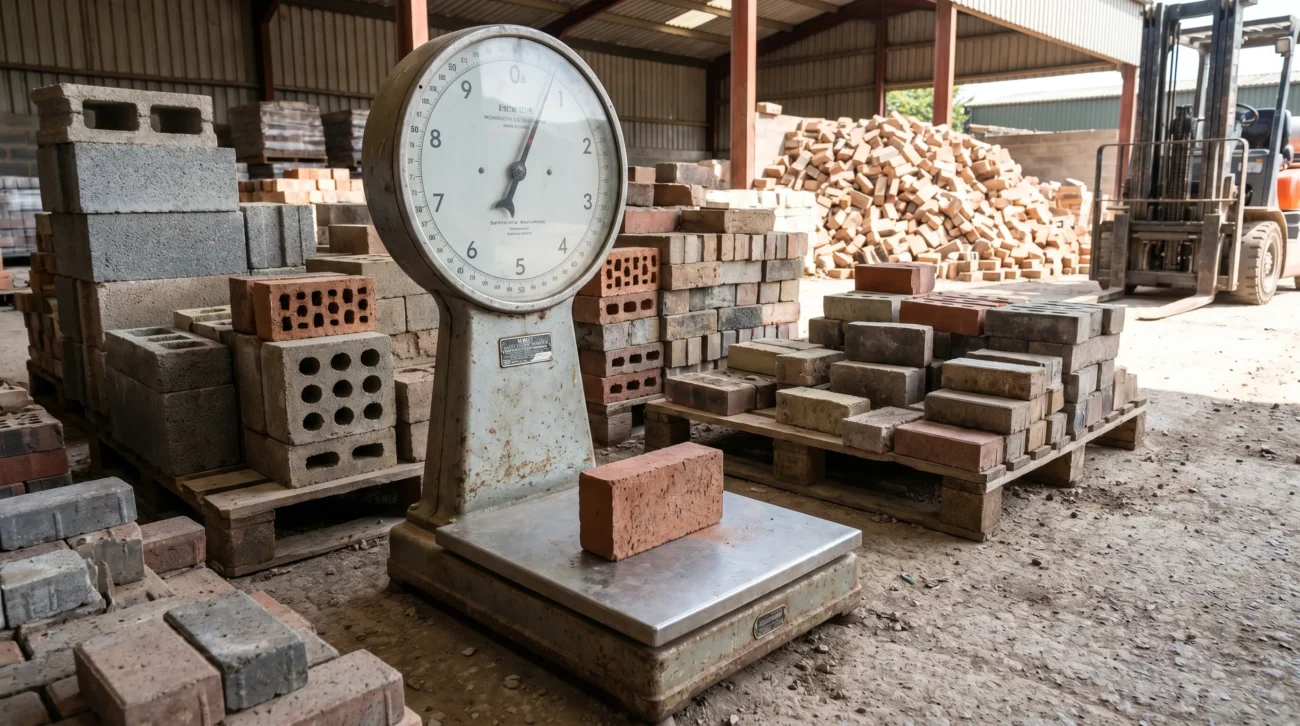
What is the weight of a brick? In most cases, a standard brick weighs about 4.5 to 6 pounds or roughly 2 to 3 kilograms, but the exact number depends on the brick type, brick dimensions, material, density, and even the country standard being used.
That simple answer helps, but it is not the whole story. A standard red brick does not weigh the same as a thin brick, an engineering brick, a Roman brick, or a concrete block. A brick used for residential construction, commercial construction, patios, fireplaces, or traditional brick exteriors may vary quite a bit in both size and weight. That is why you can find one source saying 4.5 lbs, another showing 5.9 lbs, and another discussing much heavier masonry units.
In this guide, you will get a clear, practical answer to how much does a brick weigh, plus a breakdown by type, size, region, and project use. You will also see how to estimate brick wall weight per square foot, how much a pallet of bricks may weigh, and why online answers often seem inconsistent.
Why brick weight varies
The biggest reason people get confused about brick weight is that there is no single brick used everywhere. The weight of a brick changes based on four major factors: brick type, brick dimensions, material composition, and whether the unit is solid, hollow, or perforated.
A standard clay brick is usually much lighter than a dense concrete block, while a thin brick weighs far less than a full-thickness brick because it is designed more like brick veneer or cladding than a full masonry unit. A face brick made for visible walls may have a different weight than a structural brick, and an engineering brick is often denser than a normal facing brick.
Size matters just as much. A modular brick, queen brick, king size brick, Norman brick, Roman brick, utility brick, or Monarch brick can all have different measurements, so even when they are made from similar clay, their mass changes. In simple terms, more volume usually means more weight. This is why builders sometimes use the idea behind weight of brick = volume × density when they need a rough estimate.
Material and moisture matter too. A dry brick can weigh less than a damp one, which is why wet brick weight vs dry brick weight is a useful detail for real-world estimating. The same applies to reclaimed brick weight, since older bricks may absorb more moisture or vary in density depending on age and manufacturing style.
So, when someone asks, what is the weight of a brick, the honest answer is: it depends on the brick you mean.
Average weight of a standard brick
If you want the most practical quick answer, the average brick weight for a common standard brick is usually around 4.5 pounds or about 2.04 kg. In many everyday situations, you will also see the broader range of 4.5 to 6 pounds or 2 to 3 kg used because it covers the most common variations.
A typical standard red brick or standard clay brick used in house walls often falls close to that range. Some smaller or lighter units may come in around 4.2 lbs or 1.9 kg, while slightly larger or denser bricks can be closer to 5.9 lbs or 2.68 kg. That is why standard brick weight in pounds and standard brick weight in kg are both better understood as ranges rather than one fixed number.
For many readers, the most helpful way to think about it is this:
| Brick type | Typical weight |
|---|---|
| Thin brick | 0.88 lbs / 400 grams |
| Standard red brick | 4.5 lbs / 2.04 kg |
| Modular brick | 4.2–5.1 lbs / 1.9–2.3 kg |
| Engineering brick | 5.9–6.9 lbs / 2.68–3.15 kg |
| King size brick | 6.5–7.5 lbs / 2.95–3.4 kg |
| Concrete block | 16–32 lbs / 7.26–14.5 kg |
This table shows why a direct question like how much does one brick weigh needs a more detailed follow-up. A single house brick and a concrete masonry unit are not remotely the same thing, even though people often group them together.
Brick weight chart by type and size
A brick weight chart makes the topic much easier to understand because it connects brick dimensions with actual piece weight and typical use.
| Brick / unit type | Typical size or style | Approx. weight per piece | Common use |
|---|---|---|---|
| Thin brick | veneer-style cut brick | 0.88 lbs / 400 grams | accent walls, facades, renovation |
| Standard red brick | common house brick | 4.5 lbs / 2.04 kg | walls, exteriors |
| Modular brick | common US format | 4.2–5.1 lbs | general masonry |
| Queen brick | taller face brick | 5.9 lbs / 2.68 kg | visible wall finishes |
| Roman brick | longer, lower profile | 4.7–5.6 lbs | decorative walls |
| Norman brick | longer shape | 5.2–5.9 lbs | residential exteriors |
| Utility brick | larger face size | 7.7–8.8 lbs | broader wall coverage |
| Engineering brick | denser clay unit | 5.9–6.9 lbs / 2.68–3.15 kg | load-bearing walls, foundations |
| King size brick | larger full brick | 6.5–7.5 lbs / 2.95–3.4 kg | larger wall units |
| Fire brick | heat-resistant unit | 7.7–10.2 lbs | fireplaces, kilns |
| Lightweight concrete block | larger unit | 16 lbs / 7.26 kg | wall systems |
| Dense concrete block | heavy masonry unit | 32 lbs / 14.5 kg | structural masonry |
This kind of brick weight table also explains why people searching brick weight by size type and dimensions are really asking for both a direct answer and a comparison guide.
For example, a Roman brick may look elegant on a feature wall because of its long profile, but it does not weigh the same as an engineering brick designed for performance. A thin brick is especially popular in DIY projects and renovation because it gives the appearance of full brick without creating the same load issues, transportation burden, or labor costs.
That is a major reason thin brick for facades, patios and flooring has become such a popular search topic. When homeowners want a brick look on existing surfaces, they often care just as much about handling weight as appearance.
How much do different brick materials weigh? Clay vs concrete vs thin brick
One of the most useful comparisons is clay brick vs concrete brick weight. Many readers search for brick weight, but what they actually mean is “How heavy is the masonry unit I’m looking at?”
A standard clay brick is usually in the 4.5 to 6 pound range, depending on size and density. A thin brick can be dramatically lighter, sometimes only 0.88 lbs or 400 grams, because it is not a full-depth structural unit. That makes it ideal for interior features, accent walls, and lightweight cladding applications.
A concrete block, on the other hand, is much heavier. Even a lightweight concrete block may weigh around 16 lbs, while a dense concrete block can hit 32 lbs or more. That is why people often feel confused when one article says a brick is about 4.5 lbs and another mentions 16 lbs or 32 lbs. In many cases, they are not talking about the same thing.
An aircrete block is another category that changes the conversation. It may be lighter than a dense concrete block but is still much larger than a standard face brick. That means its unit weight can still be much higher even if its density is lower.
This comparison matters for more than curiosity. If you are planning a fireplace, patio, feature wall, or exterior project, material choice affects shipping weight, installation, and structural load capacity. A brick that looks similar from a distance can behave very differently when you have to move 100, 200, or 400 of them.
Brick weight in the US, UK, India, and Australia
Another reason this topic gets messy is that UK brick weight, US brick weight, and weights used in other countries are not always based on the same dimensions.
In the UK, a common modern brick size is around 215mm × 102.5mm × 65mm. A brick in that category often falls around 2 to 3 kg, depending on the product. In the United States, common brick formats such as modular brick often use inch-based dimensions like 3-5/8 × 2-1/4 × 8, and weights often appear in pounds rather than kilograms.
In India, one often-cited brick dimension is around 190 mm × 90 mm × 90 mm, while Australia may use sizes such as 230mm × 110mm × 76mm. Because these shapes and thicknesses vary, the weight of a standard brick also changes. That means a student or DIYer searching red brick weight in kg may get a very different answer depending on which country’s standard the article assumes.
This is one of the best examples of brick weight by country affecting search intent. A user in one region might think a “standard brick” weighs 4.5 pounds, while another expects about 3 kg. Both can be right within their own local standards.
So, if precision matters, always look at the actual brick dimensions, not just the word standard.
How much does a pallet of bricks weigh?
A very practical search is how much does a pallet of bricks weigh, and it is one of the biggest missed opportunities in many competing articles.
The answer depends on three things: how many bricks on a pallet, the weight per brick, and the weight of the pallet and packaging itself. A common estimate is that a pallet may contain 400–500 bricks, and the total may reach around 1.2–1.5 tonnes, depending on the brick type.
Here is a simple way to estimate brick pack weight:
- If one brick weighs 4.5 lbs, then 100 bricks weigh about 450 pounds.
- 200 bricks weigh about 900 pounds.
- 400 bricks weigh about 1,800 pounds.
- 500 bricks weigh about 2,250 pounds.
That is before adding pallet and wrapping weight, plus any extra moisture. This is why brick delivery weight limits matter for larger projects. A pallet of dense engineering brick or heavier units may weigh even more than a pallet of lighter facing bricks.
For contractors, landscapers, and homeowners, this is where construction estimating for brick weight becomes important. It helps with shipping bricks by weight, equipment planning, and site access. If you are ordering a full pack, you should never rely only on the average single brick weight.
Brick wall weight per square foot and square meter
Some people do not need the weight of one brick. They need the brick wall weight per square foot or brick wall weight per square meter.
That is where area-based estimates help. A traditional full brick wall section may weigh around 35–40 lbs per square foot, 40–45 lbs per square foot, or even 45–50 lbs per square foot, depending on the brick and wall build-up. A thin brick surface may be far lighter, sometimes around 5–6 lbs per square foot.
This is especially useful in renovation work. Suppose you want a brick finish on an upstairs room or on an existing framed wall. A full brick wall may create major load issues, while a thin brick veneer may provide the same visual effect at a fraction of the weight.
Area calculations also matter when you are estimating quantity. Some brick references use values like 6.86 units/ft² or 73.12 units/m² for certain sizes, though the exact count depends on brick dimensions and mortar joints. Once you know the number of bricks per area and the average brick weight, you can estimate the load of an entire wall section.
This is the point where masonry material handling becomes real. Moving one brick is easy. Moving hundreds across a whole wall changes the project entirely.
How to estimate brick weight for a project
If you want a fast method for brick load calculation, use this three-step approach.
First, identify the brick type and brick dimensions. Do not assume all bricks are interchangeable. A modular brick, engineering brick, Roman brick, and concrete block will all produce very different totals.
Second, find the weight per piece or estimate it using the simple idea behind brick density calculator logic. If you know the unit’s size and approximate density, you can estimate weight. That is why formula-based guides often refer to volume × density.
Third, multiply the piece weight by the quantity needed. If your project uses 400 standard red bricks at 4.5 lbs each, your total brick weight is about 1,800 pounds. If you instead use a lighter veneer product at 0.88 lbs each, the total drops dramatically.
Here is a quick case-style example. Imagine a homeowner wants an accent wall using a brick look. They compare a full-depth brick at 4.5 lbs with a thin brick at 0.88 lbs. For 200 units, the full brick option weighs about 900 pounds, while the thin brick option weighs only 176 pounds. That one choice changes installation difficulty, transportation, labor costs, and structural requirements.
That is why the best article on this topic should not stop at how much does a brick weigh. It should also help readers answer, How much brick weight am I really bringing into my project?
FAQ: common questions about brick weight
How much does one standard brick weigh?
A standard brick usually weighs about 4.5 to 6 pounds, though some types fall a bit below or above that range.
What is the weight of a brick in kg?
A common answer is about 2 to 3 kg for many standard full bricks, with some lighter units below that and denser units above it.
How many pounds does a brick weigh?
For a common standard red brick, around 4.5 pounds is a practical estimate. Larger or denser bricks can weigh more.
Are concrete bricks heavier than clay bricks?
Often, yes. A dense concrete block can weigh 16 to 32 pounds or more, which is much heavier than a typical clay house brick.
How much does a pallet of bricks weigh?
A pallet can be around 1.2–1.5 tonnes, depending on the brick count, brick type, and packaging.
Why do brick weights vary so much?
Because size, material, density, country standard, and whether the unit is solid, hollow, or thin all affect the final weight.
Can one person lift a brick safely?
Usually, yes, for a normal single brick. But moving large quantities is a different matter. Repeated lifting creates fatigue, especially with heavier engineering bricks, utility bricks, or blocks.
What is the best way to find the exact weight of a brick?
Check the manufacturer’s product data sheet for the specific brick. That is the most accurate answer when project specifications matter.
Conclusion
So, what is the weight of a brick? The best everyday answer is that a typical standard brick weighs about 4.5 to 6 pounds or around 2 to 3 kilograms. But the real answer depends on the brick type, brick dimensions, density, material, and regional standard.
A thin brick may weigh only 0.88 lbs, while a dense concrete block can weigh 32 lbs or more. A standard red brick, modular brick, engineering brick, and Roman brick all sit in different ranges. That is why understanding average brick weight is only the first step.
When precision matters, always check the actual size and product specification. For general planning, though, this guide gives you a practical, easy-to-use answer for brick weight, brick wall weight, and pallet weight without the confusion that often comes from oversimplified online estimates.
Disclaimer:
This article is for general informational purposes only. Brick weight, size, density, pallet weight, and wall load may vary by brick type, material, region, moisture, and manufacturer specifications. Always check product data or consult a qualified builder before planning structural work.
