


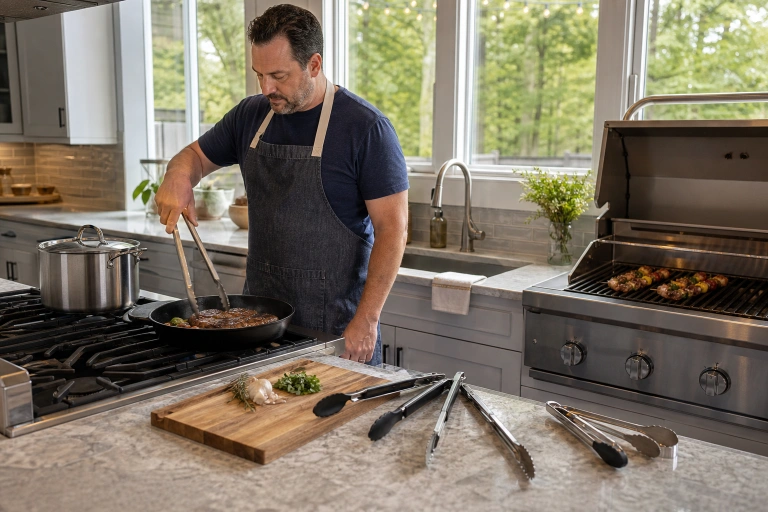
Key Takeaways
- Choose tongs according to the task, food texture, cookware surface, and heat level.
- Soft tips can help protect coated cookware, while firmer tips offer more control with heavy foods.
- Length affects both safety and precision around skillets, ovens, grills, and deep pots.
- Comfortable handles, balanced spring tension, and an easy lock make frequent use less tiring.
- Use separate clean tongs for raw foods and cooked or ready-to-eat foods.
- Replace tongs with worn tips, rust, loose handles, broken springs, or areas that cannot be cleaned.
Table Of Contents
- Why Tongs Matter in Everyday Cooking
- Choose Tongs by Cooking Task
- Compare Common Tip Materials
- Match Tong Length to the Heat Source
- Check Grip, Spring, and Locking Design
- Use Tongs With Better Food Safety Habits
- Clean and Store Tongs Correctly
- Know When Tongs Need Replacing
- Use a Simple Buying Checklist
- Final Thoughts
Kitchen tongs are one of the simplest tools in a cook’s drawer, but a well-chosen pair can make daily food preparation safer, cleaner, and more controlled. Whether you are turning vegetables, lifting chicken from a pan, tossing pasta, or serving salad, custom tongs can help you choose a design suited to the way your kitchen operates.
The best pair is not necessarily the longest, strongest, or most expensive option. It should feel secure in your hand, reach food without placing your fingers too close to heat, and grip ingredients without crushing them. A small amount of planning before buying can prevent scratched cookware, dropped food, sore hands, and messy cleanup later.
Why Tongs Matter in Everyday Cooking
Tongs work like an extension of the hand. They let you turn, lift, toss, arrange, and serve food while keeping a safer distance from hot oil, steam, and cookware. They also provide more reach than a fork and usually cause less damage to food than piercing it. That matters when handling items that need a gentle touch, including fish fillets, roasted tomatoes, soft rolls, and tender greens.
For example, a skillet of roasted vegetables benefits from a firm grip that lets you flip pieces evenly. A delicate fish portion needs wide, aligned tips that hold it securely without tearing the flesh. The right tool gives you control over both situations, rather than forcing you to improvise with utensils that are not designed for the job.
Choose Tongs by Cooking Task
One pair can cover many basic jobs, especially for a small home kitchen. Still, a small range of tongs is often more practical for people who cook frequently. Consider the tasks you perform most often before focusing on color, appearance, or price.
- Stovetop cooking: Medium-length tongs are useful for sautéing vegetables, turning cutlets, and moving food around a skillet.
- Grilling: Longer tongs add distance from flames and radiant heat while helping you move larger portions.
- Serving: Shorter or medium tongs work well for salad, pasta, roasted vegetables, pastries, and buffet dishes.
- Delicate plating: Narrow, precisely aligned tips are helpful for herbs, small garnishes, and fragile foods.
- Heavy portions: Firmer tongs with a strong spring and broad tips are better for thick steaks, corn, baked potatoes, or large pieces of poultry.
Compare Common Tip Materials
Tip material affects grip, cookware protection, heat tolerance, and cleaning. Product testing often considers these details along with handle comfort, length, storage locks, and how well tongs perform with both heavy and delicate foods. For a useful comparison of tested designs, review these kitchen tong comparisons before narrowing down your options.
Stainless Steel Tips
Stainless steel tips are firm, durable, and effective for gripping slippery or weighty foods. They are a strong fit for uncoated pans, sheet pans, serving platters, and grill work. However, metal edges can scratch nonstick or other coated cookware, so they should be used carefully around those surfaces.
Silicone Tips
Silicone-tipped tongs are a practical choice for nonstick pans and delicate foods because the tips provide a little cushioning. Look for a design with enough internal strength to hold food without flexing excessively. Check the manufacturer’s stated heat limit, particularly if the tongs will be used near a broiler, grill, or very hot pan.
Nylon and Wood Options
Nylon tips can offer a middle ground between surface protection and firmness, although heat limits vary by product. Wood designs may suit serving and lower-heat tasks, but they need thorough washing and drying. Wood can also be harder to sanitize if cracks develop or food residue remains in joints.
Match Tong Length to the Heat Source
Length is a balance between reach and control. Short tongs, often around 6 to 9 inches, are convenient for serving, plating, and close work. Medium tongs, commonly around 10 to 12 inches, are versatile for everyday skillet cooking. Longer tongs are useful for grills, deep stockpots, ovens, and high-heat cooking because they create more space between your hand and the heat source.
Before buying, hold the tongs closed and squeeze them several times. Your hand should stay relaxed, and you should be able to control the tips without overextending your wrist. If possible, test how the tongs feel when picking up both a small item and a bulky one.
Check Grip, Spring, and Locking Design
Small design details can have a major effect during repeated use. A sturdy-looking pair may still be frustrating if the spring is overly stiff, the handles pinch your fingers, or the tips fail to meet evenly. Textured handles may improve control when hands are damp or greasy, while a smooth one-hand lock makes storage easier.
- Open and close the tongs several times to assess spring tension.
- Check that the tips line up evenly when closed.
- Test the grip with both a smooth item and a larger, heavier item.
- Engage and release the lock with one hand.
- Inspect seams, grips, and hinges for gaps that may trap food or grease.
Use Tongs With Better Food Safety Habits
Tongs can support safer food handling only when they are kept clean and assigned to the right stage of cooking. Do not use the same unwashed tongs to place raw chicken on a grill and then remove the cooked chicken later. Keep a second clean pair nearby for cooked food, serving, or ready-to-eat ingredients. This simple habit reduces the chance of transferring raw-food residue to finished meals.
For grilling, also consider how heat, wear, and material condition affect food-contact tools. This guide to grilling tool safety considerations can help when evaluating durable materials and replacing tools that show damage. Wash your hands after handling raw meat, poultry, or seafood, and never place clean tongs on a plate or tray that previously held raw food.
Clean and Store Tongs Correctly
Rinse off visible residue soon after use, then wash tongs with hot, soapy water or in the dishwasher if the manufacturer approves it. Pay close attention to hinges, ridges, locking mechanisms, silicone seams, and textured grips. Dry the tool completely before storing it, since trapped moisture can lead to odors, corrosion, or deterioration of certain materials.
Store tongs in a clean drawer, on a utensil rail, or in another protected location where the tips will not collect dust or contact dirty surfaces. Locking tongs can save space, but make sure the locking mechanism is clean before closing them for storage.
Know When Tongs Need Replacing
Replace kitchen tongs when the tips no longer align, the spring feels weak or uneven, silicone or nylon begins to split, or rust appears on food-contact areas. Loose handles, cracks, sharp edges, and permanently trapped residue are also clear warning signs. A worn pair may slip, damage cookware, or become difficult to clean properly.
Use a Simple Buying Checklist
- What foods will the tongs handle most often?
- Will they touch coated cookware?
- How much reach do you need around heat?
- Are the tips firm enough for the foods you prepare?
- Can you use the handles comfortably for several minutes?
- Are the care instructions clear and realistic for your routine?
- Could food or moisture become trapped in the design?
- Can the tongs be stored cleanly without taking up unnecessary space?
Final Thoughts
The right kitchen tongs should fit the task, protect the cookware, feel comfortable in your hand, and support clean food-handling habits. You do not need the most complicated tool available. A dependable pair that grips well, cleans easily, and matches the way you cook can make everyday preparation safer and more efficient.
