


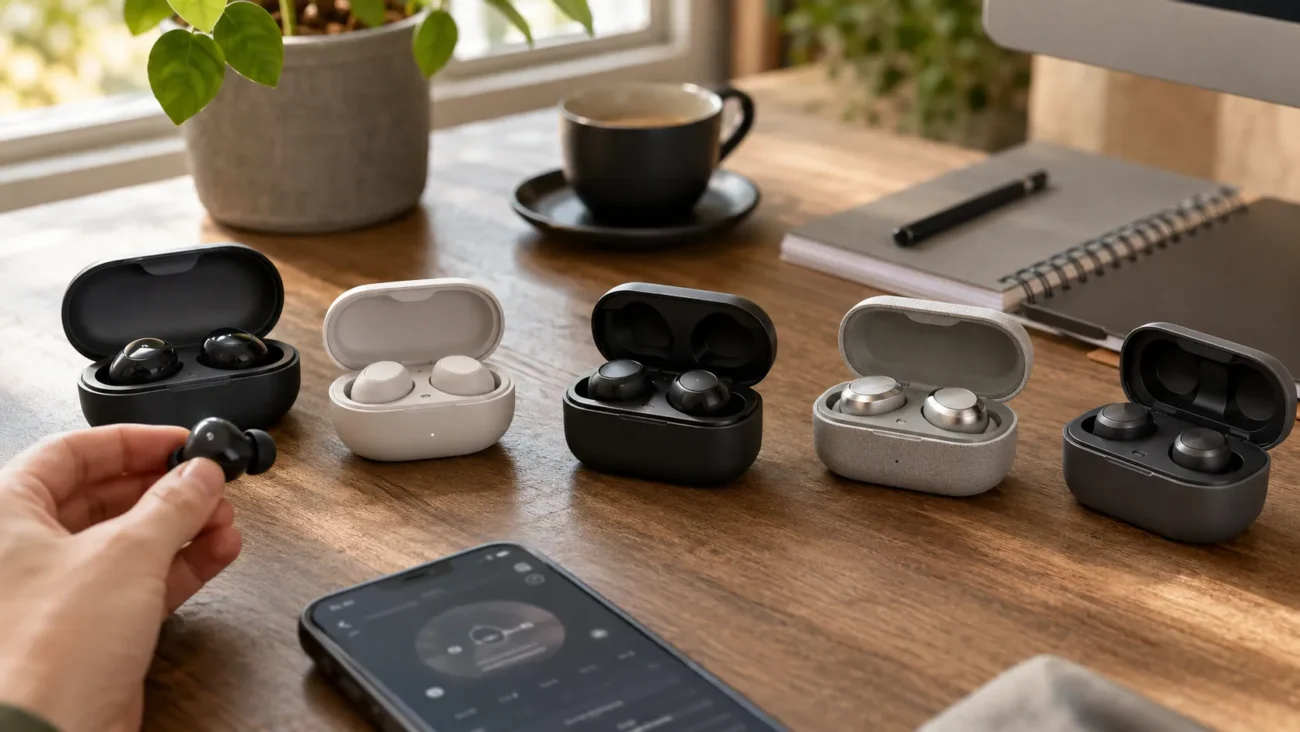
Two hundred dollars is the point where wireless earbuds stop asking you to compromise. Below that, you’re usually giving something up — noise cancellation, battery life, app support, or build quality. Above it, you’re often paying for a brand name or a feature you’ll use once. Right in that $200 band is where active noise cancellation, solid app control, all-day battery, and genuinely good sound all show up together.
This guide breaks down the best options by what you actually need them for — an all-rounder, an iPhone-first pick, a Samsung pick, the strongest noise cancellation, the best sound, the comfiest fit, and a workout-ready pair — plus a shorter list of budget options if $200 is more ceiling than target.
Quick answer: the best wireless earbuds under $200
| Pick | Best for | Price | ANC | Battery (buds + case) |
| Anker Soundcore Liberty 4 Pro | Overall | $129.99 | Yes (~30dB reduction) | ~7 hrs / 28 hrs |
| Apple AirPods 4 (ANC) | iPhone | $179.99 | Yes (~20dB) | ~5 hrs / 25 hrs |
| Samsung Galaxy Buds3 FE | Samsung/Android | ~$149.99 | Yes | ~6 hrs / 24+ hrs |
| Sony WF-C710N | Noise cancellation | $119.99 | Yes (~85% avg. reduction) | 9+ hrs / 30+ hrs |
| Creative Aurvana Ace 3 | Sound quality | $149.99 | Yes (~75% avg. reduction) | 6+ hrs / 26 hrs |
| Nothing Ear (3) | Comfort | $179.00 | Yes | 5+ hrs / 22 hrs |
| Beats Fit Pro | Workouts | $199.99 | Yes | 6 hrs / 24 hrs |
| JBL Live Beam 3 | Smart case/features | $200.00 | Yes | ~8 hrs / 32 hrs |
| Bose QuietComfort Earbuds | Bose fans | $179.00 | Yes | 8.5 hrs / ~30 hrs |
Prices shift constantly with sales — treat these as MSRP reference points and check the current listing before buying.
How this list was put together
Rather than rephrasing spec sheets, every pick below is checked against its official MSRP and cross-referenced with independent lab testing (frequency response, ANC attenuation in decibels, and measured battery life) from outlets that publish their testing methodology. Where a claim is a manufacturer number rather than an independently measured one, it’s noted as such. Nothing here is included just because a brand name is recognizable — a few well-known models were left off because a genuinely better option exists nearby in price.
Best overall: Anker Soundcore Liberty 4 Pro
$129.99 — the rare pair that doesn’t force a tradeoff to hit this price.
The Liberty 4 Pro’s charging case has a small touch display for switching ANC modes without pulling out your phone — more novelty than necessity, but it’s backed by real substance underneath. Independent testing measures the ANC cutting low-frequency noise by around 30dB, which is unusually strong for the price, and transparency mode is clear enough to hold a conversation without pulling the buds out. The companion app is the standout: full EQ customization, adjustable ANC strength, and per-ear controls that most $150+ competitors don’t match.
- Fast charging: 5 minutes in the case ≈ 4 hours of playback
- Strong, adjustable ANC and transparency mode
- Deep app with granular EQ control
- Touch-display case is a nice-to-have, not essential
Best for iPhone: Apple AirPods 4 with Active Noise Cancellation
$179.99 — the first entry-level AirPods to get real ANC.
The AirPods 4 keep the open, unsealed fit of standard AirPods but add ANC that independent testing puts at roughly 20dB of noise reduction — noticeably less than sealed in-ear designs, but a real jump from having none at all. What makes them worth it for iPhone owners is the software: Adaptive Audio blends ANC and transparency automatically based on your surroundings, and Conversation Awareness lowers your music the moment you start talking. The H2 chip also unlocks Spatial Audio with head tracking on supported content.
- Open-fit design — comfortable for long wear, less isolating than sealed tips
- Adaptive Audio and Conversation Awareness are genuinely useful, not gimmicks
- Best experience is iOS-exclusive; Android users lose most of the smart features
- Sub-bass is lighter than sealed earbuds due to the open design
Best for Samsung and Android: Samsung Galaxy Buds3 FE
Around $149.99 at launch, frequently discounted below $120 — the sensible Samsung pick.
The Buds3 FE replaced the original Galaxy Buds FE with a redesigned “blade” shape, stronger ANC, and better background noise reduction on calls than its predecessor. It pairs instantly with Galaxy phones, hands off between Samsung devices automatically, and gives Galaxy AI/Gemini access for on-device voice features. It’s not chasing audiophile sound — it’s built to be an easy, reliable daily driver for anyone already in the Samsung ecosystem.
- Fast, automatic switching across Galaxy phones, tablets, and watches
- Improved ANC and call clarity over the original Buds FE
- Loses ecosystem perks (and some features) outside Samsung/Android
- Regularly discounted well under its launch price
Best noise cancellation under $200: Sony WF-C710N
$119.99 — the loudest silence you’ll get for the money.
This is the pick if blocking sound matters more than anything else. Sony pairs snug silicone tips (rated to block up to 40dB of high-frequency noise passively) with active cancellation that cuts another 30dB of low-frequency rumble — together, independent testing puts the average noise reduction around 85%, which is genuinely rare below $150. The Sound Connect app adds Adaptive Sound Control that shifts ANC and ambient settings based on your activity, and battery life is excellent at over 9 hours per charge, 30+ with the case.
- Best-in-class isolation for the price — strong on planes, trains, and open offices
- Over 30 hours total battery with the case
- No aptX or LDAC — a downside for Android listeners chasing hi-res audio
- IPX4 splash resistance, Bluetooth 5.3
Best sound quality under $200: Creative Aurvana Ace 3
$149.99 — built for people who actually care about audio.
The Ace 3 uses a hybrid driver setup — an xMEMS solid-state driver for mids and treble paired with a 10mm dynamic driver for bass — and it shows. It posted one of the highest scores independent labs have recorded on the MDAQS sound-quality scale, and Mimi Sound Personalization runs a short hearing test to tune output to your own ears rather than a generic curve. Android users also get both LDAC and aptX Lossless for genuine hi-res playback.
- Hybrid xMEMS + dynamic driver delivers detail most earbuds this price can’t match
- Personalized sound profile via a quick in-app hearing test
- ANC is only decent (~75% average reduction) — not the category leader
- Battery is shorter than most on this list: around 6 hours per charge
Most comfortable: Nothing Ear (3)
$179.00 — disappears in your ears in a way few earbuds manage.
Nothing lowered the stem angle from the previous generation, which keeps the buds stable without wings or fins, and the included XS through L tip sizes make finding a proper seal easy. The Nothing X app is one of the better companion apps around, offering both a simple 3-band EQ for quick adjustments and a full parametric EQ for anyone who wants to dial things in precisely. Battery is a little shorter than the rest of this list at just over 5 hours per charge, but the case adds up to 22 hours total.
- Genuinely secure, fatigue-free fit without silicone wings
- One of the better companion apps for EQ control, plus LDAC and a low-latency gaming mode
- “Super Mic” call feature (mics built into the case) sounds interesting on paper but is awkward in practice — you’re holding the case up like a walkie-talkie
- Default tuning is bass-heavy; the parametric EQ fixes this if you take the time to use it
Best for workouts: Beats Fit Pro
$199.99 MSRP, frequently on sale closer to $160 — built to stay put.
Flexible wing tips are the whole story here. Where stem-style earbuds can work loose mid-run, the Fit Pro’s wingtip design — paired with an in-app ear tip fit test — keeps them locked in through lifting, running, or anything sweatier. The H1 chip makes pairing and switching effortless on iPhone, but Beats also ships a full-featured Android app, so this isn’t an iOS-only recommendation. ANC is solid without being class-leading, and the IPX4 rating and USB-C case cover the basics.
- Secure wingtip fit is the best in this price range for high-movement activity
- Works well on both iOS (H1 chip perks) and Android (full app support)
- 6 hours per charge with ANC on, 24 hours total with the case
- Bass-forward tuning can blur vocal clarity on some tracks
Best smart features: JBL Live Beam 3
$200.00 — right at the ceiling, and it knows it.
The Live Beam 3’s party trick is a charging case with its own small touch display, letting you switch ANC modes, adjust playback, and check battery without touching your phone. It’s a genuine convenience if you fiddle with settings often, though it’s easy to live without if you don’t. Sound leans toward bass and treble by default, but a “Studio” EQ preset tames that into something more balanced, and ANC testing shows it handles low-frequency, steady noise — engines, HVAC hum, transit — well.
- Smart case display is a real, if niche, convenience
- Multiple EQ presets, including a more neutral “Studio” mode
- At full MSRP, it’s the most expensive pick here — worth waiting for a sale
- Strong battery life: roughly 8 hours per charge, 32 hours with the case
Best Bose pick: Bose QuietComfort Earbuds
$179.00 — the Bose name, without the Ultra price tag.
This is the standard QuietComfort Earbuds, not the pricier Ultra model, and it’s the one that actually fits under $200. Battery life lands at up to 8.5 hours per charge, the case adds roughly two and a half more full charges, and a 20-minute quick charge buys about two hours of playback. The Bose QCE app handles EQ, ANC/transparency shortcuts, and device management, and the case includes nine combinations of eartip and stability-band sizes — more fit options than most competitors offer out of the box.
- Reliable, well-regarded ANC without stepping up to the $299 Ultra model
- Nine eartip/stability-band combinations for dialing in fit
- IPX4 water resistance, Bluetooth 5.3 with multipoint
- Sound is tuned for broad appeal rather than audiophile detail
If $200 is the ceiling, not the target: budget alternatives under $100
Not everyone needs to spend close to $200 to be happy. These four consistently punch above their price:
- Anker Soundcore Liberty 4 NC — $99.99. Strong ANC for well under $100; the best noise-cancelling value on this entire list.
- Nothing Ear (a) — $95. The more affordable Nothing sibling. Sound isn’t as refined as the Ear (3), but the feature set is excellent for the price.
- Google Pixel Buds A-Series — $94. The natural pick for Pixel and Android-first users, with a flat default tuning that works especially well for podcasts and audiobooks.
- CMF Buds Pro 2 — $59. Surprisingly capable ANC and sound quality for a price that undercuts nearly everything else here.
What actually matters when you’re choosing
Fit comes before everything else. A poor seal thins out bass, weakens ANC, and can make even a $200 pair sound worse than a well-fitted $50 one. Try every included tip size before writing an earbud off.
ANC numbers need context. Independent lab testing measures noise reduction in decibels or as an average percentage across frequencies, and it’s genuinely useful — but no earbud under $200 creates silence. ANC is strongest against steady, low-frequency sound (engine drone, HVAC hum, plane cabin noise) and much weaker against sudden noises, wind, or nearby voices.
Battery claims are usually best-case. Manufacturers often quote battery life with ANC off at moderate volume. Real-world numbers with ANC on, higher volume, or a hi-res codec running will usually land lower — check whether a quoted figure is “ANC on” or “ANC off” before comparing two pairs.
Codecs matter less than the marketing suggests. LDAC and aptX enable higher-bitrate audio on compatible Android phones, but they don’t fix bad tuning or a poor seal, and they’re irrelevant to iPhone users entirely. Comfort and EQ flexibility usually matter more day to day.
Your phone narrows the field. iPhone owners lose the most functionality pairing with Android-optimized earbuds (and vice versa). Samsung and OnePlus buyers get extra ecosystem perks from their own brand’s earbuds. Nothing, Sony, Anker, and Creative are the most evenly capable across both platforms.
Common mistakes to avoid
Chasing a discount without checking the release date. An older flagship on sale can still be a great deal, but check whether a newer, cheaper model has since matched or beaten its noise cancellation and battery life — the market moves fast enough that a two-year-old flagship isn’t automatically better than a current mid-ranger.
Assuming ANC means silence. It doesn’t, and expecting total quiet leads to disappointment with otherwise excellent earbuds. Set expectations at “meaningfully quieter,” not “silent.”
Overweighting codec support. If you’re not an Android user with a good ear for the difference, LDAC or aptX Lossless support shouldn’t be a deciding factor over fit, comfort, and app quality.
Frequently asked questions
What are the best wireless earbuds under 200 dollars right now? The Anker Soundcore Liberty 4 Pro is the strongest all-around pick at $129.99, combining strong ANC, a deep companion app, and fast charging. For a specific need — iPhone integration, maximum noise cancellation, or sound quality — the category-specific picks above are worth the small step up.
Are wireless earbuds under $200 good enough for real noise cancellation? Yes, several are. The Sony WF-C710N and Anker Soundcore Liberty 4 Pro both post strong, independently measured ANC results. None will match a $349 flagship in absolute isolation, but the gap has narrowed considerably.
Which earbuds under $200 work best with an iPhone? The Apple AirPods 4 with ANC, for the tightest software integration (Adaptive Audio, Conversation Awareness, Spatial Audio). The Beats Fit Pro is the better choice specifically for workouts, thanks to its secure wingtip fit.
Which earbuds under $200 are best for Samsung or Android phones? The Samsung Galaxy Buds3 FE is the easiest choice for Galaxy owners specifically. For Android generally, the Creative Aurvana Ace 3 and Nothing Ear (3) offer LDAC support and don’t depend on any one phone brand.
Should I buy a discounted flagship instead of a new mid-range pair? Sometimes. Flagship earbuds like Sony’s WF-1000X series or Jabra’s Elite 8 Active normally sit above $200 but occasionally drop into range during major sales (Black Friday, Prime Day) or as open-box units. That can be a genuine upgrade — just weigh it against a shorter remaining support window and, for open-box units, a shorter warranty.
How long do wireless earbuds under $200 typically last before needing to be replaced? Battery capacity is the usual limiting factor, not the electronics — expect noticeably reduced battery life after roughly 2–3 years of regular use. Keeping firmware updated, avoiding full battery drains, and storing them in the case when not in use all help extend that window.
Do I need LDAC or aptX support? Only if you’re on Android, use lossless or high-bitrate streaming, and can genuinely hear the difference. For calls, podcasts, and most everyday listening, it’s a nice-to-have rather than a requirement.
Bottom line
There’s no single best pair under $200 — there’s a best pair for how you actually use earbuds. The Anker Soundcore Liberty 4 Pro is the safest starting point for most people, the Sony WF-C710N wins if quiet matters most, the Apple AirPods 4 and Samsung Galaxy Buds3 FE make the most sense if you want your phone’s ecosystem to do the work, and the Beats Fit Pro is the one to grab if the others keep falling out mid-workout. Whichever direction you go, get the fit right first — it affects sound quality and noise cancellation more than any spec on the box.
