


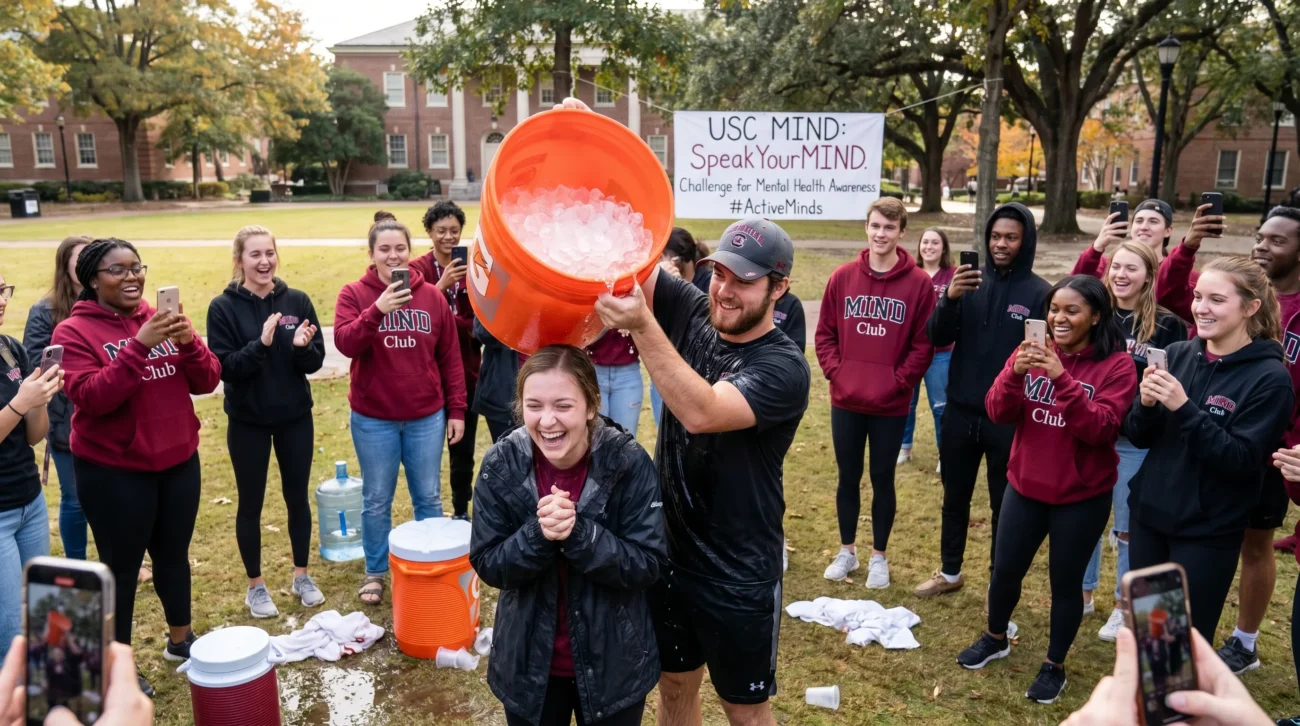
It is a student-led mental health awareness campaign connected to the University of South Carolina’s MIND club, built around the #SpeakYourMIND challenge and designed to raise both awareness and donations for Active Minds, a nonprofit focused on youth and young adult mental health. While the format looks familiar because it echoes the 2014 ALS Ice Bucket Challenge, the newer USC version is centered on mental health advocacy, open conversations, and suicide prevention awareness rather than ALS fundraising alone.
In other words, this is not just another random viral social media challenge. It is a campus-born movement that used the power of TikTok, Instagram, peer nominations, and recognizable internet culture to spread a message that many students and young adults care deeply about: mental health should be talked about openly, not hidden behind stigma. That message is a big reason the challenge took off so quickly in 2025.
What the USC Ice Bucket Challenge Actually Means
At its core, the USC Ice Bucket Challenge is a reimagined awareness campaign. Participants dump ice water on themselves, post the video online, tag other people to do the same, and connect the challenge to #SpeakYourMIND. The point is not just to copy an old trend for views and likes. The real aim is to push people to talk openly about mental health, share resources, and support organizations doing real work in the space, especially Active Minds.
The challenge is closely tied to USC’s MIND club, short for Mental Illness Needs Discussion. That name matters because it captures the campaign’s whole purpose. The message is simple but powerful: people, especially college students and young adults, should feel more comfortable speaking honestly about emotional distress, stress, anxiety, depression, and the need for support.
That is why searchers looking for terms like “what is the usc ice bucket challenge 2025”, “usc speak your mind challenge explained”, or “is the new ice bucket challenge for ALS or mental health” are really looking for more than a definition. They want the story, the cause, and the difference between this version and the one they remember from years ago.
Who Started the USC Ice Bucket Challenge?
One of the most important parts of this story is that the challenge did not come from a giant media company or a corporate brand. It came from students. Official University of South Carolina coverage credits the effort to the university’s MIND club, and that coverage identifies Wade Jefferson as the student leader behind the movement. That makes the challenge feel very different from a generic internet trend. It has a real human origin and a real campus-based mission.
This founder-led angle is one reason the campaign resonated. A lot of social media trends go viral because they are funny, nostalgic, or easy to imitate. The USC student-led mental health challenge spread because it combined all of those things with something deeper: a cause that already mattered to many young people. It gave students a way to join a public conversation about mental health awareness on college campuses without needing a huge platform or polished campaign materials.
That origin story also strengthens the legitimacy of the campaign. When people ask “who started the USC ice bucket challenge” or “is the USC Ice Bucket Challenge legitimate?”, the answer is clearer when you know it began with a recognized student organization and quickly connected to Active Minds, an established nonprofit.
Why USC Launched It: The Mental Health Mission Behind #SpeakYourMIND
The strongest reason for the challenge’s popularity is its mission. The #SpeakYourMIND challenge was built to encourage more direct, visible, public conversations about mental health struggles. Rather than asking people to silently care, it asks them to act in a way that others can see, then link that action back to a larger cause.
According to Active Minds, the campaign supports a broader effort to change how young people talk about emotional well-being. The language around the campaign focuses on breaking stigma, transforming mental health norms, and helping people recognize that asking for help is not weakness. For a generation that lives heavily online, that public element matters. A shared challenge can normalize a conversation that many people still find hard to start face-to-face.
This is where the campaign’s awareness vs action balance becomes important. Awareness alone is not enough. The best version of the campaign encourages people to post, tag others, include a donation link, and explain why the cause matters. That turns a familiar challenge format into a more meaningful mental health fundraising campaign.
It also explains why the campaign appealed so strongly to youth and young adults. College students often understand the pressures behind burnout, isolation, and mental health stigma firsthand. A student-born campaign that feels both social and mission-driven has a natural advantage in that environment.
Key takeaway: The USC challenge is not only about dumping water on your head. It is about making mental health advocacy visible, shareable, and harder to ignore.
How the 2025 USC Ice Bucket Challenge Works
For anyone searching “how the 2025 USC Ice Bucket Challenge works” or “rules of the USC Ice Bucket Challenge,” the process is straightforward. A participant records a video of themselves being drenched in ice water, posts it online, uses the #SpeakYourMIND tag, and nominates other people to continue the chain. Campaign instructions also encouraged people to tag @uscmind and @active_minds and include a donation link so viewers could support the cause directly.
A practical version of the challenge usually looks like this:
| Step | What happens | Why it matters |
| 1. Record the challenge | Dump ice water on yourself on camera | Makes the action instantly recognizable |
| 2. Post it publicly | Share on TikTok or Instagram | Expands the campaign through social reach |
| 3. Use the hashtag | Add #SpeakYourMIND | Connects posts to the broader movement |
| 4. Nominate others | Tag three others or a small group | Keeps the challenge moving through social circles |
| 5. Add the donation link | Link viewers to Active Minds | Turns awareness into support and fundraising |
This mechanic is a big part of why the challenge spread so quickly. It is easy to copy, easy to post, and emotionally tied to a cause people can explain in one line. That mix is ideal for social media. But it is also where some of the criticism comes in. If participants skip the explanation and the donation link, the challenge can start to look like pure performance instead of awareness campaign activism.
Is It the Same as the Original ALS Ice Bucket Challenge?
This is one of the biggest user questions online, and the answer is no, not exactly.
The original ALS Ice Bucket Challenge became a global phenomenon in 2014 and raised enormous awareness and funding for ALS research. It was tied to amyotrophic lateral sclerosis, often shortened to ALS, and became one of the most recognizable charity challenge campaigns of the social media era.
The newer USC Ice Bucket Challenge borrows the format, but it changes the cause and the message. Instead of centering ALS, the USC version centers mental health awareness, youth mental health, and support for Active Minds. The campaign still uses cold water, nominations, and viral sharing, but the mission is different.
Here is the clearest comparison:
| Element | 2014 ALS challenge | 2025 USC / #SpeakYourMIND challenge |
| Primary cause | ALS research and awareness | Mental health awareness and support |
| Associated organizations | ALS Association and ALS-related efforts | USC MIND club and Active Minds |
| Main message | Awareness and fundraising for ALS | Speak openly about mental health and support youth-focused advocacy |
| Format | Ice water + nominations + posting online | Same core format, but with #SpeakYourMIND branding |
| Audience energy | Broad internet-wide charitable participation | Strong campus, youth, and social platform momentum |
That difference matters for SEO because many people are asking comparison-style questions such as “is the new ice bucket challenge for ALS or mental health” and “difference between the USC challenge and the original ALS Ice Bucket Challenge.” A good article has to answer those directly, not bury them.
At the same time, there is some continuity between the two. Both are examples of how viral social media challenges can turn a simple act into public awareness. Both rely on peer nominations, public participation, and easily repeated content. That is part of why the format still works more than a decade later.
Why the USC Ice Bucket Challenge Went Viral Again
A big reason this challenge exploded in 2025 is that it mixed nostalgia with a new purpose. People already understood the visual language of an ice bucket challenge. They did not need a long explanation to recognize it. That familiarity lowered the barrier to participation, while the new focus on mental health made it feel timely and emotionally relevant.
Another reason is platform fit. TikTok and Instagram reward content that is quick, visual, emotional, and easy to imitate. The USC Speak Your Mind challenge checks all of those boxes. A short video can show the act, the reaction, the nominations, and the hashtag in seconds. It is built for reposting and chain participation.
Official USC coverage also points to participation and amplification beyond one campus, helping explain why the campaign quickly became a broader story. Once recognizable names and influential creators joined in, the challenge moved from a student initiative to a national conversation.
This is also where the internet culture side comes in. Social media users are often drawn to content that is part activism, part trend, and part community ritual. The USC challenge gave them all three.
Where the Donations Go and Why That Matters
One of the smartest things you can do in an article about this topic is answer a trust question directly: Where does the money go?
The answer is Active Minds. The challenge was tied to fundraising for the nonprofit, which focuses on mental health awareness, peer support, and culture change among young people. That link gives the campaign structure and credibility beyond social buzz.
The fundraising numbers also became part of the story. Early campaign reporting from Active Minds cited 2,300+ donations and more than $40,000 raised, while later coverage showed the total climbing much higher as the challenge spread. Those figures matter because they show the campaign was not just collecting views and likes. It was generating actual support.
Here is why that matters from a user perspective:
- It answers legitimacy concerns
- It shows awareness turning into action
- It gives participants a concrete way to help
- It separates meaningful activism from empty trend-following
For searchers asking “where do donations go” or “does the USC Ice Bucket Challenge support Active Minds,” this section is essential. It also helps establish the article as more useful than quick reaction posts or opinion pieces.
Why Some People Criticized the Challenge
No major viral campaign stays free from criticism, and this one did not either.
The most common critique was that parts of the challenge felt performative. In other words, some people believed participants were copying a trend for attention, social validation, or internet visibility without really discussing mental health, adding the donation link, or explaining the cause. That concern was especially visible in commentary that argued the campaign risked becoming more about aesthetics and popularity than meaningful advocacy.
Another criticism was the comparison to the original ALS challenge. Some observers worried that reusing such a recognizable format for a different cause could blur the message or overshadow the original purpose. That made the question “ALS or mental health?” even more important in coverage.
Still, criticism alone does not define the campaign. It is also true that the revival sparked real discussion, real donations, and real visibility for mental health advocacy. The most balanced view is that the challenge can be both helpful and imperfect. Its value depends a lot on how responsibly people participate.
That is why the phrase awareness vs action fits this topic so well. Awareness gets people in the door. Action is what gives the campaign lasting value.
Why This Trend Matters on College Campuses
The campus angle is not just background detail. It is central to understanding why the challenge hit such a nerve.
College students and young adults are often navigating academic pressure, identity shifts, social stress, uncertainty about the future, and the emotional strain that can come with all of it. A campaign born in that environment feels more authentic because it speaks the language of the people it is trying to reach.
The challenge also shows how college campus mental health activism has evolved. Instead of limiting awareness work to posters, club meetings, or one-off events, students can now use familiar digital tools to turn a campus idea into a nationwide movement. That does not replace deeper support systems, but it can open the door to conversation in a powerful way.
From a topical-authority perspective, this matters because the story is about more than a trend. It is about how youth-led activism works in the social media era, how mental health norms are shifting, and why student-created campaigns can scale quickly when they tap into a real need.
How to Join the Challenge Responsibly
If someone wants to take part, the best approach is not just to copy the visual. It is to support the mission.
A responsible participant should explain that the challenge is tied to mental health awareness, use #SpeakYourMIND, tag the relevant accounts when appropriate, and include a donation link to Active Minds. They should also think carefully about who they nominate and why. When done well, the challenge becomes a real invitation to talk, learn, and support.
A poor version of the challenge is easy to spot: a quick post, no context, no mention of the cause, and no pathway for viewers to help. That is the version most likely to trigger criticism about performative activism. A better version keeps the cause at the center.
Here is a simple rule of thumb:
Do the challenge for the cause, not just for the clip.
That one idea captures the best way to participate.
Quick Facts About the USC Ice Bucket Challenge
| Question | Answer |
| What is the USC Ice Bucket Challenge? | A mental health awareness and fundraising campaign tied to USC’s MIND club and Active Minds. |
| Is it for ALS? | Not primarily. The USC version is focused on mental health, though it echoes the original ALS format. |
| Who started it? | It is linked to the University of South Carolina’s MIND club, with Wade Jefferson identified in official USC coverage. |
| How do you do it? | Record the ice-water challenge, post it publicly, use #SpeakYourMIND, nominate others, and include the donation link. |
| Where does the money go? | To Active Minds, which supports youth and young adult mental health advocacy. |
| Why is it controversial? | Some critics say it can become performative if people post without explaining the cause or supporting it meaningfully. |
Final Thoughts
The best answer to “what is the USC Ice Bucket Challenge” is that it is a student-led, mental health-focused revival of a familiar internet format. It grew because it was easy to join, emotionally resonant, and deeply suited to how social media spreads ideas in 2025. But the challenge is at its strongest only when people connect the viral moment back to its mission: mental health awareness, open discussion, and real support for Active Minds.
That balance is what makes the story interesting. It is both a viral comeback and a reflection of how young people, especially on college campuses, are trying to reshape the conversation around mental health. And that is exactly why so many people are searching for it now.
Disclaimer:
This article is for general informational and educational purposes only. Details about the USC Ice Bucket Challenge, #SpeakYourMIND campaign, MIND club, Active Minds donations, social media participation, and campaign impact may vary over time as new updates appear. Readers should verify current information through official USC, MIND club, or Active Minds sources before donating, participating, or sharing campaign details.
