


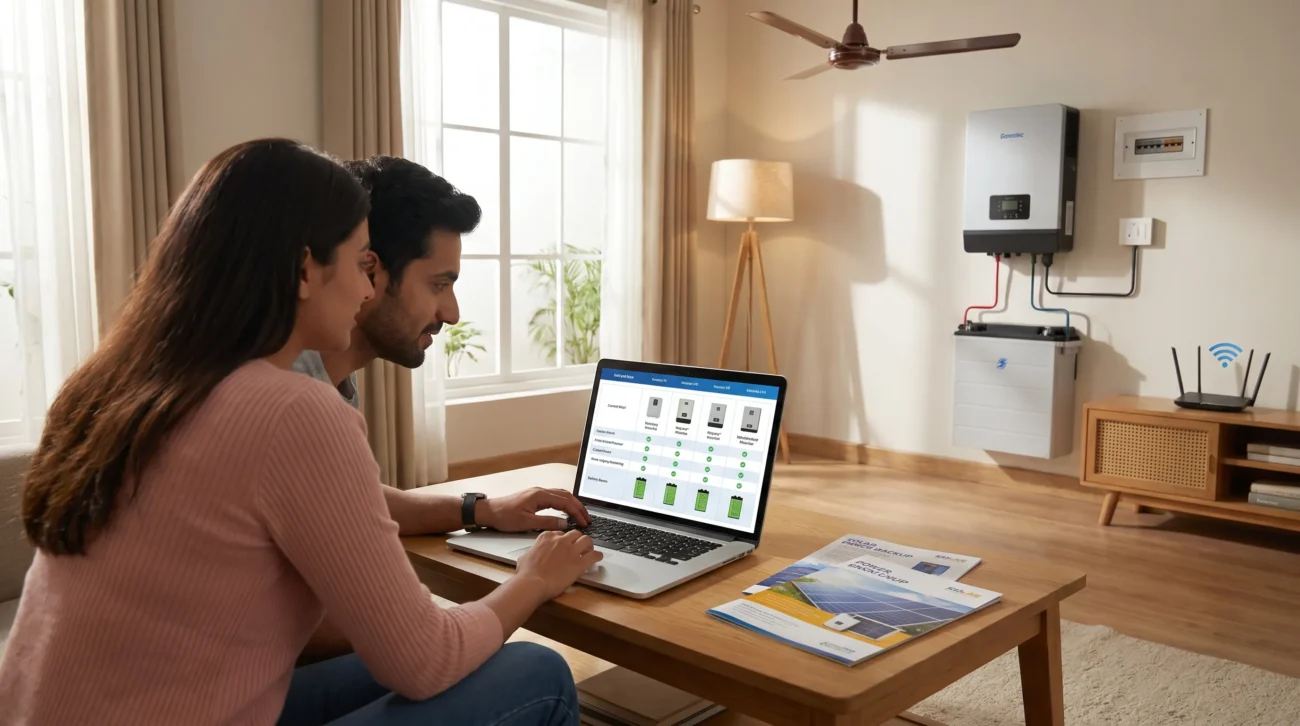
How to select the inverter for home is one of the most important questions to answer before you spend money on a home power backup system. A good home inverter keeps your lights, fans, Wi-Fi router, TV, computer, and other essential appliances running during a power outage, but the wrong one can leave you with poor backup time, overloaded circuits, weak performance, and unnecessary expense.
Many homeowners make the mistake of buying an inverter based only on brand name or price. In reality, the right choice depends on your power requirements, inverter capacity, battery capacity, backup duration, type of inverter, and the appliances you actually want to run during a blackout. You also need to think about starting load vs running load, surge capacity, energy efficiency, and whether you may want a solar inverter for home or a hybrid solar inverter later.
This guide explains how to choose inverter for home in a practical way. You will learn how to calculate power requirements for inverter, how to choose the right VA rating, how to match the correct battery size, and how to avoid common buying mistakes. By the end, you will know how much inverter capacity you need, which pure sine wave inverter or hybrid inverter type suits your house, and how to build a safer, smarter backup power solution.
Understand Your Power Needs Before Buying
The first step in home inverter selection is understanding what you actually want to power. Not every home needs a system that supports the whole house. In many cases, homeowners only want basic comfort and productivity during outages: a few LED lights, ceiling fans, a Wi-Fi router, a TV, maybe a refrigerator, and sometimes a computer or small home office backup setup.
Start by making a list of the appliances you want to run. Then write down their wattage. If you do not know the wattage, check the label on the appliance, the user manual, or the manufacturer’s website. This gives you your basic power consumption picture. The goal is not to guess. The goal is to calculate the combined wattage of your essential load.
Here is a simple example:
| Appliance | Approx. Watts |
|---|---|
| 3 LED lights | 30W |
| 2 ceiling fans | 150W |
| Wi-Fi router | 15W |
| LED TV | 100W |
| Laptop / computer | 100W |
Your total in this example is about 395 watts. That number helps you begin your load calculator process.
This step matters because the best inverter is not always the biggest one. If your real need is only 400 VA to 700 VA worth of essential backup, buying a very large system may waste money and reduce efficiency. On the other hand, choosing an underpowered inverter can cause overload problems and poor performance. So before asking which type of inverter is best for home, ask a more important question first: what do I actually need to run?
How to Calculate the Right Inverter Capacity
Once you know your household load, the next step is to calculate the correct inverter size. This is where many buyers get confused between watts, VA rating, and kilowatts.
In simple terms, watts measure real power, while VA or Volt-Ampere is the number often used to size an inverter. Because an inverter has conversion losses and different load types behave differently, you should not always match watts to VA one-to-one. A common practical method is to add a safety margin.
A very basic formula is:
Required inverter VA = Total load in watts ÷ power factor
For everyday home planning, many people simplify this by multiplying the total watt load by a safety factor. For example, if your appliances total 500W, you might estimate:
500W × 1.5 = 750 VA
That means a system near 750 VA may work for that load, although many homeowners prefer stepping up to a 1,000 VA inverter for some extra room. If the essential load grows further, a 2,000 VA inverter may be more suitable.
Here is a quick reference:
| Total Running Load | Suggested Inverter Range |
|---|---|
| Up to 300W | 375 VA – 400 VA |
| 300W–500W | 600 VA – 750 VA |
| 500W–800W | 1,000 VA inverter |
| 800W–1,500W | 1,500W / 2,000 VA inverter |
| Above 1,500W | Higher-capacity or hybrid system |
This is not a universal formula for every appliance, but it is a practical starting point for anyone asking how to choose inverter capacity for home appliances.
A key point here is that inverter capacity solves one problem: how much load can the inverter handle at one time. It does not tell you how long the system will run. That is where battery capacity comes in.
Choose the Right Battery Size for Backup Time
A lot of people think a bigger inverter automatically means longer backup. That is not true. The inverter decides how much load the system can handle. The battery size decides how long that load will run.
If you want to understand how to choose the proper battery size for inverter, think in terms of backup duration. For example, running 300 watts for 3 hours needs much more stored energy than running that same load for only one hour.
A simple planning formula often used is:
Battery Ah ≈ Load in watts × Backup hours ÷ Battery voltage
For example:
300 × 3 / 12 = 75 Ah
That means a 75 Ah battery may be enough for a light load and limited runtime, though in real-life conditions users often choose 100 Ah, 120 Ah, 150 Ah, 160 Ah, or even 220 Ah for better backup and longer battery life.
Here is a practical battery guide:
| Battery Size | Best For |
|---|---|
| 75 Ah | Very small backup needs |
| 100 Ah | Lights, fans, router, TV |
| 120 Ah | Small family backup |
| 150 Ah | Longer backup with moderate load |
| 160 Ah | Balanced home backup |
| 220 Ah | Heavy use or 4 to 5 hours backup |
When thinking about battery capacity for desired backup duration, do not use 100% of the battery every time. Real systems have efficiency losses, battery aging, and recommended safe usage limits. That is why buyers who want 3 hours backup or 4 to 5 hours backup often choose a battery size larger than the minimum calculation.
If you are comparing lead-acid battery, tubular battery, or LiFePO4 Battery options, remember that different battery technologies differ in price, maintenance, charging speed, and lifespan. For most standard home users, the real question is not just “Which battery is cheapest?” but “Which battery gives stable backup, usable battery capacity, and acceptable maintenance over time?”
Types of Home Inverters: Which One Should You Pick?
When people search how to select an inverter for home, they usually discover that there is more than one type of inverter. Choosing the wrong type can affect appliance safety, sound quality, motor performance, and future upgrade options.
The most common categories are square wave inverter, modified sine wave inverter, and pure sine wave inverter. A square wave inverter is basic and usually the least advanced option. A modified sine wave inverter is better, but it may still not be ideal for sensitive electronics or appliances with motors. A pure sine wave inverter produces cleaner output and is generally the best choice for modern homes, especially if you run a TV, computer, Wi-Fi router, fridge, or other sensitive electronics.
Then there are broader system categories like solar inverter, hybrid inverter, battery ready inverter, and off-grid storage inverter. A standard inverter is fine for simple backup. A hybrid solar inverter is more suitable if you want to add solar panels, energy storage, or a future solar-ready inverter setup.
A simple buying rule is this: if your goal is basic outage backup, a pure sine wave inverter is usually the safest and most practical choice. If your goal is long-term energy flexibility, lower grid dependence, and future expansion, a hybrid inverter may be smarter.
This is also where many users ask UPS vs inverter for home. In simple language, both provide backup, but an inverter-based home power backup system is usually built for longer household support, while UPS-style systems are often focused on immediate, shorter backup for sensitive electronics. If you want backup for a whole room or multiple appliances, an inverter is often the more suitable option.
Starting Load vs Running Load: The Most Common Sizing Mistake
One of the biggest content gaps in most guides is the difference between starting load vs running load. This matters a lot because some appliances do not just need their listed wattage when they start. They need extra power for a few seconds.
For example, a refrigerator, water pump, motor, or air conditioner may have a compressor or other moving components that create a much higher startup peak power. This is why a fridge may need 2–3 times higher than refrigerator rated power at startup. Some motor-driven appliances may need 2 times rated power or even 3 to 7 times rated power for a short moment.
This is why surge capacity matters. A system that looks perfect on paper for running watts can still fail when a motor starts. A practical approach is to think of three kinds of loads:
- Resistive load like lights or heaters
- Inductive load like fans, pumps, or refrigerators
- Capacitive load in certain electronics and power supplies
Some guides suggest simple planning multipliers such as 1.2 multiplier for resistive loads and 1.5 or 2 multiplier for inductive loads. The exact requirement depends on the appliance, but the message is clear: never size an inverter on running watts alone if you plan to run motors or compressors.
If you are wondering can inverter run fridge and fan together, the answer is yes in many cases, but only if the inverter can handle both the running load and the fridge’s startup surge.
Can the Inverter Run Your Appliances Safely?
This section answers one of the most common user questions: what appliances should not be connected to an inverter, and can inverter run AC at home?
A home inverter can usually handle low to moderate essentials such as lights, fans, router backup, TV, and computer. With the right sizing, it may also support a refrigerator. But heavy appliances such as large air conditioners, heaters, powerful water pumps, and high-load kitchen appliances can be difficult or impractical on a normal home inverter.
So when evaluating inverter rating for refrigerator, inverter rating for water pump, or how to choose an inverter for an air conditioner, focus on three things:
First, the running watts.
Second, the starting watts or peak load.
Third, the length of time you want the appliance to run.
A small backup system may comfortably run lights, fans, and a Wi-Fi router, but struggle with a large inverter air conditioner. A medium system might handle a fridge, but only if the inverter’s surge load calculation has enough margin.
The safest rule is simple: use a home inverter mainly for essential appliances, not every heavy appliance in the house. That gives you better backup power solution performance, better battery life, and fewer overload issues.
Features, Efficiency, and Safety Checklist
After sizing, look at the practical features that improve daily use. The best home inverter buying guide should not stop at capacity. It should also ask how safe, efficient, and convenient the system will be.
Look for overload protection, short-circuit protection, stable output, and a clear digital display. Strong warranty support, a nearby service center, and reliable after-sales service also matter because inverter systems are long-term products, not one-time gadgets.
Modern options may include mobile app control, monitoring, Monitoring-Wi-Fi with Bluetooth, or even Monitoring-4G. These features are not essential for every buyer, but they can be useful if you want better visibility into load, charging, and battery status.
Safety also matters. Good planning should include proper inverter installation requirements, safe placement, airflow, and protection devices such as MCB and fuse protection for inverter, a surge protection device, and correct earthing for inverter. If you are placing batteries indoors, think about ventilation for inverter battery and safe wiring for inverter setup.
A short rule worth remembering is this:
“A good inverter is not just one that runs the load. It is one that runs the load safely, efficiently, and reliably.”
Solar, Hybrid, and Future-Ready Buying
A growing number of homeowners do not just want backup. They want a system that can grow with their needs. That is where solar compatibility, solar inverter capacity for home, and hybrid solar inverter decisions become important.
If you already plan to install solar panels, it makes sense to consider a home solar inverter or hybrid inverter now instead of replacing your system later. A hybrid solar inverter can work with grid power, battery backup, and solar input, making it more flexible for the future.
This matters even more in areas with load shedding, long outages, rising electricity costs, or growing interest in renewable energy. A future-ready system can support energy storage, better efficiency, and even net metering compatibility depending on your local setup and regulations.
This does not mean every home must buy a hybrid system. But if you are choosing between a basic inverter and a more advanced model, it is smart to ask whether your home may need future expansion capacity in the next few years.
Quick Inverter Size Chart for Common Home Setups
Here is a simple inverter size calculator for home style reference:
| Home Setup | Typical Load | Suggested Inverter | Suggested Battery |
|---|---|---|---|
| Lights + fans + router | 200W–300W | 400 VA – 600 VA | 75 Ah – 100 Ah |
| Lights + fans + TV + router | 300W–500W | 700 VA – 750 VA | 100 Ah – 120 Ah |
| Small apartment essentials | 500W–800W | 1,000 VA inverter | 120 Ah – 150 Ah |
| Family backup with fridge | 800W–1,200W | 1,500W / 2,000 VA inverter | 150 Ah – 220 Ah |
| Heavy backup / solar-ready | 1,200W+ | Hybrid inverter | Depends on runtime goal |
This chart is not a replacement for a detailed load calculation, but it gives homeowners a practical direction. It is especially helpful for people asking about best inverter size for small home, inverter for apartment, or inverter for 2 bedroom house style scenarios.
Common Mistakes to Avoid
The most common inverter buying mistakes are easy to avoid if you know what to look for.
One big mistake is ignoring starting watts and buying only for continuous load. Another is confusing inverter capacity with battery runtime. A third is buying for the whole house when you only need essential backup. Many users also ignore battery aging, usable battery capacity, and maintenance cost of inverter ownership over time.
Another mistake is failing to think ahead. If you may want solar later, buying a solar-ready inverter or hybrid inverter now may save money. And finally, many buyers forget safety issues like correct placement, ventilation, and protection devices.
The smartest approach is simple: calculate first, compare second, buy last.
FAQs About Choosing a Home Inverter
What size inverter do I need for a small home?
A small home with lights, fans, a router, and maybe a TV may need anything from 400 VA to 1,000 VA, depending on total load and backup goals.
Is a pure sine wave inverter better?
Yes, in most cases a pure sine wave inverter is the better choice for modern homes because it is safer for sensitive electronics and performs better with many appliances.
How do I calculate backup time?
Estimate your appliance load in watts, choose the number of hours you want, and then match the right battery capacity in Ah. For example, 75 Ah, 100 Ah, 150 Ah, and 220 Ah batteries suit different backup goals.
Can a home inverter run a refrigerator?
Yes, but only if the inverter can handle the fridge’s running load and startup surge.
Should I buy a hybrid inverter now or later?
If you expect to add solar panels or want more flexible energy storage later, buying a hybrid solar inverter now can be a smart long-term move.
Conclusion
Choosing the right inverter is not about guessing or buying the most expensive model. How to select the inverter for home comes down to five practical decisions: calculate your power requirements, choose the right inverter capacity, select the correct battery capacity, account for starting load, and decide whether a basic or hybrid inverter suits your future plans.
If you keep your focus on essential appliances, backup duration, surge capacity, energy efficiency, and safety, you will be able to choose the right inverter for your home without overbuying or undersizing. A well-chosen inverter gives you more than backup. It gives you comfort, reliability, and confidence every time the power goes out.
