


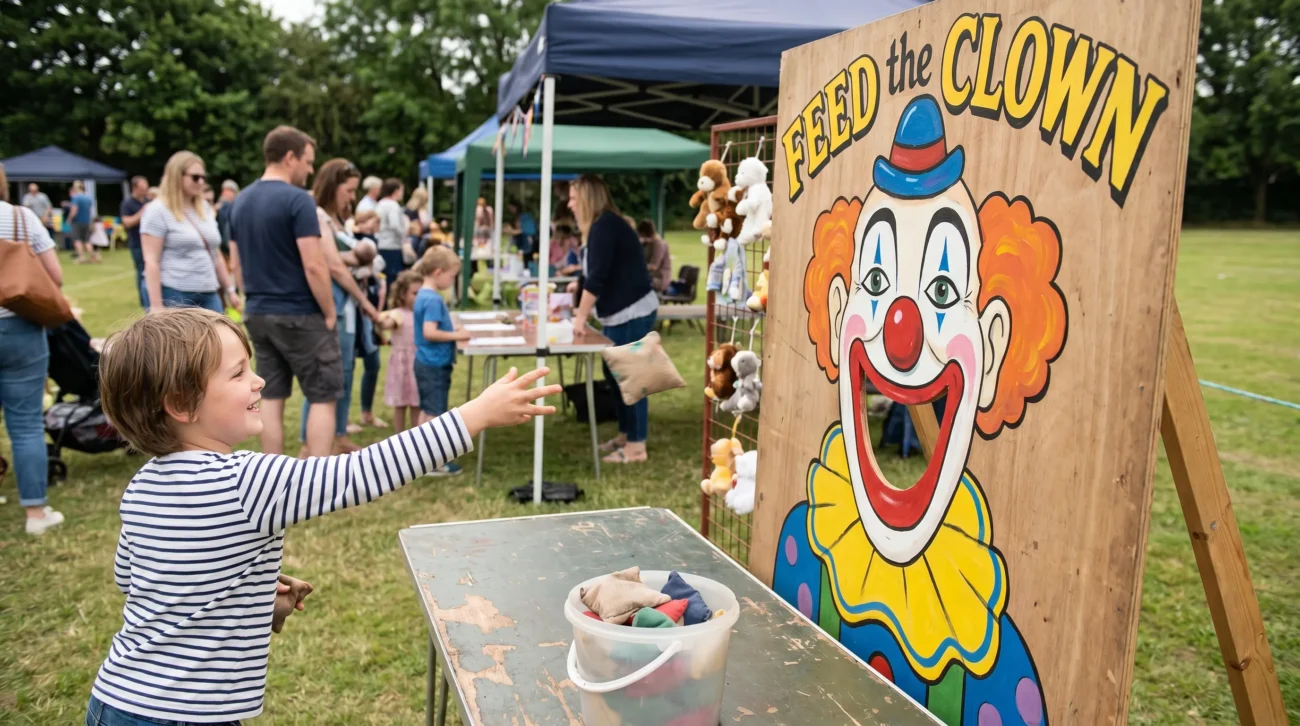
Feed the clown game is one of those classic carnival games that almost everyone understands the moment they see it. A big clown face, an open mouth, a few balls or bean bags, and a simple challenge: land your throws cleanly and score points or win a prize. That simplicity is exactly why this side stall game remains popular for school fairs, fetes, fundraising events, birthday parties, family fun days, and even corporate fun day setups.
What makes feed the clown so effective is that it works on two levels at once. It is easy enough for children to enjoy, yet competitive enough to keep adults involved. It also fits many event formats, from a garden games package to a full fairground game zone. Whether you want feed the clown game hire, a DIY version for a school event, or just want to understand how to play feed the clown game, this guide covers everything from rules and setup to pricing, safety, and creative event ideas.
What Is the Feed the Clown Game?
At its core, feed the clown game is a traditional side stall game where players throw balls toward a clown target and try to land them inside the clown’s mouth. That simple mechanic makes it a fairground classic, and it is often described as a fun variation on a ball in a bucket game, except the visual theme makes it much more memorable.
In many event settings, the game appears as an A Frame Side Stall Game or a carnival-style throwing board. Players stand at a marked distance and toss 3 balls one after another. Depending on the setup, each successful throw may count as a point, earn a prize, or move the player into a higher scoring tier. Because the objective is instantly clear, the game is ideal for events where you want people to join in without needing long instructions.
This is also why the clown game works so well in mixed crowds. Some guests see it as a nostalgic fun fair game, while others treat it as a light-hearted skill challenge. That blend of recognition, simplicity, and replay value explains why it remains one of the most useful carnival games for both children and adults.
How to Play Feed the Clown Game?
If you are wondering how to play feed the clown game, the rules are usually straightforward. A player stands behind a line, takes a set number of balls, and throws them one by one toward the clown’s mouth. If the balls go in, the player scores. In many event setups, the goal is to get as many balls into the clown’s mouth as possible using 3 balls.
The easiest version works like this: each player gets 3 balls, stands at the marked throwing point, and tries to “feed” the clown by landing the balls in the mouth opening. One successful throw may earn a small reward, while two or three successful throws may win a prize. This format is simple, fast, and perfect for queues at school or community events.
You can also make the game more interesting by changing the distance. Younger children can stand closer, while older kids and adults can throw from farther back. That one adjustment makes the same party game feel fair for different age groups.
Because feed the clown is basically a target toss challenge, it is also highly adaptable. Some organizers use foam balls, others use bean bags, and some create a fast-paced round where each player has only ten seconds to throw. That flexibility is one of the biggest reasons this event entertainment option stays popular year after year.
Feed the Clown Game Rules and Scoring Ideas
One area where many event pages stay thin is the actual feed the clown game rules. If you want your setup to feel organized and engaging, it helps to define a clear scoring system before the event starts.
A simple beginner format is this:
| Action | Points / Result |
|---|---|
| 1 ball in | 1 point |
| 2 balls in | Small prize |
| 3 balls in | Top prize |
This works well when you want the game to move quickly and keep the queue flowing. But if you want more structure, you can create a points-based version. For example, a clean throw into the center of the clown’s mouth could be worth 5 points, while hitting the rim and bouncing in could be worth 3.
You can also use age-based rules. For children all ages 3+, keep the throwing line closer and use larger, lighter balls. For older players, move the line back and reduce the size of the ball. This makes the game fairer without changing the basic design.
Another strong option is team play. In a school fair or sports days setting, teams can compete for the highest total score across a round of turns. That transforms a simple clown mouth game into a more social attraction.
If you are running a fundraiser, prize ladders work especially well. One successful throw might win a sticker, two successful throws might win sweets, and three successful throws could unlock a premium prize. This approach gives the game a strong fundraising angle while keeping it fun and accessible.
Why the Feed the Clown Game Works So Well at Events
There is a reason suppliers keep offering feed the clown game for events, fete packages, and corporate fun day bundles. The game checks many boxes at once.
First, it is visually strong. A clown face instantly catches attention, especially from children. Second, it is low-pressure. Even players who are not naturally sporty will try a tossing game because it feels approachable. Third, it fits almost any crowd. Families, school groups, office teams, and neighborhood guests can all play the same game with small rule changes.
It also performs well because it supports natural crowd movement. One player takes a turn, the next watches, laughs, and usually wants to try as well. That makes feed the clown game for parties especially useful when you need a reliable attraction that keeps people circulating through your space.
Compared with more complex carnival games hire options, this one is easy to explain and easy to reset between players. That simplicity matters more than many event planners realize.
Best Occasions to Use a Feed the Clown Game
The most common use case is a school fair or fayre, where children line up for simple prize game activities. But the game also works extremely well at family fun days, community events, and field days because it creates quick participation with very little setup effort.
For fundraising carnival game ideas, it is especially useful because the rules are flexible. You can charge per turn, sell bundled tickets, or offer bonus rounds for larger donations. Schools and local groups often prefer games like this because they feel familiar and do not require advanced equipment.
At a birthday party, the game works as a rotating activity station. At a wedding with outdoor entertainment, it can become a playful outdoor party game that gives guests something light and memorable to do between formal moments. At a business event, it becomes a surprisingly effective family fun game or break-time challenge for staff and guests.
That range is exactly why feed the clown game for fete, feed the clown game for school fair, and feed the clown game for corporate fun day are all strong long-tail angles.
Indoor vs Outdoor Setup: Space, Surface, and Safety
A lot of suppliers mention whether the game can be used indoors or outdoors, but practical setup matters just as much as availability. A proper feed the clown game setup should consider surface, weather, throwing distance, and crowd flow.
If your venue has a hall or gym, the game can usually sit well on an Indoors on Hard Surface area. For event spaces with synthetic turf, Indoors on Artificial Grass is another workable option. Outside, you may place it on Outdoors on Grass, Outdoors on Artificial Grass, or Outdoors on Hard Surface, depending on the frame and support structure. If rain is possible, Outdoors Under Cover is ideal.
The safest layout usually includes a clearly marked throw line, enough room behind players for the queue, and side space so onlookers do not drift into the throwing zone. Foam balls are often best for younger children, while bean bags can work well in windy conditions.
Quick setup checklist
| Setup element | Recommendation |
|---|---|
| Throwing distance | Adjust by age group |
| Surface | Grass, hard surface, or artificial grass |
| Weather backup | Covered area if outdoors |
| Queue space | Leave room behind throw line |
| Safety zone | Keep spectators out of throw path |
| Equipment | Use soft balls or bean bags for children |
A good setup does more than protect the equipment. It makes the game smoother, safer, and more enjoyable.
Feed the Clown Game for Kids, Adults, and Mixed-Age Groups
One of the best things about feed the clown game is that it suits Adults & Children without needing a full redesign. A few small adjustments can make it work for nearly everyone.
For younger children, use larger targets, closer throw lines, and softer balls. For older children, move the line back slightly and add point-based scoring. Adults often enjoy the game more when there is a challenge layer, such as timed throws or smaller scoring zones.
If your event includes mixed-age groups, you can run separate lanes or simply change the throwing line by age bracket. That is why phrases like adults and children and all ages 3+ matter in commercial copy: they speak to how flexible the attraction really is.
This also opens up content opportunities that competitors rarely explain, such as feed the clown game for adults, feed the clown game for toddlers, and feed the clown game for mixed age groups. Those long-tail and gap angles are useful because real event planners often need to serve different audiences at once.
DIY Feed the Clown Game: How to Make One at Home or for School
Not every reader wants feed the clown game hire. Some want a low-cost version for a classroom, fundraiser, or backyard party. That is where a DIY feed the clown game can be a great solution.
The easiest homemade feed the clown game uses a large cardboard box, paint, and a cut-out mouth opening. Draw or paint a clown face on the front, reinforce the inside edges, and place a container or back panel behind the mouth to catch the balls. Use foam balls or bean bags for safety.
A stronger version can be built from plywood or a freestanding board if you need something reusable for annual school events. This is ideal for a school carnival or community fundraiser because it keeps costs low and can be customized with school colors, themed characters, or branded prize sections.
Basic DIY materials
- Large cardboard sheet or box
- Paint or colored paper
- Marker pens
- Craft knife or cutting tool
- Tape or wood supports
- Foam balls or bean bags
- Prize basket or score sheet
A cardboard clown toss game does not need to look perfect to work well. In fact, part of the charm of a DIY feed the clown game is that it feels homemade and fun. The most important thing is a visible target, stable support, and a throwing distance that matches your audience.
Prize Ideas, Difficulty Levels, and Game Variations
Prize strategy can make an average game feel much more exciting. If the event is for young children, small items like stickers, novelty pencils, sweets, or mini toys work well. For older children, you might offer vouchers, premium snacks, or a bonus turn. For adults, consider raffles, branded giveaways, or team-based rewards.
You can also create difficulty levels. An easy version might let players stand very close and throw 3 balls. A medium version might move the line back by a meter or two. A hard version could require all three throws to land inside the mouth to win a prize.
To make the game feel fresh, add variations such as blind draw prizes, timed rounds, team relays, or a golden-ticket throw where one ball is worth double points. These kinds of feed the clown game ideas are especially useful for fundraising carnival game ideas, because they encourage replay and boost participation.
This is where the gap keywords become powerful. Terms like best prizes for feed the clown game and feed the clown game difficulty levels speak directly to user needs that most simple rental pages ignore.
How Much Does Feed the Clown Game Cost to Hire?
When people search feed the clown game hire, they usually want a rough pricing idea before contacting a supplier. Competitor pricing shows that costs can vary depending on region, supplier, and package details, with examples such as From £30, From £45, From £54, and €30. Some suppliers also mention 20% VAT or extras like extra £30 for overnight or extended use. Those figures vary by provider and location.
In practice, pricing depends on whether the game is hired alone or as part of a larger garden games or event entertainment package. Delivery distance, staffing, event length, and setup requirements can all affect the quote.
Typical price factors
| Factor | Can increase cost? |
|---|---|
| Delivery distance | Yes |
| Weekend demand | Yes |
| Overnight hire | Yes |
| Package bundle | Sometimes lowers cost |
| Staffed operation | Yes |
| Indoor vs outdoor logistics | Sometimes |
If you are comparing suppliers, ask what is included. A low advertised price may not include setup, delivery, prize stock, or extended hire time.
Booking, Delivery, and What to Check Before You Hire
Before you book feed the clown game online or request a quote, it helps to know exactly what to ask. Many suppliers offer check availability, enquiry forms, or booking systems, but the most useful step is to prepare your event details in advance.
Start with the basics: date, time, venue type, expected age group, and whether the game will be used indoors or outdoors. Then confirm the surface, access route, and whether the game needs shelter. Some operators mention fast response windows such as 24–48 hours, while others highlight round-the-clock enquiry access like 24/7 support or online forms.
A smart booking checklist includes:
- event date and duration
- exact venue address
- surface type
- indoor or outdoor use
- age range of players
- prize needs
- delivery timing
- weather backup plan
This turns a vague enquiry into a much stronger booking request and helps avoid surprises on event day.
Where to Hire Feed the Clown Game Near You
Local intent matters. Many searches for this keyword are really looking for nearby suppliers, which is why location references are common on hire pages. Current competitor examples include service areas tied to Colchester, Essex, and several counties in Ireland, including Carlow, Kildare, Kilkenny, Laois, Wexford, Wicklow, and Offaly.
If you want the best result, search with your location added to the keyword, such as feed the clown game hire in Ireland or feed the clown game hire near me. Also check whether the supplier includes delivery in the base price or adds mileage fees by region.
For publishers creating content, this is also a strong place to build local SEO relevance through city or county modifiers.
Halloween and Seasonal Variations of Feed the Clown Game
Although the most common use is for fairs and parties, the concept also fits seasonal themes. A Halloween feed the clown game can be redesigned with a spooky face, glow elements, or themed prizes. That variation works especially well for autumn school events, mall promotions, and themed house parties.
This is a valuable angle because many standard supplier pages stay focused only on the rental version. By including a seasonal section, your article can speak to users searching for something more creative than a standard side stall game.
Final Thoughts: Is Feed the Clown Game Worth It?
If you need a simple, memorable, and flexible attraction, feed the clown game is absolutely worth considering. It works as a carnival game, party game, fundraising activity, and family fun game without demanding complex rules or expensive equipment. It is easy to understand, quick to reset, and adaptable for children, adults, and mixed-age groups.
For some events, the best option is feed the clown game hire from a supplier. For others, especially schools and community groups, a DIY feed the clown game can deliver the same fun at a lower cost. Either way, the appeal is the same: a classic clown target, a few throws, and the simple excitement of trying to land the ball cleanly in the mouth.
That is why this traditional side stall game continues to stand out. It is easy to run, easy to enjoy, and still one of the most reliable fun fair games for events of all sizes.
Disclaimer:
This article is for general informational purposes only. Feed the clown game rules, pricing, setup, safety needs, hire terms, and suitability may vary by event type, age group, venue, supplier, and location. Always check with your event provider before booking or setting up the game.
