


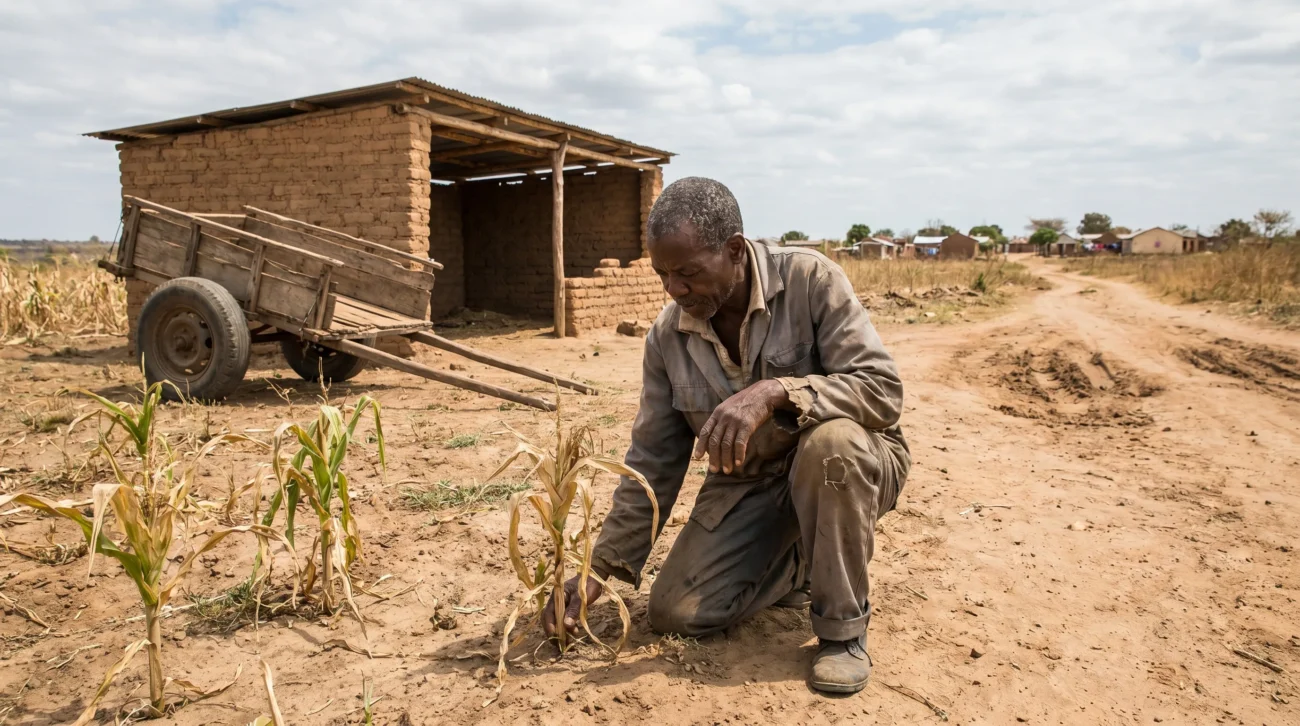
The risks agriculture faces in developing countries are not limited to bad weather or low prices. They come from a chain of connected problems: climate change, extreme weather, price volatility, weak infrastructure, limited rural finance, poor market transparency, and policy systems that often fail to protect the people who need support most. In many low-income regions, food production still depends heavily on smallholder farmers, and that makes the whole system more exposed when drought, floods, pests, or unstable markets hit. FAO and the World Bank both emphasize that smallholders face overlapping risks that threaten livelihoods, nutrition, and food security, especially where resilience systems are weak.
This is why the topic matters beyond farming alone. When agriculture becomes more risky, the effects spread into hunger, household income, national stability, and social welfare. A poor harvest can mean less food in the market, less cash for farming families, and fewer resources to invest in the next season. In other words, agricultural risks in developing countries are also development risks.
Why Agriculture in Developing Countries Is So Vulnerable
Agriculture is risky everywhere, but it is usually more dangerous in developing countries because so many farmers work with very small margins. A large share of them are small-scale producers who rely on rainfall, family labor, and limited savings. They often have less access to knowledge and technology, improved seeds, irrigation, storage, and formal insurance. When one shock arrives, there is rarely a strong safety net underneath it.
That is the heart of smallholder vulnerability. A commercial farm may be able to absorb one bad season through savings, borrowing, insurance, or diversification. A smallholder family may not. If rainfall fails, the crop yield drops. If yields drop, income falls. If income falls, the family may reduce food spending, delay school fees, sell animals, or borrow at high interest. IFAD notes that poor rural people are less resilient because they have fewer assets to fall back on, while climate stress, market volatility, food insecurity, and poor governance reinforce each other.
Weak infrastructure makes the problem worse. In many rural areas, roads are poor, electricity is unreliable, storage is limited, and transport costs are high. Even when farmers produce enough, they may not reach good buyers at the right time. That reduces their bargaining power and increases dependence on intermediary purchasers who capture more of the value chain.
Climate Change, Extreme Weather, and Environmental Stress
Among all the risks agriculture faces in developing countries, climate change is one of the most serious. It changes rainfall patterns, increases the frequency and intensity of extreme weather events, and places more pressure on soils, water, and ecosystems. For smallholder farmers, that means a growing gap between what they used to expect and what actually happens in the field. FAO states that climate change makes agriculture more risky and that smallholders are increasingly exposed to climate-related shocks. The World Bank also frames climate change and food insecurity as two of the biggest development challenges of our time.
The danger is not only one event. It is the combination of many events. A season may begin with delayed rain, continue with heat stress, and end with flooding or pest pressure. In regions dominated by rainfed agriculture, there is no easy backup. Water scarcity can reduce planting, weaken livestock, and limit irrigation exactly when crops need it most. Over time, soil quality, land degradation, and soil fertility decline also make farms less productive and more fragile.
This is where the long-tail phrase “climate change and its consequences for small-scale agriculture” fits naturally. The consequences are practical and immediate: lower crop yields, more uncertainty, and greater losses after every shock. Farmers also face long-term adaptation pressure. They may need to switch planting dates, adopt crop varieties resilient to new climate trends, or diversify plant and animal species and varieties to spread risk across different conditions.
A simple way to see the problem is in the table below.
| Risk area | How it affects farmers | Why it hits developing countries harder |
|---|---|---|
| Drought | Lower yields, livestock stress, crop failure | High dependence on rainfed farming |
| Floods | Soil loss, crop damage, storage destruction | Weak drainage, limited insurance |
| Heat stress | Poor plant growth, reduced animal productivity | Low access to cooling, irrigation, and adaptive technology |
| Erratic rainfall | Uncertain planting and harvest timing | Fewer buffers and limited climate data services |
| Land degradation | Falling productivity over time | Less investment capacity for soil restoration |
Market Volatility and the Cost of Farming
Climate is only one side of the story. The other is price volatility. Farmers in developing countries often face instability in both input markets and product markets. The seed, fertilizer, feed, fuel, or machinery they need may become more expensive, while the crops they sell may fall in price at harvest time. That is why the long-tail term “price volatility in input and product markets” matters so much.
Recent international concern about fertilizer shortages shows how serious this problem can be. When supply is disrupted or prices rise sharply, farmers may use fewer inputs, plant less land, or accept lower yields. The damage can last well beyond one season because weak input use today can affect soil fertility, production, and household income tomorrow. The World Bank’s food security work also continues to link agriculture, irrigation, social protection, and resilience as part of one broader response to food-system stress.
Low market transparency adds another layer of risk. Many farmers do not have up-to-date pricing information or easy access to competitive buyers. As a result, marketing costs rise, seasonal price conditions work against them, and they often sell under pressure. When there is no storage, they may be forced to sell immediately after harvest, when supply is high and prices are weakest.
This is also why commodity futures markets appear in discussions of agricultural risk. In theory, they can help manage uncertainty. In practice, many smallholders in developing countries remain too far from these tools to benefit directly. The issue is not whether a financial instrument exists. The issue is whether local farmers can actually access it through trusted systems, affordable finance, and practical support.
Infrastructure, Storage, and Market Access Problems
One of the most overlooked risks is what happens after production. A farm can grow food successfully and still lose income because of poor roads, weak food storage facilities, and inefficient transport. This is where post-harvest losses, storage losses, and supply chain disruption become central parts of the story.
FAO has long treated food losses as a major issue in developing-country agriculture, especially where drying, storage, handling, and transport are weak. Its food-loss work also highlights that losses happen across the supply chain, not just in the field.
That matters for SEO and for real life. Many competitors mention roads and storage, but they do not fully explain how these problems raise risk. Poor roads mean farmers cannot move produce efficiently to markets. Limited water storage facilities make irrigation harder. Weak warehousing increases spoilage and discourages farmers from holding stock until prices improve. All of that reduces farm income and increases the feeling that agriculture is unpredictable even after a good harvest.
In practical terms, improvements to infrastructure can have a major impact on risk for farmers. Better roads, reliable local markets, cold chains, village storage, and stronger transport links all reduce loss and strengthen the value chain.
Financial Risk: Credit, Insurance, and Rural Finance Gaps
Risk is easier to survive when a farmer has cash reserves, formal credit, or good insurance. Yet in many developing countries, access to rural finance remains limited. Loans may be expensive, paperwork may be difficult, and repayment schedules may not match agricultural cycles. That leaves farmers underinvested in good years and highly exposed in bad years.
Insurance is another challenge. Private insurance can help in theory, but availability, trust, affordability, and claims systems often remain weak. That is why many experts discuss risk transfer instruments, disaster risk financing, and adaptation finance alongside more traditional farm lending. These are not abstract policy ideas. They are part of the real answer to how poor farmers recover after climate shocks.
Public support also matters. Social safety nets, public welfare programmes, and carefully designed subsidies can reduce hardship, protect food access, and help families avoid distress sales. But badly designed support can miss its target. One of the named facts that appears in the competitor material is “sixty percent of beneficiaries of subsidies”, which points to a common policy problem: benefits often do not reach the farmers who need them most. That is why the long-tail phrase “financial assistance from the government does not always go to the farmers who most need it” is worth keeping in the draft.
Policy Failures and Structural Weaknesses
Some agricultural risks are environmental. Others are created or amplified by policy. Unsupportive government policies, weak regulation, poor input planning, and distorted subsidy systems can turn a difficult environment into a damaging one.
For example, a country may underinvest in extension services, ignore market supply issues, or fail to maintain strategic systems for procurement and holding of stocks. In such cases, smallholder families face price shocks, supply shortages, and uncertainty with little public support. Even when states intervene, they may favor politically connected actors, large landowners, or urban interests more than rural producers.
This is why greater state intervention to reduce risks for farmers is not always about spending more money. It is about spending smarter. Effective intervention can include transparent subsidies, targeted irrigation, weather data, local roads, storage systems, and support for farmer organizations. Poor intervention can create dependence, corruption, or benefits captured by rich landowners, non-farmer traders, or larger agribusiness companies.
Why Smallholder Farmers Face the Highest Risk
The phrase “smallholder farmers in developing countries face major risks” is not just a summary. It is the core of the article. Smallholders are more exposed because they sit at the intersection of nearly every agricultural weakness: limited land, low savings, weak market access, climate exposure, and fewer formal protections.
FAO’s family farming work highlights that globally, poor and hungry people live mainly in rural areas where agriculture is the main source of livelihood, and that smallholders face interconnected risks that threaten livelihoods, nutrition, and resilience.
This helps explain why food insecurity can exist inside farming communities themselves. A family may produce food and still remain poor because the system around them is unstable. When prices swing, yields fall, or debt rises, the household loses both income and security. That is also why small-scale agriculture should not be discussed only as a production issue. It is a risk, poverty, and social protection issue at the same time.
How Collective Action Helps Farmers Reduce Risk
No farmer can control global climate or world markets alone. But farmers can reduce risk together. Collective action groups, co-operatives, and producers’ groups can improve purchasing power, lower transaction costs, and increase access to better buyers. They can also help farmers share information, store crops more effectively, and negotiate stronger prices.
This matters because weak political and economic bargaining power is one of the reasons local farmers lose value in the chain. When they work together, they may gain access to financing, transport, or certification systems that are hard to reach individually. In some cases, they can move closer to consumers through direct marketing or community-supported agriculture models, which reduce dependence on multiple intermediaries.
Practical Solutions to Reduce Agricultural Risk
The strongest way to beat the current competitors is to go beyond the IELTS-style passage and explain what actually works. There is no single solution, but a stronger risk strategy usually combines field-level adaptation, better market systems, and smarter policy.
At farm level, climate-smart agriculture offers a useful framework. The World Bank defines it as an integrated approach to managing landscapes that addresses the interlinked challenges of food security and climate change. That makes it especially relevant for developing countries where farmers need adaptation, productivity, and resilience at the same time.
In practical terms, this can include irrigation, improved water use, resistant seeds, better soil management, crop rotation, and better agronomic practices. It also includes using crop varieties that can better handle heat, drought, or variable rainfall. At household level, livelihood diversification matters too. A family that depends on one crop and one season is far more exposed than a family with mixed crops, livestock, and off-farm income.
At system level, early warning systems, village storage, better transport, fairer input markets, and stronger farmer organizations all reduce risk. So do weather data systems that help farmers make timing decisions. IFAD’s climate adaptation work shows that investment in adaptation capacity, community groups, and climate-resilient land management can improve resilience for millions of small-scale farmers.
Real-World Examples from Developing Countries
Examples make the issue easier to understand. In Ethiopia, post-harvest crop-loss surveys have shown how significant losses can be for staple crops, reminding us that risk does not end at harvest. In Brazil and Mexico, social protection and cash-transfer discussions often appear in debates about how states should support poor households without weakening incentives for productive farming. In Bangladesh and India, climate shocks, flood exposure, and pressure on land and water continue to shape agricultural risk, especially where smallholders dominate the rural economy.
These examples are different, but the pattern is similar. Where farmers have stronger support systems, they recover faster. Where climate risk, market failure, and weak public systems overlap, agriculture becomes a cycle of repeated shocks.
A useful way to think about it: the problem is rarely one bad harvest. The problem is a fragile system that turns one bad harvest into a longer crisis.
Conclusion
The risks agriculture faces in developing countries are broad, connected, and deeply human. They include climate change, extreme weather, price volatility, weak infrastructure, limited rural finance, policy failures, and the everyday exposure faced by smallholder farmers. When these pressures combine, they threaten both food production and food security.
The good news is that the solutions are also connected. Better roads, smarter subsidies, fairer markets, stronger co-operatives, early warning systems, climate-smart agriculture, improved storage, and targeted adaptation finance can all reduce vulnerability. The goal is not to remove every risk. It is to build a farming system resilient enough to absorb shocks without pushing rural families deeper into poverty.
Disclaimer:
This article is for general informational purposes only. Agricultural risks, climate impacts, market conditions, finance access, policy support, and farming outcomes may vary by country, region, crop, infrastructure, and local conditions. Always consult relevant agricultural experts, local authorities, or development professionals for situation-specific guidance.
