


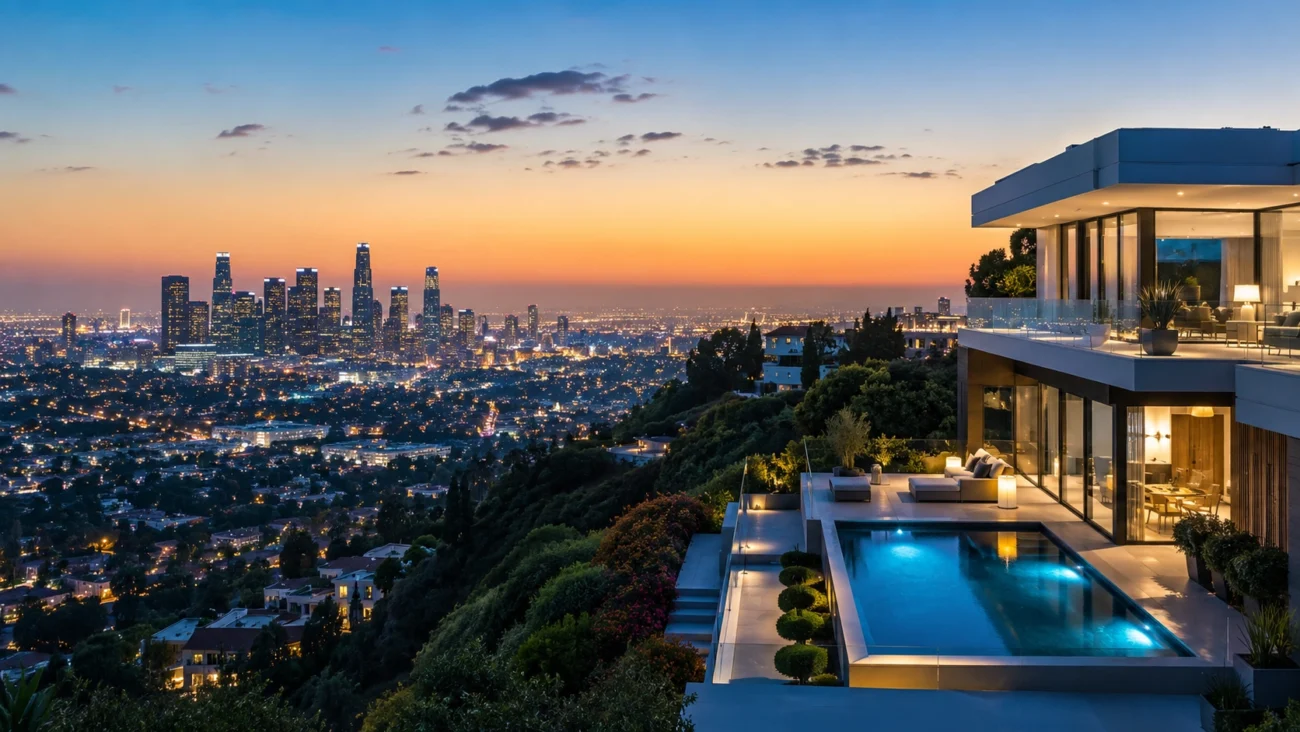
Luxury home buyers in Los Angeles are no longer making decisions based only on square footage or the view. Privacy and wellness spaces have become just as important to the modern home buyer.
There is also a specific focus on wildfire resilience when evaluating a property. By 2026, things like tax policy and insurance costs are the main factors driving where people buy. Some neighborhoods are thriving because of tax benefits, while others are seeing people relocate to avoid high fire risks and rising insurance rates.
For these buyers, the financial and environmental risks are now just as significant as the architecture of the home.
The Line That Splits the Platinum Triangle
Here’s the real story nobody’s putting on a billboard. Measure ULA, LA’s so-called mansion tax, has fundamentally altered high-end transactions inside city limits. If you browse through homes for sale in Los Angeles today, the tax divide shows up immediately in the data.
Properties inside city limits carry a very different cost structure than those just across the municipal boundary. On a $12 million sale inside LA City, that tax adds roughly $660,000 to closing costs.
The result isn’t organic demand. It’s the capital choosing a jurisdiction. While LA City neighborhoods like Bel Air and Holmby Hills take the full tax bite, independent cities exempt from Measure ULA, such as Beverly Hills and Santa Monica, have seen surges in $10M+ transactions as people seek a tax sanctuary.
Cash deals account for roughly 60.9% of those mega transactions. Inventory stays exceptionally tight, with 3 to 4 months of supply. When one side of a boundary taxes a mansion and the other doesn’t, money moves. That’s policy, not preference. While tax policy creates a clear divide across municipal lines, other neighborhoods are experiencing shifts driven by local market dynamics rather than legislation.
Brentwood’s Bump Isn’t What It Looks Like
Brentwood is located inside LA City lines and pays Measure ULA in full. There’s no tax escape here; buyers who choose Brentwood over Beverly Hills are absorbing the mansion tax entirely.
Until last year, high-end sellers refused to list for two years in protest of the tax.
In 2026, that gridlock broke. Sellers accepted the tax as a permanent cost of doing business and brought a massive backlog of luxury inventory to market all at once. Buyers who had been waiting for premium Brentwood properties flooded in, creating a data spike that will likely normalize before the year’s end.
Venice and Santa Monica Run on Scarcity
Median home values in Venice sit between $1.9 million to $2.1 million, with canal facing homes pushing up to $6 million. Strict coastal zoning prevents new inventory growth, so scarcity here is permanent.
That becomes quite evident when buyers compare available listings across neighborhoods on platforms like Houzeo. Santa Monica is split cleanly: North of Montana features stately estates, while Ocean Park caters to beach lifestyle families. This dynamic represents standard Westside market behavior rather than a specific 2026 trend. This pattern of scarcity is even more pronounced in Malibu, though the dynamics at the very high end tell a more nuanced story.
Malibu’s Median Sale Price is Misleading
Malibu’s is at $4.5M, according to Houzeo, but investors looking for the top-tier options are in for a surprise. Oceanfront properties at $30M+ remain fiercely competitive among ultra-high-net-worth buyers, with some listings demanding as high as $125M.
Additionally, Privé Malibu, the first new luxury condo development there in 20 years, just delivered 68 units. This project proves that even Malibu buyers now prioritize lower maintenance over increased square footage.
The Valley Offers Fundamental Amenities
The San Fernando Valley is no longer the compromise option. Studio City is leading that charge. The Residences at Sportsmen’s Lodge, anchored by an Erewhon Market and Equinox, is bringing 520 premium units to the corridor.
The nearby Riverwalk project adds 814 more units along the Ventura Boulevard pocket. The premium market in Tarzana is also rising, fueled by the expansion of Providence Cedars-Sinai Tarzana Medical Center, which attracts affluent medical professionals to the area.
These advancements in transit, retail, and healthcare are collectively driving prices up. This growth is a story of market fundamentals, such as infrastructure and essential services, rather than a temporary hype cycle. These infrastructure and amenity improvements reflect a broader evolution in what luxury buyers now prioritize beyond location alone.
What Luxury Actually Means Now
Today, the majority of luxury buyers consider five-plus bedrooms in the house non-negotiable. The demand for traditional home gyms is waning. Instead, recovery suites, cold plunges, infrared saunas, and multi-wavelength wellness command 25–72% price premiums.
Buyers no longer ask just about square footage. They’re asking how a house feels on a quiet Tuesday afternoon. Alongside these evolving lifestyle demands, rising insurance costs and wildfire risk are introducing a powerful new external pressure that is reshaping buyer decisions across all luxury price tiers.
Insurance is Just As Important as Mortgage
While mortgage rates have eased to 6.05%-6.15%, average days on market have stretched to 50 to 80 days, signaling more diligence and less panic. The January 2025 Palisades and Eaton fires destroyed over 16,000 structures, and their downstream effects continue to reshape the 2026 market.
Insurance carriers have significantly reduced or withdrawn coverage from high fire-risk zones across California, pushing many hillside homeowners onto the state’s FAIR Plan. As of March 2026, the FAIR Plan reported 684,388 policies in force with $750 billion in exposure—a 152% increase in policies since 2022.
Consequently, hillside properties face softening demand amid climbing costs, with FAIR Plan rate hikes of nearly 30% announced for fall 2026. In contrast, flat, low-risk, and walkable luxury pockets are seeing relative price strength as buyers prioritize insurability.
A Fragmented Luxury Landscape
The luxury market in Los Angeles for 2026 is a fragmented landscape. The tax exemption in Beverly Hills, the inventory thaw in Brentwood, the permanent scarcity in Venice, the resilience of Malibu’s top tier, and the infrastructure growth in the Valley represent five different stories with unique drivers.
The common thread is that every premium neighborhood is now shaped by a specific, verifiable factor. This factor can be tax policy, insurance risk, retail development, or wellness infrastructure. While the frenzy years rewarded guessing, this year rewards those who recognize exactly which line item they are paying for.
