


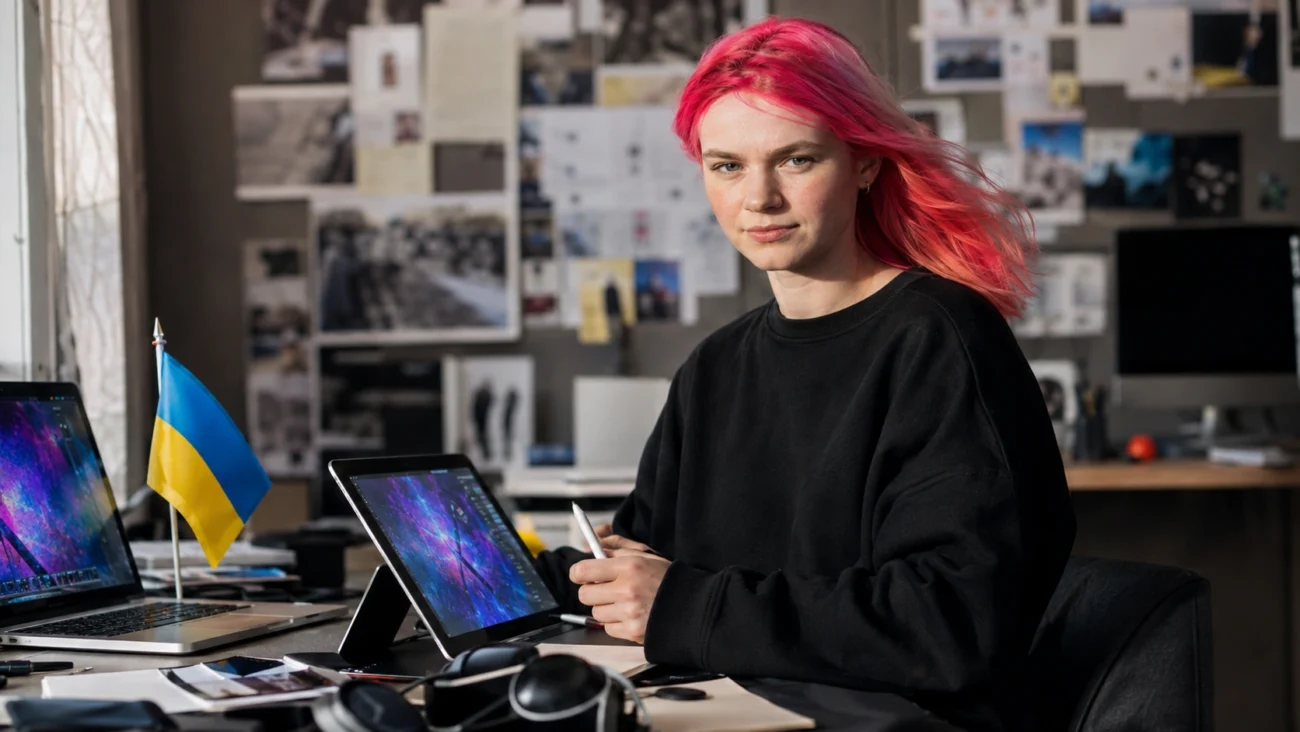
Mila Volovich is a name that now appears across biography pages, trend articles, and people-search results, yet the available descriptions do not point to one clearly documented public figure. Some websites describe her as a Ukrainian digital artist who combines traditional culture with artificial intelligence, augmented reality, and virtual reality. Another article says the phrase is simply a misspelling of Milla Jovovich, the established actress, model, and musician. A third treats the name as an online mystery created by repeated searches and SEO publishing.
That conflict is the most important fact about the keyword. This article does not assume that every repeated biography detail is true. Instead, it examines who Mila Volovich may be, why the name is trending, which claims remain unverified, and why users frequently connect it with Milla Jovovich.
Who Is Mila Volovich?
The clearest answer is that “Mila Volovich” currently functions as an ambiguous people-search query. Online pages use the name as though it belongs to an artist, creator, influencer, or public personality, but their stories are not consistent.
One detailed biography presents a woman born in Kyiv in 1998 who later moved to Berlin and developed an international digital-art career. Another page opens by telling readers that they are probably searching for Milla Jovovich instead. A trend-focused competitor says reliable public information is limited and suggests that curiosity itself may be driving the keyword.
This matters because users normally expect a biography query to produce simple answers. They want an age, birthplace, nationality, education, profession, family history, official Instagram account, photographs, and net worth. However, a search modifier is not evidence. The fact that people type “Mila Volovich age” or “Mila Volovich husband” does not prove that those details have been publicly documented.
A careful description is therefore more useful than a confident but unsupported biography:
Mila Volovich is a name associated with several conflicting online narratives, and a single independently verified public identity is not yet clear.
That wording leaves room for the possibility that a real private individual uses the name while avoiding the claim that the search results have established a notable artist or celebrity.
Why Is Mila Volovich Trending Online?
The phrase appears to have gained visibility during 2026, when multiple sites published articles about it within a relatively short period. Those articles use strong search-friendly angles such as biography, career, digital creativity, online influence, trending searches, and Milla Jovovich name confusion.
A likely explanation is a self-reinforcing content cycle. An unfamiliar name appears in search data or on another website. Publishers notice that the term has limited competition, so they produce new pages targeting it. Once more pages are indexed, users see the name in additional results and assume that it refers to someone already famous. They search again, which creates more apparent demand.
This does not prove that the keyword was deliberately manufactured. It does show why search popularity and real-world notability are not the same thing. A term can become visible because it is confusing, misspelled, repeated, or easy to rank for.
Techslassh, for example, frames Mila Volovich as a mystery keyword whose limited information encourages further curiosity rather than resolving it.
The spelling may also contribute. Mila Volovich resembles Milla Jovovich closely enough to catch typing errors, autocomplete variations, and loosely rewritten content. That makes the keyword useful to publishers covering celebrity searches even when the searcher’s original target is uncertain.
Early Life, Education, and Career Claims Found Online
The most detailed Mila Volovich biography comes from Peace Quarters. It describes her as a Ukrainian-born artist, allegedly born in Kyiv in 1998, influenced by Ukrainian folklore, the Dnipro River, St. Sophia’s Cathedral, the Orange Revolution, Euromaidan, and the 2014 annexation of Crimea.
It also claims that she studied traditional art, attended the National Academy of Fine Arts and Architecture, relocated to Berlin in 2017, and learned digital design through workshops, technology companies, and platforms such as Coursera.
The same page presents an extensive creative career. According to that article, Mila Volovich worked with oil painting, acrylics, Adobe Suite, Unity, AI algorithms, AR filters, virtual galleries, NFTs, QR codes, and VR installations.
It names projects including:
- Whispers of the Forest from 2020
- Echoes of Home and Urban Echoes from 2021
- The Dreamscapes series from 2022–2023
- Thresholds from 2023
- Skin Archive from 2024
- The Quiet Platform from 2025
These details create a complete and attractive artist narrative, but completeness is not the same as verification. Searches for the exact name combined with terms such as artist, gallery, exhibition, portfolio, interview, and official mainly returned more biography-style pages rather than a clearly attributable artist website, established gallery archive, museum catalogue, university profile, or independent interview.
There are also warning signs inside the narrative itself. The Peace Quarters text switches pronouns, introduces unexplained names, uses several quotations without showing where they were published, and makes major claims about auctions, international shows, technology partnerships, prizes, and commissions without linking to the institutions involved.
This does not automatically prove that every claim is false. It means that responsible writers should label them accurately:
- Claimed online: born in Kyiv in 1998 and later based in Berlin.
- Claimed online: trained in fine art and digital design.
- Claimed online: created named AR, VR, textile, and installation projects.
- Not independently established in the reviewed evidence: the biography, exhibitions, auction record, awards, partnerships, quotations, or official portfolio.
That distinction allows an article to address Mila Volovich artist, Mila Volovich career, and Mila Volovich artwork searches without presenting uncertain material as proven fact.
What Information About Mila Volovich Can Actually Be Verified?
The strongest verified fact is not a personal detail. It is that several websites publish incompatible explanations of the same name. One presents a digital artist, one redirects the identity to Milla Jovovich, and one describes a trending term with limited public information.
A useful fact-check separates what a source proves from what it merely states.
| Claim category | Example | Appropriate treatment |
| Directly observable | A specific webpage publishes a Mila Volovich biography | Cite the page as evidence that the claim exists |
| Unverified biography claim | Birth year, education, residence, projects, philanthropy | Attribute the claim and avoid stating it as fact |
| Conflicting claim | Artist versus Milla Jovovich misspelling | Explain both versions and the lack of agreement |
| Independently documented identity | Milla Jovovich’s official career presence | Use authoritative sources for the actress only |
Meaningful identity verification normally comes from an official website, authenticated social account, interview, employer page, university profile, gallery representation, exhibition catalogue, museum record, published portfolio, or reputable independent media coverage.
For a notable artist, readers would usually expect several of these sources to connect the same person, work, dates, and biography.
It is also important to understand circular sourcing. Five pages repeating the same unsupported statement do not necessarily provide five independent confirmations. One page may have copied another, paraphrased it with AI assistance, or reproduced details without checking the original evidence.
Search volume can make a claim look familiar, but familiarity is not authentication. For that reason, the most accurate Mila Volovich biography must openly separate confirmed facts, online claims, and unknown details.
Mila Volovich vs. Milla Jovovich: Are They the Same Person?
The two names are similar, but they should not automatically be treated as identical.
| Search phrase | Key difference |
| Mila Volovich | One “l” in Mila; surname begins with “Vol” |
| Milla Jovovich | Two “l” letters; surname begins with “Jov” |
| Milla Jovović | Diacritic form of the actress’s surname |
| Mila Jovovich | Common shortened or misspelled variation |
| Milla Volovich | Hybrid spelling combining both forms |
Aicot states directly that people searching for Mila Volovich are usually looking for Milla Jovovich. That conclusion is plausible for some searches, but the page does not demonstrate that every use of the name refers to the actress.
Techslassh presents the resemblance more cautiously as one possible cause of the trend.
Unlike the unclear Mila Volovich identity, Milla Jovovich has an official website that identifies her as an actress, musician, and model, links to her official social channels, and provides a film and music archive.
The site lists The Fifth Element from 1997, where she played Leeloo, and Resident Evil: The Final Chapter from 2016, where she played Alice. It also documents her album The Divine Comedy, released on April 5, 1994.
IMDb identifies her full name as Milica Bogdanovna Jovovich and records her birth on December 17, 1975, in Kyiv, then part of the Ukrainian SSR in the Soviet Union.
The official distinction can be summarized simply:
Milla Jovovich’s official site describes her as an “Actress. Musician. Model.”
Therefore, someone searching for the Resident Evil star, Leeloo, Alice, or the actress born in 1975 almost certainly means Milla Jovovich, not Mila Volovich.
Someone searching for the alleged digital artist may be responding to the newer biography pages. The safest approach is person-name disambiguation, not an unsupported declaration that the two are always the same person.
Why Do Mila Volovich Biographies Contradict One Another?
The search results provide a useful case study in entity confusion. The same keyword has been attached to at least three different stories:
| Online narrative | Main description | Main problem |
| Digital-artist narrative | Ukrainian-born creator using AI, AR, VR, folklore, and installations | Extensive claims lack visible independent documentation |
| Celebrity-misspelling narrative | Mila Volovich is Milla Jovovich | May resolve some searches but assumes all users mean the actress |
| Trend-mystery narrative | An unclear name made popular through searches and publishing | Explains ambiguity but cannot identify the original person |
Several factors can create this pattern. Publishers may target a low-competition keyword before reliable source material exists. Writers may combine generic biography language with popular themes such as digital creativity, authenticity, resilience, personal branding, Ukrainian culture, and artificial intelligence.
Later pages may treat the earlier copy as evidence, causing unsupported details to spread.
The wording across newer pages often remains broad. Some call Mila Volovich a creative voice, influencer, artist, designer, storyteller, or modern digital personality without naming verifiable clients, publications, institutions, gallery representation, or original work.
This does not justify accusing every publisher of fabrication or AI generation. It does justify asking basic questions:
- Where did the biographical detail originate?
- Is there a primary source?
- Can the named exhibition, school, employer, or artwork be traced independently?
- Does the photograph belong to the named person?
- Are multiple pages genuinely independent, or do they repeat one another?
An evidence-based article should never create new facts simply to fill a biography template.
Official Profiles, Photographs, and Digital Footprint
Users searching for Mila Volovich Instagram, TikTok, YouTube, official website, portfolio, or photos have navigational intent. They are not only asking for a story; they want the correct destination.
A genuine official profile should show several consistent signals. The name and spelling should remain stable. The account should contain original posts over time, link to a recognized website or employer, identify real collaborators, and match information from independent sources.
A generic Instagram topic page, search landing page, or unrelated account is not enough to establish a public identity.
Photographs need the same care. Because Mila Volovich and Milla Jovovich are easily confused, an image of the actress may be reused or mislabeled. Before publishing a photo, check its original caption, photographer, licensing information, and first known appearance.
A reverse-image search can reveal whether the picture belongs to Milla Jovovich, another creator, a stock-photo model, or an unrelated private person.
For the alleged artist identity, a meaningful digital footprint would normally include an artist statement, dated portfolio, gallery page, exhibition history, catalogue entry, interviews, commissions, and traceable collaborators.
In the searches reviewed here, biography and trend pages were far more visible than such first-party or institutional records.
Search Popularity Does Not Prove Public Notability
A searchable name is not automatically a famous person. Search engines index whatever publishers make available, including misspellings, duplicate pages, speculative profiles, and content created around emerging keywords.
Real-world notability usually involves sustained independent coverage, identifiable achievements, and reliable sources that are not controlled by the subject or copied from one another. A keyword can rise because users are confused, not because the person behind it has become influential.
This distinction explains the Mila Volovich trend. The phrase may have growing visibility, yet the results still struggle to answer the basic question: Who is the independently documented person?
Until that changes, search interest should be described as evidence of curiosity—not proof of fame, professional success, or a specific biography.
What Remains Unknown About Mila Volovich?
Several popular biography questions still lack dependable answers for a distinct public figure under this exact name.
| Detail | Current status |
| Age and birth date | The 1998 claim appears in biography pages but is not independently established |
| Nationality | Ukrainian identity is claimed, not conclusively documented |
| Education | Art-school and academy claims require institutional confirmation |
| Profession | Pages variously describe an artist, creator, influencer, or misspelled actress |
| Official social accounts | No account should be labeled official without authentication |
| Husband or partner | No dependable public information established |
| Net worth | No credible basis for a figure |
| Artwork and exhibitions | Require gallery, catalogue, museum, festival, or auction records |
| Photographs | Require source and identity verification |
Privacy also matters. If Mila Volovich is a real person without a public career, the lack of a detailed biography may simply mean that personal information is not intended for broad publication.
Could Mila Volovich Continue Trending?
Yes, but future demand is difficult to predict without trustworthy keyword-volume data. Interest could increase if a verified creator publicly claims the name, an official portfolio appears, a reputable outlet investigates the conflicting biographies, or social-media discussions grow.
The term could also receive renewed attention whenever Milla Jovovich appears in entertainment news, because spelling confusion may send some users to the wrong query. Milla’s official site continues to document active film work, which keeps her name relevant and searchable.
However, more articles alone would not resolve the identity. The trend becomes genuinely informative only when new pages add primary evidence rather than repeating previous descriptions.
Frequently Asked Questions
Who is Mila Volovich?
Mila Volovich is an ambiguous name linked to several online narratives. Some pages describe a Ukrainian digital artist, another treats the phrase as a misspelling of Milla Jovovich, and others discuss it as a trending keyword.
A single independently verified public identity is not clear from the reviewed evidence.
Is Mila Volovich a real public figure?
A real private person may use the name, but the reviewed search results do not clearly establish one notable public figure with an authenticated biography, official portfolio, and consistent independent coverage.
Is Mila Volovich the Same Person as Milla Jovovich?
Not necessarily. One competitor says the term is usually a misspelling, while another presents the similarity as a possible explanation.
Milla Jovovich is the documented actress, model, and musician associated with The Fifth Element and the Resident Evil films.
Is Mila Volovich a Ukrainian Digital Artist?
That description appears in multiple biography pages, but the detailed claims about her birth, education, exhibitions, artworks, partnerships, and career require independent confirmation.
It is more accurate to call this an online claim than a settled fact.
Why Is Mila Volovich Trending?
Likely reasons include repeated publishing, low keyword competition, online curiosity, and confusion with Milla Jovovich. The precise origin of the trend has not been conclusively established.
Does Mila Volovich Have an Official Instagram Account?
No account should be called official unless it can be authenticated through a consistent professional identity, an official website, verified links, or dependable independent sources.
Generic topic pages and unrelated accounts do not provide enough proof.
Are Mila Volovich’s Age and Net Worth Known?
No dependable age or net-worth figure has been established for a distinct public figure under the exact name.
The frequently repeated 1998 birth claim comes from biography-style pages, while net-worth searches appear to be standard celebrity-query modifiers rather than evidence.
How Can Readers Verify Mila Volovich Information?
Start with primary sources: an official website, verified social profile, direct interview, institutional biography, gallery or exhibition archive, published portfolio, or reputable news report.
Check whether several independent sources agree, trace quotations to their originals, and verify photographs before reusing them.
Conclusion
Mila Volovich is best understood as an unresolved identity query rather than a fully verified celebrity biography. The online record currently mixes a detailed digital-artist story, a Milla Jovovich spelling explanation, and a search-trend mystery.
The responsible approach is to identify those narratives, verify what can be verified, and clearly label everything else as a claim or unknown. Until stronger primary evidence appears, accuracy is more valuable than a polished but unsupported life story.
Disclaimer:
This article is for general informational purposes only. Information, experiences, preferences, and individual circumstances may vary, so readers should use their own judgment when applying any details discussed.
