


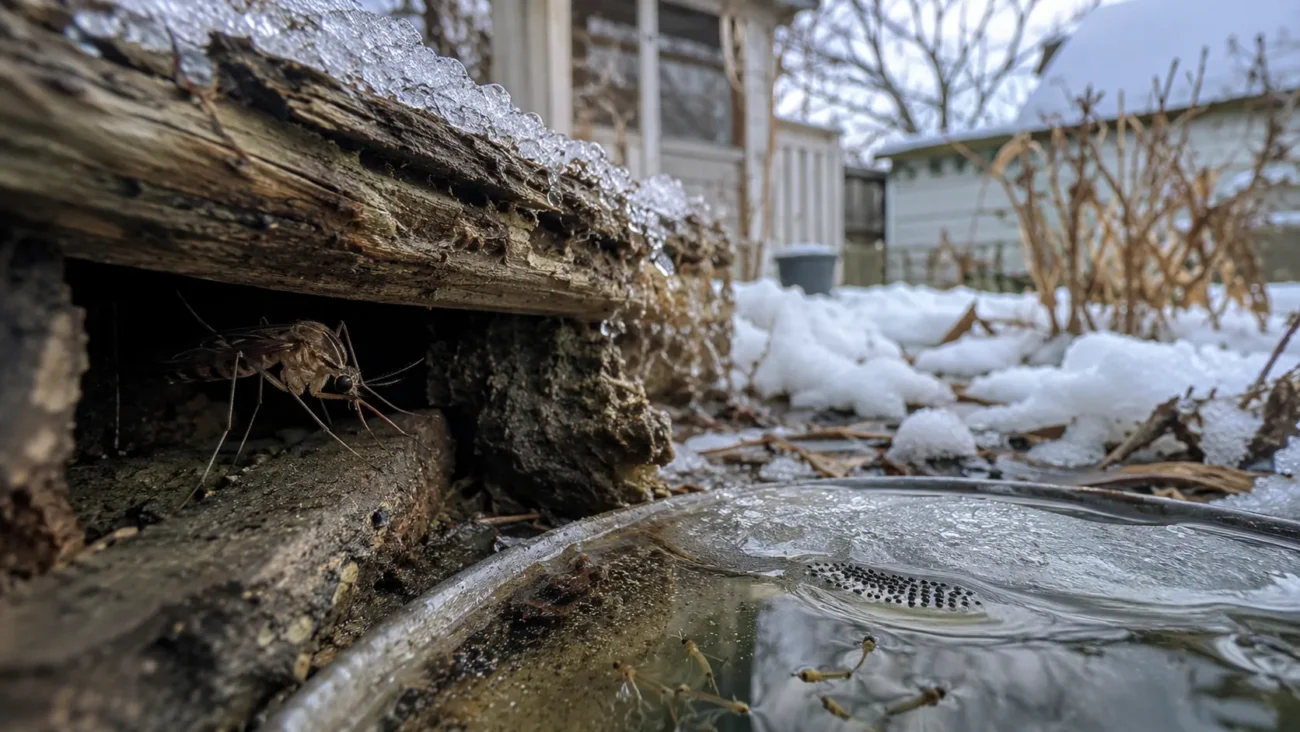
Where do mosquitoes go in the winter is a common question because these tiny pests seem to disappear when cold weather arrives, then suddenly return when spring becomes warm and wet. The simple answer is that mosquitoes do not all go to one place. Some die, some hide, and some survive as dormant eggs, larvae, or adult female mosquitoes.
Mosquitoes are cold-blooded insects, which means their activity depends heavily on the temperature around them. When the weather gets too cold, they slow down, stop flying, stop breeding, or enter a resting state. In many areas, mosquito activity drops sharply when temperatures fall around 50°F.
Still, winter does not erase mosquitoes completely. Enough of them survive in protected places, water sources, or dormant life stages to restart the mosquito life cycle when warm weather, standing water, spring rains, and snowmelt return.
This guide explains how mosquitoes survive winter, where they hide, whether they die or hibernate, how eggs and larvae make it through cold weather, and what you can do before spring to reduce mosquito problems around your home.
The Short Answer: Mosquitoes Hide, Go Dormant, or Survive as Eggs
Mosquitoes survive winter in different ways depending on the species, climate, and life stage. Some adult mosquitoes die when temperatures drop, especially exposed adults that cannot find shelter. But other mosquitoes survive by entering a dormant state or by staying protected as eggs or larvae.
Here is a simple breakdown:
| Mosquito Life Stage | What Happens in Winter |
| Adult females | Hide in sheltered areas and may enter diapause |
| Mosquito eggs | Stay dormant until warmth and water return |
| Mosquito larvae | May survive in cold water in some species |
| Male mosquitoes | Usually die before or during cold weather |
This is why mosquitoes seem to vanish but come back so quickly. They are not always starting from zero in spring. In many places, overwintering mosquitoes are already nearby, waiting for better conditions.
Adult females may hide in basements, garages, sheds, storm drains, hollow logs, tree holes, animal burrows, or other protected spots. Eggs may sit in damp soil, containers, or flood-prone areas until spring rain or melting snow creates the right conditions for hatching.
So, when people ask where do mosquitoes go during the winter, the best answer is: they survive wherever they can stay protected from harsh cold, drying winds, and freezing exposure.
Do Mosquitoes Die in the Winter?
Yes, many mosquitoes do die in winter, but not all mosquitoes die in winter. Cold temperatures can kill exposed adults, especially if they are not protected by shelter. Male mosquitoes are especially unlikely to survive the cold season because their role is mostly to mate, and they usually die before or during winter.
However, mosquito populations survive because some females, eggs, or larvae make it through the cold months. In some species, adult females mate before winter, then hide and enter a resting state. When spring arrives, those females may become active again and look for a blood meal so they can lay eggs.
Temperature matters, but it is not the only factor. Many mosquitoes become slow and inactive when temperatures drop near 50°F. At lower temperatures, they may stop flying completely. Hard freezes can kill exposed mosquitoes, but mosquitoes protected inside storm drains, basements, woodpiles, crawl spaces, or tree holes may survive much longer.
Eggs can be even tougher. Some cold-resistant eggs can remain dormant through winter and hatch later when water and warmth return. This is one reason mosquitoes return every year even in cold northern climates.
So, the answer is not simply “winter kills mosquitoes.” A better answer is: winter kills many mosquitoes, but some survive through dormancy, shelter, or eggs.
Do Mosquitoes Hibernate or Enter Diapause?
People often ask, do mosquitoes hibernate? In everyday language, it is fine to say mosquitoes “hibernate,” but the more accurate term is diapause.
Diapause is a natural resting state that helps insects survive poor conditions. During diapause, a mosquito’s development slows down, its metabolism drops, and it waits until the environment becomes better. This is similar to hibernation, but it is not exactly the same as the way bears or mammals hibernate.
Mosquitoes may enter diapause because of shorter daylight, colder temperatures, or seasonal changes. For adult female mosquitoes, diapause can help them survive the winter in protected places. For eggs or larvae, dormancy can pause development until spring.
Another related term is quiescence. This is a shorter-term pause caused by unfavorable conditions, such as sudden cold or dryness. If the weather warms again, the mosquito may become active more quickly.
In simple terms:
- Diapause is a deeper, seasonal survival pause.
- Quiescence is a temporary pause caused by bad conditions.
- Hibernation is the common word people use, but it is less exact for mosquitoes.
Understanding this helps explain how mosquitoes survive winter without needing food, flight, or normal breeding activity. They are not active in the same way they are during summer. They slow down and wait.
Where Adult Mosquitoes Hide During Winter
Adult mosquitoes, especially adult female mosquitoes, look for quiet, protected places during winter. They need shelter from freezing temperatures, strong wind, and dry air. Many prefer damp or dark areas because moisture helps them avoid drying out.
Common winter hiding places include:
- Basements
- Garages
- Sheds
- Crawl spaces
- Storm drains
- Sewer drains
- Tree holes
- Hollow logs
- Woodpiles
- Animal burrows
- Leaf piles
- Cracks in foundations
- Spaces under decks
Around homes, mosquitoes may rest in areas that are rarely disturbed. A garage corner, a basement drain area, or a damp crawl space may give them enough protection to survive until warmer days return.
Outdoors, they may use natural shelters like hollow tree trunks, tree holes, thick vegetation, or animal burrows. In cities and suburbs, storm drains, clogged gutters, and drainage areas can also provide sheltered winter spaces.
This is why mosquito prevention is not only a summer task. If your yard has standing water, leaf piles, clogged gutters, or damp hiding places, you may be helping mosquitoes survive winter or giving them a place to breed when spring arrives.
The key idea is simple: mosquitoes do not fly south like birds. They usually stay close to where they already live, then survive in hidden, protected spaces.
How Mosquito Eggs and Larvae Survive Cold Weather
Not all mosquitoes survive winter as adults. Many species survive as mosquito eggs or mosquito larvae.
Some mosquito eggs are laid before winter in places that may later fill with water. These include containers, damp soil, tree holes, flood-prone areas, and small outdoor objects that collect rain. The eggs can stay dormant until spring brings moisture and warmth.
This is especially important for Aedes species, including mosquitoes often linked with container breeding. Their eggs may be laid just above the waterline in containers or damp areas. When water rises later, the eggs can hatch.
Some mosquito eggs are very resilient. In certain cases, eggs may survive for over a year or even longer under the right conditions. That does not mean every mosquito egg survives every winter, but it does show why removing water-holding items matters even in cold months.
Mosquito larvae can also survive cold weather in some situations. Larvae live in water, so their survival depends on the water source, temperature, oxygen, and species. In cold climates, some larvae may stay inactive in water where conditions remain stable. In warmer climates, larvae may continue developing slowly if the water does not get too cold.
This is why standing water is always important. Even a small amount of water in a bucket, tire, bird bath, gutter, or plant saucer can become a breeding site when temperatures rise.
What Temperature Makes Mosquitoes Inactive?
Mosquitoes are cold-blooded, so they cannot control their body temperature the way humans do. When the air gets cold, their bodies slow down.
Many mosquitoes become less active around 50°F. Below that point, they may fly less, bite less, and stop normal breeding activity. When the weather gets much colder, exposed adults may die. But there is no single temperature that kills every mosquito in every situation.
Why? Because survival depends on:
- The mosquito species
- Whether it is an adult, egg, larva, or pupa
- How long the cold lasts
- Whether the mosquito is sheltered
- Whether water or moisture is available
- Whether a warm microclimate exists nearby
For example, a mosquito exposed to freezing air may die quickly, while another mosquito hidden in a basement, drain, or hollow log may survive the same cold spell. Eggs can also be tougher than adult mosquitoes.
Warm winter days can briefly change mosquito behavior. If temperatures rise above 50°F for several hours, some mosquitoes may become active again, especially in mild climates. This is why people sometimes notice mosquitoes during winter warm spells.
So, instead of asking only what temperature kills mosquitoes, it is better to ask: what conditions help mosquitoes survive or become active again?
Why Mosquitoes Come Back So Quickly in Spring
Mosquitoes return quickly in spring because winter does not fully remove them. Dormant adults, eggs, or larvae may already be waiting nearby. Once temperatures rise and water becomes available, the mosquito breeding cycle can restart.
Spring creates ideal mosquito conditions because of:
- Warmer temperatures
- Spring rains
- Snowmelt
- Standing water
- Longer daylight
- Moist soil and containers
- More animal and human activity outdoors
When dormant eggs are flooded by rain or melting snow, they may hatch. Larvae then develop in water, become pupae, and finally emerge as adult mosquitoes. Under warm conditions, parts of this life cycle can move quickly, sometimes in about one to two weeks.
This is why a yard can seem mosquito-free in late winter but feel full of mosquitoes a few weeks after spring rain. A single female mosquito can lay hundreds of eggs, so even a small number of survivors can lead to a large spring population.
The best time to reduce spring mosquitoes is before the first big wave appears. Removing water sources early can stop eggs and larvae before they become biting adults.
Do All Mosquito Species Survive Winter the Same Way?
No, all mosquitoes do not survive winter the same way. Mosquito species differences matter a lot.
Some species survive winter as dormant adult females. For example, certain Culex mosquitoes, including Culex pipiens, may overwinter in sheltered places. These mosquitoes can rest through the cold season and become active again when conditions improve.
Other mosquitoes, including some Aedes species, often survive as eggs. These eggs can wait through dry or cold periods, then hatch when water returns. This is common with container-breeding mosquitoes and floodwater mosquitoes.
Some mosquitoes may survive as larvae in water, especially if conditions are protected enough. Others are more adapted to cold regions. For example, Aedes communis, sometimes called a snow mosquito or winter mosquito, is known for appearing in colder areas.
This is why simple answers like “mosquitoes die in winter” or “mosquitoes hibernate” are incomplete. The real answer depends on the type of mosquito and the environment.
A helpful way to think about it is this:
| Survival Method | Common Example |
| Adult female dormancy | Some Culex mosquitoes |
| Dormant eggs | Some Aedes mosquitoes |
| Larval survival | Some species in protected water |
| Cold-adapted activity | Snow mosquitoes in colder regions |
This species-level detail makes the topic clearer and more accurate.
Why You May Still See Mosquitoes Indoors in Winter
Seeing mosquitoes indoors during winter can be confusing, but it does happen. An indoor mosquito does not always mean there is a large infestation. It may be an adult mosquito that found shelter inside before the weather turned cold.
Mosquitoes may hide or rest in:
- Basement corners
- Crawl spaces
- Garages
- Utility rooms
- Laundry areas
- Damp storage spaces
- Floor drains
- Potted plant saucers
- Sump pump pits
Indoor warmth can also allow mosquitoes to remain active longer than they would outdoors. If there is water nearby, such as a plant saucer, drain, or damp container, mosquitoes may have a place to rest or possibly breed in mild conditions.
If you notice mosquitoes in your house during winter, check for standing water first. Empty plant trays, fix leaks, clean drains, and look for damp areas in basements or utility rooms. Also check gaps around doors, windows, vents, and foundation openings.
In most cases, indoor winter mosquitoes are not a sign that mosquitoes are “taking over” your house. But they are a signal that hidden moisture or entry points may need attention.
Cold Climates vs Warm Climates: Why Winter Mosquito Activity Varies
Winter mosquito activity depends strongly on where you live. In cold northern climates, mosquitoes are usually inactive for long periods. Adults may die unless sheltered, while eggs or larvae may wait for spring.
In warmer regions, mosquitoes may remain active much longer. In mild winter climates, warm spells can allow adult mosquitoes to fly, bite, or breed. In some subtropical areas, mosquito activity can continue for much of the year.
Urban and suburban areas can also create warmer microclimates. Buildings, drains, basements, and sheltered yards may hold enough warmth and moisture to help mosquitoes survive. Rural wetlands, marshes, ditches, and low-lying areas can also support eggs or larvae that return with spring water.
That is why two people in different places may have very different winter mosquito experiences. Someone in a cold northern area may see no mosquitoes for months. Someone in a warmer coastal or southern region may still see mosquitoes during mild winter days.
The article answer stays the same: mosquitoes survive by slowing down, hiding, or waiting in dormant life stages. But the amount of winter activity depends on the local climate.
Winter Mosquito Prevention: What to Do Before Spring
Winter is a smart time to reduce mosquito problems before they grow. You may not see many mosquitoes, but eggs, larvae, or sheltered adults may already be nearby.
The most important step is to remove standing water and reduce sheltered mosquito hiding places. Mosquitoes need water for eggs and larvae, so fewer water sources means fewer mosquitoes later.
Use this simple winter and early spring checklist:
| Area to Check | What to Do |
| Gutters | Clean leaves and clogs so water drains properly |
| Buckets and toys | Store upside down or indoors |
| Bird baths | Empty, clean, and refresh often |
| Pet bowls | Do not leave water sitting outside |
| Tires | Remove or cover them |
| Tarps and covers | Pull tight so water does not pool |
| Pool covers | Drain collected rainwater |
| Rain barrels | Keep screened and covered |
| Leaf piles | Remove damp yard debris |
| Basements and drains | Check for moisture and standing water |
Also inspect crawl spaces, garages, sheds, and areas under decks. Seal gaps around doors, windows, and foundations where mosquitoes may enter or hide.
If your area has heavy mosquito problems every year, early prevention can make spring easier. In severe cases, contacting a local mosquito control program or professional pest control service may help identify hidden breeding sites.
The goal is not only to kill adult mosquitoes. The bigger goal is larval source reduction, which means removing places where mosquitoes can develop before they become biting adults.
Common Myths About Mosquitoes in Winter
There are many myths about mosquitoes and cold weather. Clearing them up helps homeowners take better action.
| Myth | Truth |
| All mosquitoes die in winter | Many die, but some survive as adults, eggs, or larvae |
| Mosquitoes hibernate like bears | They usually enter diapause or dormancy, not true mammal-style hibernation |
| Freezing weather kills every egg | Some eggs are cold-resistant and can stay dormant |
| Standing water does not matter in winter | It can become a spring breeding site |
| Mosquitoes only survive in warm states | Many species survive cold climates through dormancy |
| If I do not see mosquitoes, there are none nearby | Eggs or hidden adults may still be present |
The biggest myth is that winter solves the mosquito problem completely. It does reduce mosquito activity, but it does not always remove the next generation. That is why early prevention matters.
Conclusion: Mosquitoes Do Not Vanish — They Wait for Better Conditions
Mosquitoes do not simply disappear in winter. Some die, but others survive by hiding in sheltered areas, entering diapause, staying dormant as eggs, or slowing down as larvae in protected water.
The exact survival method depends on the mosquito species, local climate, temperature, moisture, and available shelter. In cold areas, mosquitoes may be inactive for months. In warmer regions, they may appear during mild winter days.
The best takeaway is simple: winter is the right time to prepare for spring. Remove standing water, clean gutters, check containers, reduce yard debris, and inspect indoor damp areas. These small steps can help reduce the mosquito population before it grows again.
FAQs About Where Mosquitoes Go in the Winter
Do mosquitoes completely disappear in winter?
No. Mosquitoes may seem to disappear because they become inactive, but some survive as dormant adult females, eggs, or larvae. Their activity drops in cold weather, then returns when temperatures rise and water becomes available.
Can mosquitoes survive freezing temperatures?
Some can, depending on the species and life stage. Exposed adult mosquitoes may die in freezing weather, but cold-resistant eggs or sheltered adults may survive. Mosquitoes hidden in basements, storm drains, hollow logs, or other protected areas have a better chance of making it through winter.
Why do mosquitoes come back after winter?
Mosquitoes come back after winter because dormant eggs hatch, larvae develop, and adult females become active again when warm temperatures, spring rain, and standing water return. Even a small number of survivors can rebuild the population quickly.
Can mosquito eggs survive winter?
Yes, some mosquito eggs can survive winter. Certain species lay eggs that stay dormant until water and warmth return. These eggs may be found in containers, damp soil, tree holes, or flood-prone areas.
Should I remove standing water in winter?
Yes. Removing standing water in winter helps prevent mosquito problems in spring. Buckets, tires, bird baths, clogged gutters, tarps, plant saucers, and pool covers can all collect water and become mosquito breeding sites when the weather warms.
Disclaimer: This article is for general informational and educational purposes only and does not constitute medical, public health, pest-control, or environmental advice. Mosquito behavior, survival patterns, and seasonal activity vary by species, climate, and local conditions. For concerns about mosquito-borne diseases or severe infestations, consult qualified healthcare professionals or local pest-control authorities.
