


Key Takeaways
- A strong supply plan keeps critical parts, tools, and safety items ready before equipment fails.
- Inventory decisions should reflect equipment risk, part usage, supplier lead times, and maintenance history.
- Clear labels, organized storage, and standardized items reduce repair delays and duplicate orders.
- Simple digital tracking can improve reorder timing and reveal costly stockouts.
- Energy-control devices and personal protective equipment should be managed as essential operating inventory.
Table Of Contents
- Introduction
- Why Supply Planning Matters
- Audit Current Inventory
- Rank Equipment By Risk
- Set Practical Stock Levels
- Organize MRO Items
- Use Maintenance Data
- Build Supplier Rules
- Protect Worker Safety
- Create A 90-Day Action Plan
- Common Questions
Production uptime depends on more than skilled technicians and dependable equipment. It also depends on whether the right parts, tools, and safety supplies are available when work begins. Working with a reliable industrial equipment supplier serving the Triangle can help manufacturing teams reduce avoidable delays and make purchasing decisions that support long-term plant performance.
A smarter maintenance supply plan gives maintenance, operations, purchasing, and safety teams a shared method for deciding what to stock, where to store it, and when to reorder it. The goal is not to fill every shelf. It is to protect the equipment and jobs that matter most while avoiding unnecessary inventory costs.
Why Supply Planning Matters
Downtime often begins before a machine stops. A missing bearing, belt, fuse, fitting, fastener, or inspection tool can turn a straightforward repair into hours of waiting. Emergency orders also create premium freight charges, disrupt schedules, and pull technicians away from planned maintenance. For example, a low-cost sensor may stop an entire packaging line if no approved replacement is available locally.
Supply readiness supports quality, safety, and output. A slow-moving spare may still earn its shelf space when it protects a bottleneck asset, prevents a rushed repair, or avoids using an unapproved substitute.
Audit Current Inventory
Start with a physical count of what is actually on-site. Compare shelves, cabinets, cages, and maintenance carts with purchasing records. Record part numbers, descriptions, brands, sizes, quantities, storage locations, and condition. Flag damaged, expired, obsolete, duplicated, or unidentified items.
Practical Audit Steps
- List every maintenance, repair, and operations item by location.
- Review recent work orders to identify frequently used materials.
- Identify parts with long lead times, limited suppliers, or unclear compatibility.
- Remove unusable inventory and mark uncertain items for technical review.
- Use a spreadsheet for a small plant, or barcodes and a CMMS for larger inventories.
Rank Equipment By Risk
Not every asset requires the same level of protection. Rank equipment as low, medium, or high risk based on safety consequences, production impact, repair difficulty, failure history, replacement lead time, and availability of backup equipment. A failed backup fan may be inconvenient, while a failed drive motor or control component on a bottleneck line may halt production.
High-risk assets should receive priority during spare-parts budget reviews. For each one, identify the parts needed to restore service, confirm approved specifications, and decide whether the item should be held on-site or available through a dependable rapid-delivery arrangement.

Set Practical Stock Levels
Stock levels should reflect actual operating conditions rather than habit. Set a minimum level that triggers reordering, a maximum level that limits excess inventory, and safety stock for unexpected demand or delivery delays. The reorder point should account for normal usage during supplier lead time, plus an appropriate cushion for critical items.
A part used only once a year can still be a critical spare if delivery takes several weeks and a failure would stop production. Review planned shutdowns, seasonal demand, supplier reliability, and shelf-life limits before deciding how much to carry.
Organize MRO Items
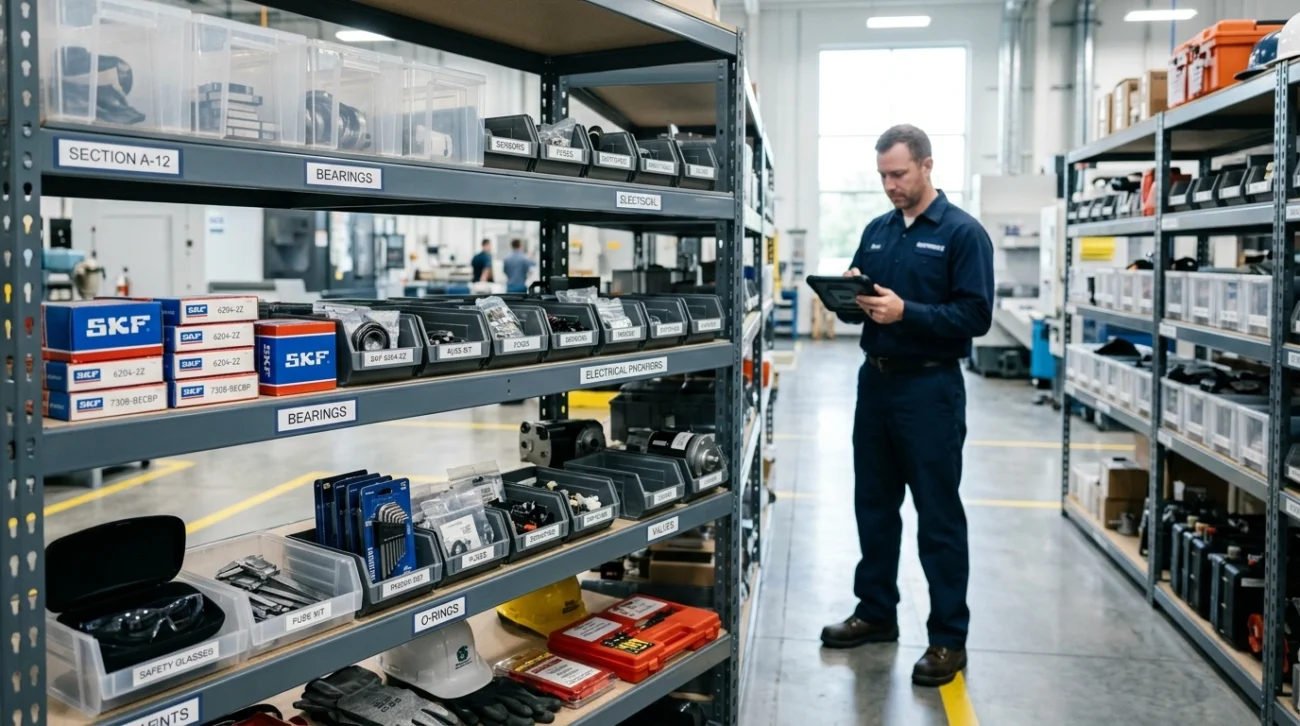
Organized storage helps technicians spend time repairing equipment rather than searching for supplies. Use clear bin labels that include a part number and plain-language description. Separate electrical, pneumatic, mechanical, welding, chemical, and safety supplies. Place high-use items near the maintenance area, while keeping expensive or restricted items in controlled-access storage.
A simple labeled-bin system can make a major difference. When a technician can locate the correct 6205 bearing, approved lubricant, or pneumatic fitting in seconds, the team is less likely to order duplicates or install the wrong part. Rotate date-sensitive materials using first-in, first-out practices and protect moisture-sensitive products from unsuitable storage conditions.
Use Maintenance Data
Work orders provide useful evidence for improving inventory decisions. Track monthly part usage, stockout frequency, emergency orders, supplier lead times, repeat failures, and repair delays caused by missing items. These measures reveal whether a reorder point is too low, whether a part fails more often than expected, or whether multiple departments are borrowing from the same inventory.
Digital records do not need to be complicated to be useful. Maintenance data can connect failure patterns with purchasing decisions, and planning and control research highlights the value of linking equipment information, diagnostics, and operational decisions. Start with reliable part descriptions and accurate counts before adding more advanced software.
Build Supplier Rules
Clear supplier rules prevent urgent purchases from becoming risky purchases. Review product compatibility, delivery performance, warranty terms, return policies, freight costs, and backup sourcing options. Evaluate the total cost rather than the unit price alone, since a cheaper item can become expensive if it fails early or requires rush shipping.
Set approval rules for substitutes. A replacement must meet the required size, material, pressure, temperature, electrical rating, and safety requirements. Maintenance and engineering should approve substitutions for critical components before installation, especially where a mismatch could create equipment damage, quality issues, or worker exposure.
Protect Worker Safety
Safety inventory belongs in the core supply plan. Maintain adequate quantities of lockout/tagout devices, safety glasses, face shields, hearing protection, gloves, respirator supplies, welding protection, fall-protection equipment, spill-control materials, barriers, and warning signs.
Energy-control supplies deserve particular attention because maintenance work can involve electrical, mechanical, hydraulic, pneumatic, chemical, and thermal hazards. Lockout/tagout practices that control hazardous energy help protect workers from unexpected startup and stored-energy release during servicing. Review devices, procedures, and training whenever equipment or processes change.
Create A 90-Day Action Plan
Days 1-30: Find The Gaps
- Complete a physical inventory count and remove unusable items.
- Identify the 20 most-used supplies and the highest-risk assets.
- Document critical spares, current quantities, and supplier lead times.
Days 31-60: Set Standards
- Assign storage locations and standardize part descriptions.
- Set minimum, maximum, and reorder levels.
- Establish approved-substitute and supplier-review rules.
Days 61-90: Track Results
- Measure stockouts, emergency orders, and repair delays.
- Adjust reorder points based on actual consumption.
- Train maintenance and purchasing staff, then schedule quarterly reviews.
Common Questions
How Much Spare Inventory Should A Plant Keep?
The right amount depends on equipment risk, downtime cost, usage history, supplier lead time, and available backup equipment. Critical parts usually require more protection than common items with fast delivery.
Is A CMMS Required?
No. A disciplined spreadsheet can work for a smaller operation. A CMMS becomes more valuable as the number of assets, work orders, storage locations, and suppliers grows.
What Is The Biggest Planning Mistake?
Treating every item the same is a common mistake. Risk-based planning directs attention and budget toward the parts and supplies that can create the greatest operational or safety consequences.
Conclusion
A smarter maintenance supply plan starts with accurate counts, organized storage, risk-based decisions, and regular review. When the right parts, tools, and safety supplies are available before they are needed, manufacturing plants can reduce avoidable downtime, support safer repairs, and make better use of every production hour.
