


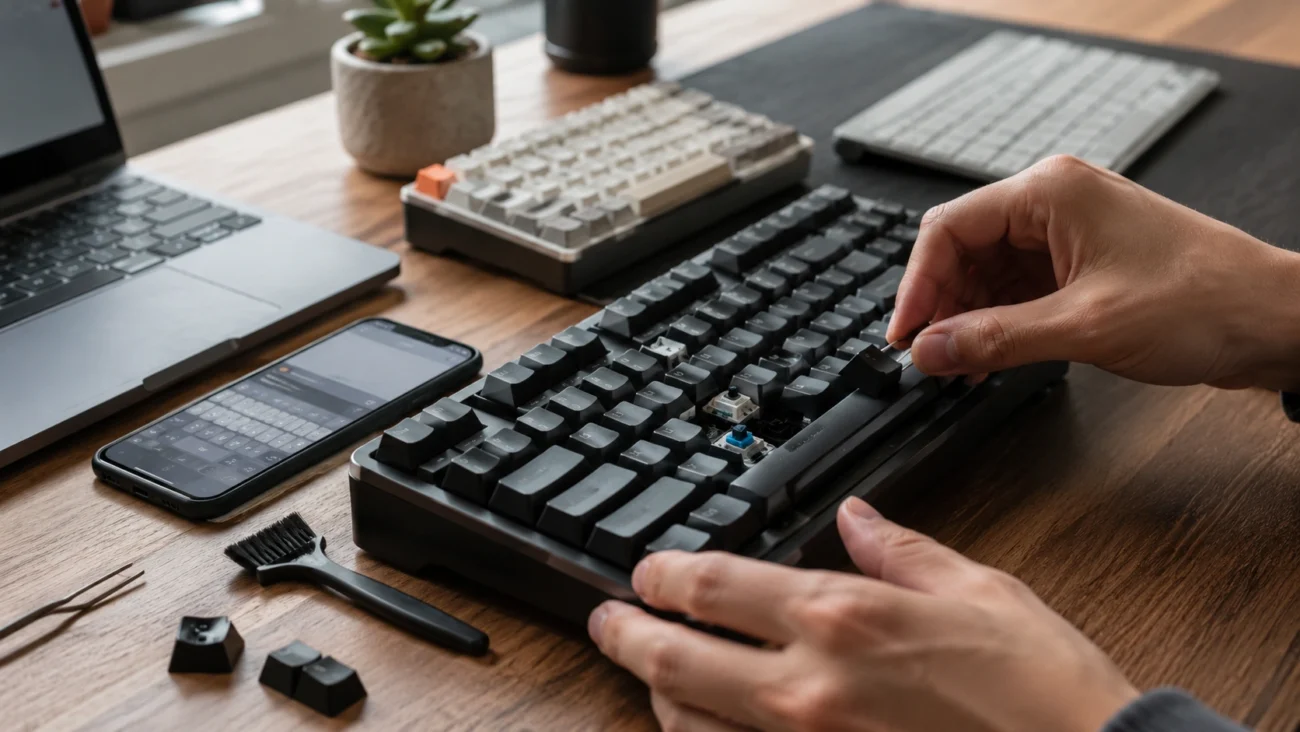
Kibard is usually a phonetic or incorrect spelling of keyboard, the physical or virtual input device people use to enter letters, numbers, symbols, shortcuts, and commands. Someone may type “kibard” because of pronunciation, fast mobile typing, voice-to-text transcription, or a simple spelling mistake. Search engines normally understand the intended topic and show results about computer keyboards.
This guide covers the kibard meaning, keyboard types, layouts, buying factors, modern technology, and practical fixes.
Kibard Meaning: The Quick Answer
The correct English spelling is keyboard. Kibard is commonly used as a misspelling or pronunciation-based variation.
| Search term | Meaning |
| Kibard | A common phonetic spelling or typing error |
| Keyboard | An input device used to type and control a digital device |
A keyboard may be physical or virtual, but both forms enter information and control software.
Is Kibard an Official Word, Product, or Brand?
In technology searches, kibard is not the standard English word for the device. The accepted term is keyboard, and most searchers want keyboard information rather than a separate product.
Why Do People Type Kibard Instead of Keyboard?
The error makes sense when “keyboard” is written according to sound. Common causes include fast touchscreen typing, failed autocorrect, voice-to-text transcription, regional pronunciation, and missing letters during hurried searches.
The spelling may appear in Pakistan, India, Bangladesh, and other multilingual markets where English technology terms are sometimes searched phonetically. The correction should be polite and immediate.
Why Does Google Show Keyboard Results for Kibard?
Search systems consider spelling similarity, surrounding words, and likely intent. Therefore, “gaming kibard price” is usually understood as a gaming-keyboard query, while “kibard not working” signals troubleshooting intent.
What Is a Keyboard and How Does It Work?
A keyboard is an input device, not an output device. It sends information to a computer, laptop, tablet, phone, smart TV, or gaming console. Output devices, such as monitors and speakers, present information back to the user.
When you press a physical key, the keyboard detects the action through a switch, membrane layer, optical sensor, or magnetic sensor. It then sends a key code through a wired USB connection, a wireless receiver, or Bluetooth. The operating system and active application interpret that code as a letter, number, symbol, shortcut, or command.
For example, A may insert a character, while Ctrl + C may copy selected text. The result depends on the application, layout, modifier keys, and system settings.
A virtual keyboard works differently at the hardware level but performs the same basic role. A tap on a touchscreen is translated into digital input. Windows also offers an On-Screen Keyboard for typing and navigation without a physical keyboard.
From Typewriters to Modern Keyboards
Modern keyboards developed from typewriter technology. Christopher Latham Sholes, Carlos Glidden, and Samuel W. Soule received an 1868 patent connected to an early commercially produced typewriter. E. Remington & Sons later began producing the Sholes and Glidden Type-Writer in 1873.
The QWERTY layout takes its name from the first six letters on the upper letter row: Q, W, E, R, T, and Y. Over time, keyboard design moved from mechanical type bars to electrical terminals, desktop keyboards, laptops, wireless models, touchscreens, and highly customizable gaming keyboards.
Main Parts of a Keyboard
A standard keyboard includes alphabet keys, a number row, function keys, modifiers, arrows, navigation controls, and sometimes a numeric keypad. Compact designs remove or combine controls to save space.
Important key groups include:
- Modifier keys: Shift, Ctrl, Alt, Command, and the Windows key
- Navigation keys: Arrow keys, Home, End, Page Up, and Page Down
- Editing keys: Backspace, Delete, Enter, and Tab
- Function keys: F1 to F12
- Numeric keypad: Useful for accounting, spreadsheets, and data entry
- Media controls: Volume, brightness, playback, and keyboard lighting
Common Keyboard Types and Their Best Uses
Different keyboard types are designed around price, comfort, portability, feedback, and performance.
| Keyboard type | Main advantage | Best use |
| Membrane | Quiet and affordable | Home, school, and office |
| Mechanical | Distinct key feel and replaceable switch options | Writing, programming, and gaming |
| Chiclet or scissor-switch | Thin and portable | Laptops and travel |
| Wireless | Less cable clutter | Clean desks and multi-device setups |
| Gaming | Fast response and programmable features | PC gaming |
| Ergonomic | Alternative hand and wrist positioning | Long typing sessions |
| Compact | Saves desk and bag space | Small desks and travel |
| Accessible | Adapted controls or larger targets | Specific mobility and access needs |
A membrane keyboard uses a flexible pressure layer and is usually quiet and economical. A mechanical keyboard gives each key an individual switch, allowing more variation in sound, resistance, and repair. Scissor switches are common in laptops because they are slim and stable.
Mechanical vs Membrane vs Chiclet Keyboard
There is no single best keyboard for everyone. The right choice depends on how and where you type.
A mechanical keyboard may suit users who value feedback, customization, and replaceable switches, but it can be louder and more expensive. Membrane and chiclet keyboards often suit students, shared offices, and portable work.
Mechanical switches are commonly described as:
- Linear: Smooth movement without a tactile bump
- Tactile: A noticeable bump near actuation
- Clicky: A tactile bump plus an audible click
Terms such as red, brown, and blue switches are widely used, but switch color is not perfectly standardized across all brands. Buyers should check the manufacturer’s stated force, travel, sound, and actuation rather than relying only on color.
Keyboard Sizes and Layouts Explained
Keyboard size affects desk space, portability, key access, and mouse room.
| Size | What it normally includes | Best for |
| Full-size | Function row, arrows, navigation block, and number pad | Office work and data entry |
| 96% or 98% | Nearly all full-size keys in a tighter arrangement | Compact productivity |
| TKL | Full layout without the number pad | Gaming and general work |
| 75% | Function row and arrows in a compact body | Balanced portability |
| 65% | Arrows but usually no dedicated function row | Small desks |
| 60% | Core typing keys with layered commands | Travel and minimal setups |
| 40% | Very compact, heavily dependent on layers | Experienced enthusiasts |
A full-size vs TKL keyboard decision often comes down to the number pad: data-entry users may need it, while gamers may prefer extra mouse space.
QWERTY, AZERTY, QWERTZ, and Other Layouts
QWERTY is widely used for English; AZERTY and QWERTZ appear in several European settings. Dvorak and Colemak are alternatives. ANSI, ISO, and JIS affect key shapes and positions.
If a keyboard types the wrong symbols, the hardware may be fine. The selected software layout may not match the printed keycaps. Windows allows users to add and switch keyboard layouts through language settings, including the Windows key + Spacebar shortcut for cycling through installed layouts.
Modern Keyboard Technology Explained
Hall Effect and Magnetic Switches
A Hall effect keyboard uses magnetic sensing to measure key movement without relying on a conventional metal contact point. Because the keyboard can detect how far a key has moved, some models support adjustable actuation, analog input, and rapid trigger behavior.
Rapid trigger changes activation and reset according to key movement rather than requiring the key to cross one fixed reset point. This can allow faster repeated movement commands in compatible games. Wooting, one manufacturer of Hall effect keyboards, describes the feature as dynamically activating and deactivating a key based on travel distance.
Optical Switches
An optical switch uses light-based sensing to register a press, but overall performance still depends on firmware, construction, and software.
Polling Rate, Latency, and Debounce
Polling rate is how often a keyboard reports input. Latency is the delay before recognition, while debounce prevents one press from becoming several. In practice, firmware, connection stability, and consistency matter more than one marketing number.
Anti-Ghosting and Key Rollover
Ghosting occurs when certain simultaneous key combinations are missed or produce an unintended input. 6-key rollover means the keyboard can generally report six regular keys at once, while N-key rollover, or NKRO, is designed to recognize many simultaneous presses. This is useful in games and complex shortcut combinations.
Wired, Bluetooth, or 2.4 GHz: Which Is Better?
A wired keyboard is simple, stable, and does not need charging. It is often preferred for permanent desks and competitive gaming.
A Bluetooth keyboard connects without a dedicated receiver and suits laptops, tablets, and phones, although pairing and latency vary. A 2.4 GHz keyboard normally uses a USB dongle and can provide a stable connection, but it occupies a port.
Tri-mode keyboards support wired USB, Bluetooth, and 2.4 GHz connections. They are flexible, but buyers should check battery life, charging port, device switching, operating-system compatibility, and whether configuration software works on Windows, macOS, or Linux.
How to Choose the Right Keyboard
Start with your main task rather than a fashionable feature.
Best Keyboard for Students
Students usually benefit from a quiet, durable, affordable keyboard. A compact wireless model may be useful for shared rooms and small desks, while a full-size membrane keyboard may be better for regular spreadsheet work.
Best Keyboard for Office Work
For office use, prioritize comfort, low noise, dependable connectivity, and the correct layout. Full-size helps with data entry; TKL creates more mouse space. Shared offices usually favor quiet switches.
Best Keyboard for Writers and Programmers
Writers and programmers often care about key feel, spacing, wrist position, remapping, and long-session comfort. Mechanical is not automatically better; some users prefer low-profile scissor switches.
Best Keyboard for Gaming
Gamers should consider latency, rollover, switch behavior, size, firmware, and software. Compact boards create mouse room, while Hall effect features mainly appeal to competitive players.
Before buying, check the following:
- Intended use
- Keyboard size and layout
- Switch type and noise
- Wired or wireless connection
- Windows, macOS, Linux, Android, or iPad compatibility
- PBT or ABS keycaps
- Warranty and return policy
- Availability of replacement switches, keycaps, or batteries
Kibard Price and Regional Keyboard Options
People searching kibard price in Pakistan, India, or Bangladesh may see everything from basic office models to premium custom keyboards. Prices change frequently, so fixed numbers can become outdated quickly. A better approach is to compare value within four broad groups: budget, mid-range, premium gaming, and custom enthusiast keyboards.
Regional buyers should check local warranty, authenticity, return terms, and replacement-part availability. A mechanical-looking keyboard may still use a membrane.
Multilingual users may need an Urdu phonetic keyboard, Hindi or Indic input support, a Bangla keyboard, an Arabic layout, or English–Urdu keycap stickers. Windows supports adding and switching keyboard layouts, and Microsoft also provides setup guidance for Indic phonetic keyboards.
Common Keyboard Problems and Quick Fixes
Many keyboard problems come from connection issues, settings, dirt, battery weakness, or an incorrect layout.
| Problem | First checks |
| Keys not working | Reconnect, try another port, restart, and inspect for debris |
| Wrong letters or symbols | Check language and keyboard layout |
| Double typing | Clean the key, test repeat settings, and check for switch chatter |
| Wireless disconnections | Charge or replace batteries and move the receiver |
| Number pad not working | Check Num Lock and accessibility settings |
| Keyboard not detected | Test another port, cable, receiver, or device |
| Sticky or slow keys | Clean carefully and check Filter Keys |
| Backlight not working | Check the brightness shortcut, software, and firmware |
Windows provides Sticky Keys for pressing multi-key commands one key at a time, and Filter Keys for adjusting keyboard sensitivity. These accessibility tools can be helpful, but an accidental settings change may also make a keyboard seem slow or unresponsive.
If the keyboard types the wrong letters, verify the language indicator before replacing hardware. In Windows, Windows key + Spacebar cycles through installed layouts. On a wireless keyboard, remove nearby interference, recharge the battery, and pair the device again.
For a liquid spill, disconnect the keyboard immediately. Turn off a laptop rather than repeatedly testing the keys. Do not pour cleaner or water into the board. Follow the manufacturer’s instructions and seek professional repair if liquid may have reached internal laptop components.
How to Test a Keyboard and Know When to Replace It
A keyboard key tester can reveal dead keys, repeated input, and missed combinations. Use a trusted test and never enter passwords into an unfamiliar site.
Replacement may be more practical when several keys fail, the cable or USB port is damaged, the battery swells, liquid corrosion spreads, or repair costs approach the price of a reliable new keyboard. Mechanical boards may be repairable through a switch, socket, stabilizer, or cable replacement, especially when they are hot-swappable.
There is no universal keyboard lifespan. Switch design, typing intensity, dust, spills, cable stress, battery condition, and repairability all matter.
Keyboard Cleaning, Hygiene, and Lifespan
Turn the keyboard off or unplug it before cleaning. Hold it at an angle and use short, controlled bursts of compressed air to remove loose crumbs and dust. Wipe the surface with a soft cloth that is only lightly dampened with a manufacturer-approved cleaner.
Do not spray liquid directly onto the keys. Before removing mechanical keycaps, confirm that the model supports safe removal and photograph the layout. Laptop key mechanisms are delicate and should not be pulled off casually.
Regular light cleaning is better than waiting for heavy buildup. Shared or dusty environments need more frequent care.
Ergonomic and Accessible Keyboard Options
An ergonomic keyboard may use a split, curved, tented, or angled design. Comfort varies, and desk height, chair position, typing force, and breaks also matter.
Accessible options include large-key keyboards, high-contrast labels, one-handed keyboards, keyguards, on-screen keyboards, and switch-access devices. Windows supports Sticky Keys, Filter Keys, Mouse Keys, and an On-Screen Keyboard for users with different mobility needs.
Someone with pain, tremors, hand weakness, or limited fine-motor control may benefit from advice from an occupational therapist, accessibility specialist, or assistive-technology provider before buying an expensive specialist keyboard.
Function Keys and Keyboard Shortcuts That Save Time
The F1 to F12 keys can control help menus, search, refresh, full-screen mode, media functions, brightness, and application-specific commands. Their behavior varies by laptop manufacturer, operating system, application, and Fn-lock setting.
Useful shortcuts include:
| Action | Windows | Mac |
| Copy | Ctrl + C | Command + C |
| Paste | Ctrl + V | Command + V |
| Undo | Ctrl + Z | Command + Z |
| Find | Ctrl + F | Command + F |
| Switch apps | Alt + Tab | Command + Tab |
| Lock screen or open search | Windows + L | Command + Space for Spotlight |
Shortcuts reduce repeated movement between the keyboard, menus, and mouse. Exact commands can vary by application.
Keyboard vs Touchscreen, Voice Typing, and AI Tools
A touchscreen suits short messages and mobile use. Voice typing can help with hands-free drafting or accessibility, while AI tools may assist with rewriting and organization.
A physical keyboard remains valuable for long-form writing, coding, editing, gaming, spreadsheets, shortcuts, and private input. These methods are complementary rather than universal replacements.
Conclusion:
Kibard normally means keyboard. Once the spelling is clear, the real decision is choosing a keyboard that fits the user’s work, device, desk, budget, and comfort. Mechanical, membrane, wireless, compact, ergonomic, and Hall effect models each serve different needs.
Before buying, compare the layout, size, switch type, noise, connectivity, compatibility, warranty, and repair options. When a keyboard behaves strangely, check the connection, batteries, language layout, accessibility settings, and cleanliness before assuming the hardware has failed.
Frequently Asked Questions
What Does Kibard Mean?
Kibard is usually a phonetic misspelling of keyboard. It refers to the physical or virtual input device used for typing letters, numbers, symbols, shortcuts, and commands.
Is Kibard the Correct Spelling?
No. The standard English spelling is keyboard. Search engines may still understand “kibard” because it closely resembles the intended word.
Is a Keyboard an Input or Output Device?
A keyboard is an input device because it sends letters, commands, and other information to a computer or digital device.
Which Keyboard Type Is Best for Everyday Use?
A quiet membrane or scissor-switch keyboard suits many everyday users. Mechanical keyboards may be better for people who prefer stronger feedback, customization, or replaceable switches.
Is a Mechanical Keyboard Better Than a Membrane Keyboard?
Not always. Mechanical keyboards offer more switch choices and repair options, while membrane keyboards are often quieter, lighter, and less expensive.
What Is the Difference Between Bluetooth and 2.4 GHz Keyboards?
Bluetooth connects without a dedicated receiver and is convenient for phones and tablets. A 2.4 GHz keyboard usually uses a USB dongle and may provide a more consistent low-latency connection.
Why Is My Keyboard Typing the Wrong Letters?
The most common cause is an incorrect language or keyboard layout. Check the active layout before replacing the keyboard or reinstalling drivers.
What Keyboard Size Should I Choose?
Choose full-size for a number pad, TKL or 75% for balanced productivity, and 65% or 60% when portability and mouse space matter most.
Disclaimer:
This article is provided for general informational purposes only. Individual needs, preferences, experiences, and results may vary.
